Quick Links
Zcash Orchard Pool Exploit: ZEC Recovers to $421 But Protocol Trust Deficit Lingers for Leveraged Traders
Data Snapshot
Key Takeaways
- •ZEC recovered to $421.90 (+2.06%) but remains exposed to a second leg down if pre-patch exploitation is confirmed — leveraged longs above 20x carry significant liquidation risk.
- •The Orchard shielded pool soundness bug reportedly existed for ~4 years; an emergency patch was deployed around June 2, 2026, but verification is structurally difficult given ZEC's privacy architecture.
- •Negative funding rates on ZEC perpetuals post-crash can create short-squeeze conditions — monitor CoinUnited.io funding data before entering directional positions.
- •Cross-market impact is crypto-sector-specific: BTC and ETH face minimal direct exposure, but ZK-proof protocol risk premiums may reprice across DeFi after AI-assisted exploit discovery.
- •Coinbase (COIN) faces modest indirect pressure if sustained privacy-coin distrust reduces altcoin trading volumes; MicroStrategy (MSTR) is not materially affected.
According to multiple reports including CryptoNomist and CrowdFundInsider, Zcash developers disclosed a critical soundness flaw in the Orchard shielded pool — a zero-knowledge proof circuit vulnerabil
Event Summary
According to multiple reports including CryptoNomist and CrowdFundInsider, Zcash developers disclosed a critical soundness flaw in the Orchard shielded pool — a zero-knowledge proof circuit vulnerability that could have allowed attackers to mint unlimited counterfeit ZEC without on-chain detection. The flaw reportedly existed for approximately four years before discovery was reported on May 29, 2026, with an emergency patch deployed around June 2, 2026. One report attributes discovery to a researcher using Anthropic's Opus 4 model alongside a custom AI tool.
As reported by Binance Square and CryptoNomist, ZEC fell more than 30% in a single day following disclosure. No confirmed exploitation has been publicly identified, though the privacy architecture of Zcash makes definitive verification difficult. The Zcash Counterfeit Exploit Crisis now stands as one of the most severe protocol-integrity events in privacy-coin history.
Leverage Impact Analysis
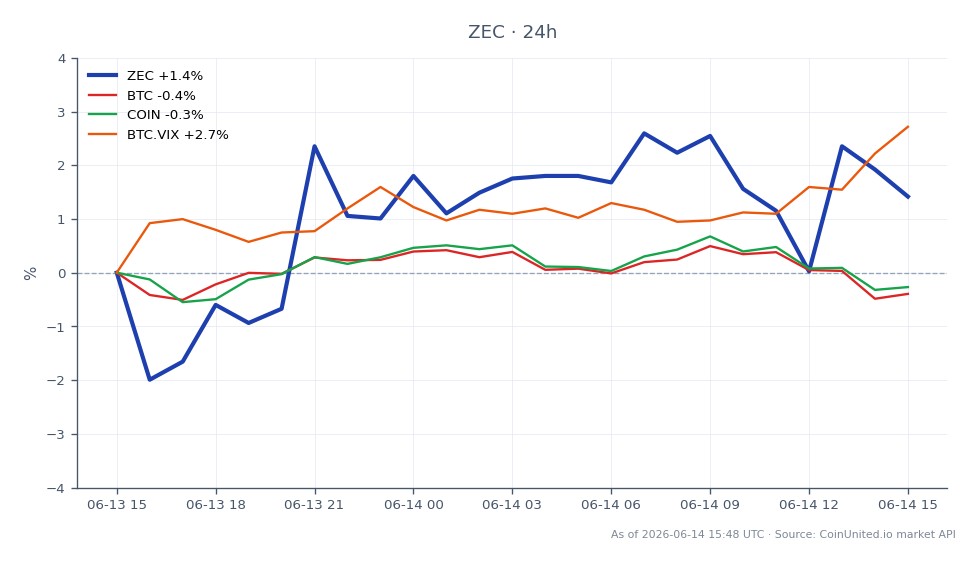
With ZEC currently trading at $421.90 (24h range: $415.64–$430.26, +2.06%), the market has partially recovered from initial crash lows — but leveraged traders face asymmetric risks in both directions.
Long exposure scenario: A trader holding a 50x long ZEC perpetual opened at $700 (pre-disclosure) would have faced near-total margin wipe at the -30% initial drop to ~$490. Even at current $421.90, that position remains deeply underwater with no buffer against further negative headlines — such as confirmation of pre-patch exploitation.
Short squeeze scenario: ZEC's +2% bounce from lows suggests residual short pressure exists. Per our crypto funding rates guide, elevated negative funding on ZEC perpetuals post-crash can create squeeze conditions if no exploitation evidence emerges and sentiment normalizes. Traders using 20x+ short leverage face liquidation risk on any sharp reversal above $430.
Key risk: The unresolved question of whether exploitation occurred before the patch is the single largest binary risk. A confirmed exploit would invalidate ZEC's fixed-supply narrative and likely trigger a second leg down, cascading liquidations across any recovering long positions.
Monitor open interest and funding rates on CoinUnited.io for real-time positioning confirmation before sizing new entries.
Cross-Market Impact
The ZEC exploit carries limited direct macro spillover but has meaningful sector-level implications. Privacy-coin peers face a trust discount as traders generalize zero-knowledge proof security concerns — a dynamic relevant to any ZK-focused protocol covered in our 2026 Crypto Market Outlook.
Bitcoin and Ethereum saw limited sympathy selling, as both lack shielded-pool architectures, though the broader narrative of AI-assisted exploit discovery adds a new threat vector that could reprice security risk premiums across DeFi protocols. See the DeFi Protocol Exploits guide for historical resolution patterns.
Crypto-proxy equities Coinbase (COIN) and MicroStrategy (MSTR) show negligible direct exposure to ZEC specifically, but a sustained privacy-coin confidence crisis could reduce altcoin trading volumes on exchanges, modestly pressuring COIN revenue estimates. The Bitcoin VIX remains the key gauge for whether this event escalates into broader crypto volatility.
Trading Considerations
At $421.90, ZEC sits in a post-crash recovery channel with the 24h high of $430.26 acting as immediate resistance. A confirmed clean bill of health — no exploitation verified — could accelerate recovery toward the $490–$500 zone (approximate pre-final-drop level). Conversely, any exploitation disclosure reopens downside toward the crash lows and beyond.
The AI-assisted discovery angle (Anthropic Opus 4) introduces a new systemic concern: if similar tools can surface latent bugs in other ZK circuits, the broader zero-knowledge proof ecosystem faces re-auditing pressure. Traders should monitor Zcash Foundation official communications and state-sponsored crypto hack channels for any exploitation confirmation.
Trade Zcash on CoinUnited.io
Trade ZEC with up to 2000xx leverage → | Create Free Account
Frequently Asked Questions
At $421.90, any long opened pre-crash above ~$600 remains deeply underwater; a 50x position opened at $700 has already been wiped. New longs at current levels face binary risk — exploitation confirmation could push ZEC materially lower, so position sizing should reflect that unresolved uncertainty.
Continue Exploring
Disclaimer: This brief is for educational purposes only and is not investment advice.