Quick Links
Zcash's $5B Wipeout: AI-Discovered zk-SNARK Bug Triggers 41% Crash — Leverage Liquidation Map
Data Snapshot
Key Takeaways
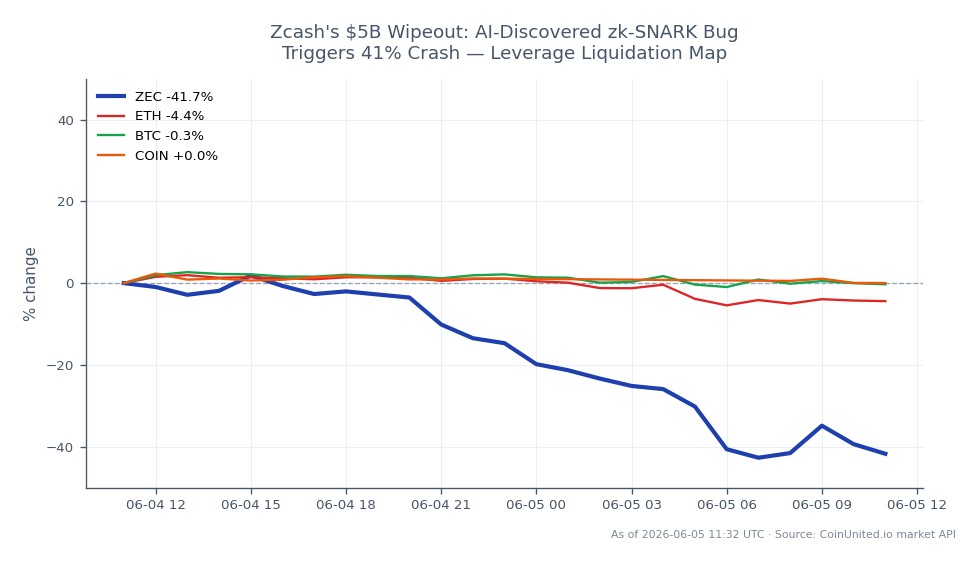
- •ZEC crashed 41.19% to $315.00 intraday — a 50x long opened at the $473.97 session high liquidated within 1.8% of entry, wiping the full position before the main move.
- •The zk-SNARK flaw existed for ~4 years; developers found no exploitation evidence, but the privacy-coin architecture means absolute supply certainty is impossible — this creates a structural risk premium on ZEC.
- •Funding rates on ZEC perpetuals likely inverted sharply negative post-crash; check live rates on CoinUnited.io before adding new short exposure at the $315 level.
- •Contagion risk extends to other privacy coins (XMR) and zk-proof infrastructure tokens that share similar cryptographic constructions — watch for sector-wide repricing.
- •Regulatory narrative risk is elevated: a 'could have minted undetectable counterfeit coins' story directly reinforces AML/CFT concerns and may accelerate exchange delistings of privacy-coin products.
Zcash has disclosed a critical counterfeiting vulnerability in its zero-knowledge proving system (zk-SNARKs) that, according to the Zcash core team, could have allowed an attacker to mint an unlimited
Event Summary
Zcash has disclosed a critical counterfeiting vulnerability in its zero-knowledge proving system (zk-SNARKs) that, according to the Zcash core team, could have allowed an attacker to mint an unlimited number of undetectable shielded ZEC. The flaw resided in the parameter setup algorithm for the MPC (multi-party computation) ceremony: a malicious prover could transform a valid proof into a counterfeit one, enabling hidden supply inflation. As reported by The Hacker News, the bug existed for approximately four years before discovery and was secretly patched in the October 2018 Sapling network upgrade — with full disclosure following only after the patch was widely deployed. Developers stated they found no forensic evidence of exploitation, though the privacy-coin architecture makes absolute certainty impossible.
Live market data confirms the immediate damage: ZEC is trading at $315.00, down -41.19% in 24 hours, with a session low of $250.00 against a high of $473.97. This erases billions in market capitalization and mirrors a prior Orchard pool counterfeiting-bug episode that drove a >30% single-session decline, as reported by Bitcoin.com.
Leverage Impact Analysis
With ZEC at $315.00 after a -41.19% drawdown, leveraged long positions opened anywhere near the $473.97 session high face catastrophic losses or full liquidation.
Worked example — long wipeout: A trader opening a 50x ZEC perpetual long at $473.97 carries a liquidation buffer of only 2% (1/50). The move from $473.97 to $465.49 — a mere 1.8% decline — would have triggered liquidation. Even a conservative 10x long from $473.97 liquidates below $430.88. At the current $315.00 price, any unprotected long above 3x leverage opened at the session high is already in negative equity territory.
Short-side opportunity and funding: Traders who shorted ZEC on disclosure news have captured 34%+ in a single session at manageable leverage. However, with ZEC already down 41%, crypto derivatives funding rates on perpetuals may invert sharply negative, meaning fresh shorts now pay a premium. Monitor funding rates on CoinUnited.io before adding short exposure at current levels.
Cascade risk: The sharp move through multiple support levels increases the probability of liquidation cascades — if open interest remains elevated, forced longs being unwound can accelerate moves toward and below the $250.00 session low. Check open interest for confirmation before sizing new positions.
Cross-Market Impact
The zk-SNARK vulnerability is not ZEC-isolated: the same cryptographic construction has been adopted across the zero-knowledge ecosystem, creating second-order pressure on privacy and zk-proof infrastructure tokens. Traders should watch for sentiment contagion into Monero (XMR) and other privacy coins, as Zcash's flagship status means its security failures reprice the entire cohort.
For listed equities, Coinbase Global carries indirect exposure via ZEC trading volume and any structured ZEC products, though this is a minor P&L contributor relative to BTC/ETH flows. The macro read-through to Bitcoin and Ethereum is limited but non-zero: a high-profile cryptographic failure in a major privacy coin reinforces regulatory narratives around AML/CFT risk, which can marginally tighten exchange listing policies and weigh on broader sentiment during risk-off windows. FX and commodities have negligible direct exposure to this event.
The DeFi Protocol Exploits playbook is relevant here: post-disclosure, watch for rotation out of shielded ZEC pools into transparent addresses, which itself signals persistent trust erosion.
Trading Considerations
Key levels: $250.00 (session low/immediate support), $315.00 (current price), $350–$380 (prior intraday consolidation zone, now resistance). A confirmed close below $250.00 opens a liquidity void toward levels not seen since pre-rally. On the upside, any recovery rally toward $380+ requires a credible "no-exploitation" narrative to take hold.
The primary risk for new shorts is mean-reversion after a >40% single-session drawdown — historically, ZEC has seen sharp percentage rebounds after capitulation events once the patch is confirmed as sufficient. For longs, the structural uncertainty around supply integrity (undetectable counterfeiting cannot be ruled out with 100% certainty) creates a persistent risk premium that may suppress ZEC's multiple relative to peers for weeks. Monitor crypto enforcement themes for regulatory follow-on actions targeting privacy coins.
Trade Zcash on CoinUnited.io
Trade ZEC with up to 2000xx leverage → | Create Free Account
Frequently Asked Questions
A 50x long opened at $473.97 liquidates at approximately $465.49 (1/50 = 2% buffer) — that threshold was breached almost immediately. Even a 10x long from the high liquidates below $430.88, well above the current $315.00 price.
Continue Exploring
Disclaimer: This brief is for educational purposes only and is not investment advice.