Quick Links
ZEC -40% After Zcash Discloses Critical zk-SNARK Counterfeiting Vulnerability: Leverage Liquidation Analysis
Data Snapshot
Key Takeaways
- •ZEC dropped 40.52% intraday (high $473.97 → low $250.00) — any leveraged long opened above ~$380 at 20x or higher is at or past liquidation threshold.
- •ECC confirms no evidence of exploitation and the bug was patched in the 2018 Sapling upgrade, creating a potential 'relief rally' trigger that puts high-leverage shorts at risk of a sudden squeeze.
- •Privacy coin peers XMR and SCRT face reputational contagion; Horizen (ZEN) and Komodo (KMD) carry direct shared-code risk and are likely to see correlated drawdowns.
- •The broader ZK ecosystem (L2 tokens, zk-rollup plays) faces elevated institutional scrutiny — not an existential risk, but a near-term sentiment headwind.
- •Funding rates on ZEC perpetuals are likely deeply negative; verify live rates before entering positions and treat this as a binary event requiring tight position sizing.
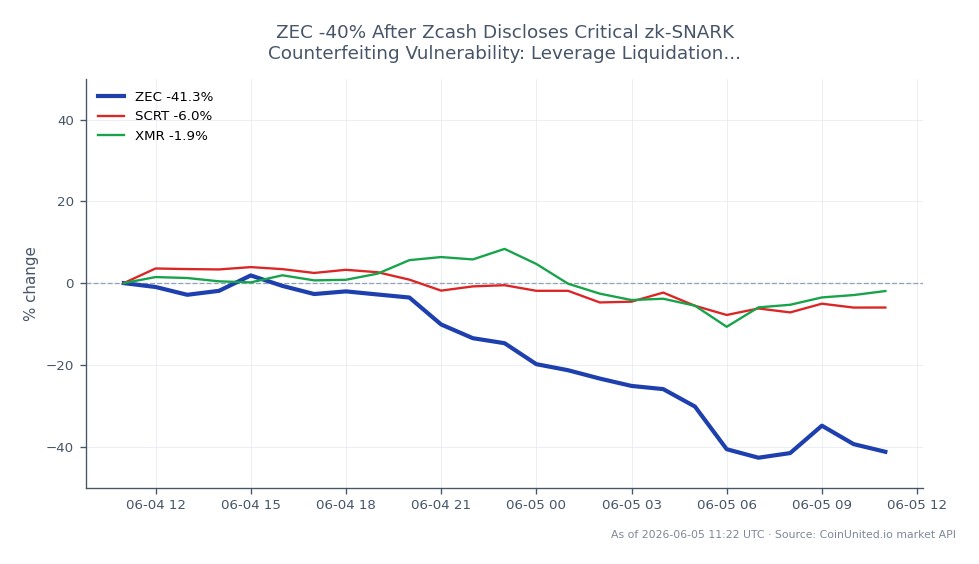
Zcash's Electric Coin Company (ECC) has publicly disclosed a critical counterfeiting vulnerability in its zk-SNARKs-based proving system that, if exploited, could have allowed an attacker to mint unli
Event Summary
Zcash's Electric Coin Company (ECC) has publicly disclosed a critical counterfeiting vulnerability in its zk-SNARKs-based proving system that, if exploited, could have allowed an attacker to mint unlimited fake ZEC without detection. According to ECC's official disclosure, the bug resided in the parameter setup algorithm for Zcash's zero-knowledge proof system — a cheating prover could transform a valid proof into a fraudulent one, enabling undetectable supply inflation. The vulnerability was silently patched via the Sapling network upgrade on 28 October 2018, with public disclosure following only after coordinated notification to affected projects including Horizen (ZEN) and Komodo (KMD). ECC maintains there is no evidence of exploitation, though Zcash's own privacy properties make certain exploit traces fundamentally difficult to verify.
Live market data confirms the severity of the market reaction: ZEC is trading at $318.60, down 40.52% over 24 hours, with an intraday range of $250.00–$473.97.
Leverage Impact Analysis
The 40.52% single-session drawdown represents one of the most dangerous environments for leveraged long positions. Consider a trader holding a 50x long ZEC perpetual opened at $473.97 (yesterday's high): the position would face liquidation well before the current $318.60 price — a ~33% drawdown against 50x leverage implies a maintenance margin breach far above that threshold. At 20x leverage, a long opened at $430 would already be underwater by over 25% of notional, again triggering forced liquidation.
For short-side traders, the risk runs the other direction. The ECC's "no evidence of exploitation" narrative has historically triggered sharp rebounds — the Sprout pool bug disclosure saw ZEC spike 10% post-fix. A 20x short at current levels ($318.60) faces a $63.72 per-unit adverse move to the nearest 20% liquidation threshold; any credible "fix confirmed, supply intact" statement could generate that move rapidly.
Funding rates on ZEC perpetuals are likely deeply negative (shorts paying longs) given the crash — check live funding on CoinUnited.io before entering any directional position. Open interest contraction during the flush typically signals capitulation; monitor for stabilization as a potential reversal signal. Given the extreme volatility, position sizing should be sized for crypto derivatives risk management principles: treat this as a binary event, not a trend trade.
Cross-Market Impact
The privacy coin complex faces direct reputational contagion. Monero (XMR) and Secret (SCRT) are the most likely recipients of fear-driven outflows from ZEC — some capital may rotate into XMR as a perceived "cleaner" privacy architecture, but broader sector sentiment will remain impaired. Projects that reused Zcash's vulnerable SNARK circuit design — explicitly Horizen (ZEN) and Komodo (KMD) — face guilt-by-association drawdowns.
The zero-knowledge technology narrative more broadly takes a credibility hit. While Ethereum-based zk-rollups use distinct constructions, headlines around "critical zk counterfeiting bugs" raise the institutional due-diligence bar for the entire ZK ecosystem. This is a headwind for zk-focused L2 tokens. For traders tracking the 2026 Crypto Market Outlook, this event reinforces a crypto enforcement and accountability risk premium on privacy-sector assets. Macro spillover to equities, forex, or commodities is minimal — this remains a crypto-specific protocol risk event.
Trading Considerations
Key levels: the 24h low at $250.00 is the immediate structural support; a breach reopens risk toward prior range lows. Resistance sits at the $400 round number and the prior session open near $473.97. The binary nature of this event — credible fix with no exploitation evidence vs. lingering supply-integrity doubt — means range compression is unlikely; expect continued elevated volatility.
Watch for: (1) any on-chain analysis confirming or denying supply anomalies in shielded pools; (2) exchange custody decisions on ZEC (delistings would accelerate drawdown); (3) ECC follow-up audit disclosures. The DeFi protocol exploits resolution framework suggests post-exploit recoveries require clear fix confirmation plus time — do not assume a V-shaped recovery without those catalysts.
Trade Zcash on CoinUnited.io
Trade ZEC with up to 2000xx leverage → | Create Free Account
Frequently Asked Questions
A 50x long opened at $473.97 requires only a ~2% adverse move before margin is exhausted — that liquidation level would be approximately $464, already breached hours ago. Any long opened above $325 at 50x leverage is at extreme liquidation risk at the current $318.60 price.
Continue Exploring
Disclaimer: This brief is for educational purposes only and is not investment advice.