Quick Links
Inotiv Files Chapter 11 with $326M Debt Reduction Plan — Equity Wipeout Risk Imminent
Data Snapshot
Key Takeaways
- •Inotiv filed Chapter 11 with a plan to reduce ~$326M of its ~$396.5M debt load, funded by a $65M DIP-style financing commitment.
- •Pre-arranged structure means equity cancellation or severe dilution is the base case — NOTV shares now trade as a low-probability recovery option.
- •Non-dischargeable plea agreement obligations survive bankruptcy, capping post-emergence valuation multiples.
- •Sector contagion is limited but lenders may tighten terms for other highly levered small-cap CROs, raising their cost of capital.
- •No meaningful macro impact on broad indices — this is a firm-specific leverage failure, not a systemic healthcare sector shock.
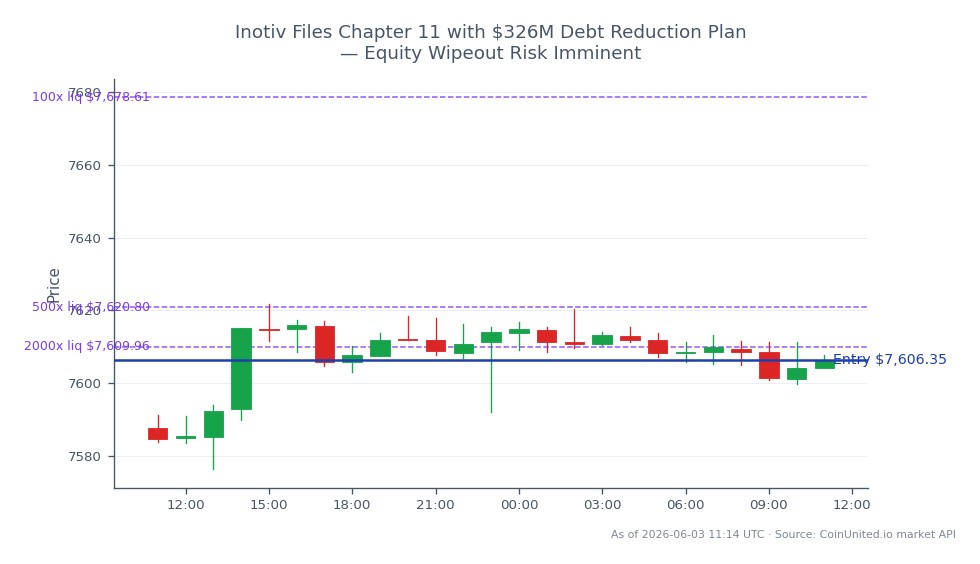
According to StreetInsider, Inotiv Inc. (NASDAQ: NOTV) has filed for Chapter 11 bankruptcy protection, securing a $65 million financing commitment as part of a restructuring plan targeting a $326 mill
Event Analysis
According to StreetInsider, Inotiv Inc. (NASDAQ: NOTV) has filed for Chapter 11 bankruptcy protection, securing a $65 million financing commitment as part of a restructuring plan targeting a $326 million reduction in total debt. The filing follows months of deteriorating financials: as of June 30, 2025, Inotiv carried $396.5 million in total debt against just $12.7 million in cash, with a $28.4 million quarterly loss and a formal going concern disclosure already on record.
This is a pre-arranged Chapter 11 — meaning key creditors likely agreed to terms before the court filing. That structure shortens the case timeline but also fast-tracks equity cancellation. With ~$400M in debt and a $326M planned haircut, creditors are effectively becoming the new owners of the reorganized entity. Existing common shareholders face near-total dilution or outright cancellation. Notably, an SEC exhibit confirms that certain obligations under a plea agreement are non-dischargeable in bankruptcy, meaning some legal and regulatory liabilities survive restructuring and will weigh on post-emergence free cash flow.
Inotiv's collapse follows an acquisition-driven expansion strategy funded by increasingly expensive capital — including 15% Senior Secured Second Lien PIK notes that raised only $17 million net while layering on compounding obligations. This is a textbook late-cycle leverage failure: aggressive M&A, high-cost debt, shrinking liquidity, and ultimately a restructuring that leaves equity holders with little to nothing. For context on how such energy, pharma & tech M&A cycles can end in distress, this case is illustrative.
The sector read-through is contained but real. As a contract research organization (CRO) serving nonclinical drug discovery, Inotiv's distress may prompt lenders to tighten credit terms for highly levered small-cap life-science services names and accelerate asset consolidation in niche areas like histology and bioanalytical services. Larger, well-capitalized CROs may benefit modestly from M&A optionality on Inotiv's site assets.
What This Means for Traders
NOTV common equity now trades as a deep distressed stub — essentially a low-probability lottery ticket on residual recovery. Expect extreme volatility, wide bid-ask spreads, and price action driven by court filings and plan negotiations rather than fundamentals. The earnings miss revenue shock dynamic here is extreme: with creditors absorbing the enterprise, pre-petition equity has virtually no mathematical claim on reorganized value. Short interest may be elevated but borrowing costs could spike; any retail-driven squeeze remains a tail risk rather than a base case.
The event is idiosyncratic — it does not move the S&P 500 Index or NASDAQ 100 Index at the macro level. Inotiv's scale is too small to create systemic sector contagion. However, traders with exposure to other highly leveraged small-cap healthcare services names should treat this as a risk calibration signal: tighter financing conditions for speculative-grade issuers are reinforced, and the market's tolerance for acquisition-heavy CROs with weak cash conversion is clearly diminishing. Monitoring credit spreads in comparable names is prudent.
Start Trading on CoinUnited.io
Create Your Free Account → — Trade crypto, stocks, forex, indices, and commodities with up to 2000x leverage and zero fees.
Frequently Asked Questions
It is mathematically possible but highly unlikely — with $396.5M in debt against a $326M planned haircut, creditors absorb virtually all enterprise value, leaving equity with at best a negligible stub. Retail speculation could briefly inflate the share price, as seen in other Chapter 11 cases, but this would not reflect fundamental recovery.
Continue Exploring
Disclaimer: This brief is for educational purposes only and is not investment advice.