Quick Links
Cboe Drops 9% as U.S. Perpetual Futures Approval Reshapes Exchange Competitive Landscape
Data Snapshot
Key Takeaways
- •A 50x long CBOE CFD at the pre-drop level would have been fully liquidated on the 9% single-session decline — illustrating extreme liquidation risk on exchange-sector CFDs around regulatory catalysts.
- •Coinbase Derivatives launched the first CFTC-de-facto-approved BTC and ETH perpetual futures (BTC-PERP, ETH-PERP) on July 21, 2025, marking a structural shift in U.S. crypto derivatives infrastructure.
- •Cboe's 9% drop reflects competitive margin compression, regulatory overhang from 'dangerous product' narratives, and multiple repricing — not a fundamental business collapse.
- •BTC and ETH face medium-term bullish structural tailwinds as regulated U.S. perps attract institutional capital previously locked out by offshore counterparty risk.
- •Cross-market: CME, ICE, and financial-sector index components face sympathy pressure, while COIN is a relative beneficiary of first-mover status in regulated U.S. crypto perps.
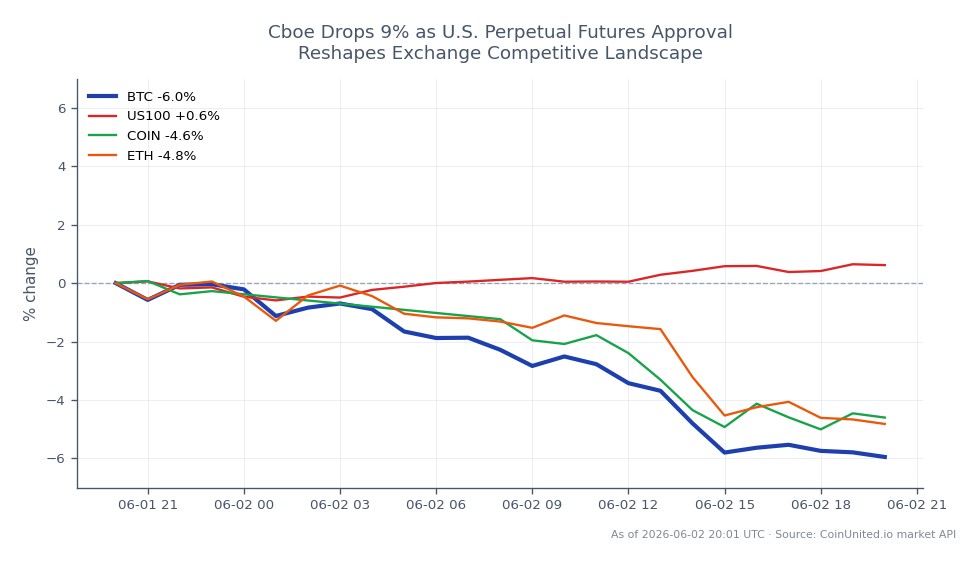
The U.S. Commodity Futures Trading Commission (CFTC) has effectively green-lit perpetual futures on Bitcoin and Ethereum for U.S.-regulated venues. Coinbase Derivatives self-certified its BTC-PERP and
Event Summary
The U.S. Commodity Futures Trading Commission (CFTC) has effectively green-lit perpetual futures on Bitcoin and Ethereum for U.S.-regulated venues. Coinbase Derivatives self-certified its BTC-PERP and ETH-PERP contracts on June 26, 2025, with trading commencing July 21, 2025 after the CFTC raised no objection. Separately, Cboe Global Markets announced its own perpetual-style "Continuous Futures" (10-year expiry, daily cash adjustments) for BTC and ETH — ticker PBT and PET — planned to begin trading December 15, 2025, cleared through Cboe Clear U.S.
According to research findings, advocacy group Better Markets has criticized the CFTC's stance, calling crypto perpetuals "one of the most dangerous crypto products for retail investors." Markets responded by repricing Cboe's equity — the stock fell approximately 9% — reflecting a combination of competitive margin pressure, heightened regulatory overhang, and multiple compression risk tied to "dangerous product" narratives. This event fits squarely within the evolving Crypto Clarity Act regulatory pivot.
Leverage Impact Analysis
For leveraged traders in CBOE stock CFDs, the 9% single-session drop is a high-impact scenario. A trader holding a 50x long CBOE CFD at the pre-drop level would have experienced a ~450% loss against margin — a full liquidation with margin to spare. Conversely, a 20x short CBOE CFD opened near session highs would have returned ~180% on margin in one session.
On the crypto side, the regulatory shift has direct implications for BTC and ETH perpetual funding dynamics. As Coinbase Global Derivatives' regulated perps attract institutional arbitrage capital, funding rates on offshore venues (Binance, Bybit, OKX) may compress as basis traders reallocate. Traders running leveraged long BTC perpetual positions on CoinUnited.io should monitor funding rate shifts — tightening arbitrage spreads can reduce the cost of carry for longs but also signal reduced momentum premium. Check live funding rates on CoinUnited.io for current conditions.
For high-leverage COIN CFD positions, the first-mover advantage in U.S. regulated perps is a bullish structural catalyst, partially offsetting the sector-wide regulatory risk premium.
Cross-Market Impact
Equities: The 9% CBOE decline signals broader exchange-sector repricing. CME Group, Intercontinental Exchange, and NASDAQ 100 components with financial-sector weighting face sympathy pressure as investors reassess crypto derivatives competitive dynamics. COIN is a relative winner — first-mover in U.S. regulated perps — but shares the regulatory overhang.
Crypto: Regulated U.S. perps deepen BTC and ETH derivatives infrastructure, potentially attracting institutional capital previously sitting on sidelines due to offshore counterparty risk. This is a medium-term structural positive for spot prices, even if near-term volatility increases. Traders can explore the broader landscape in our 2026 Crypto Market Outlook and the dedicated Crypto Derivatives Trading guide.
Indices/Risk Sentiment: A 9% drop in a major exchange operator is a localized event with limited macro spillover, but the "dangerous retail products" narrative from Better Markets could feed broader risk-off sentiment in financial-sector ETFs.
Trading Considerations
For CBOE, the 9% decline creates a potential technical oversold condition, but the regulatory overhang from advocacy groups and multiple compression risk means any bounce requires confirmation — watch for stabilization in exchange-sector peers (CME, ICE) and any CFTC commentary clarifying product constraints. Key risk: if legislators or regulators respond to Better Markets criticism with leverage caps or product restrictions, CBOE and COIN face further downside.
For BTC and ETH, the structural catalyst of regulated U.S. perps is medium-term bullish, but near-term volatility may spike as arbitrage capital repositions across offshore and onshore venues. Monitor open interest migration and basis spreads for confirmation signals.
Start Trading on CoinUnited.io
Create Your Free Account → — Trade crypto, stocks, forex, indices, and commodities with up to 2000x leverage and zero fees.
Frequently Asked Questions
Any long CBOE CFD position with more than ~11x leverage would have been liquidated on a 9% adverse move — at 50x leverage, the liquidation threshold is hit at just a 2% move against you. Always size position margins to withstand at least 2-3x the expected daily volatility range for exchange-sector stocks.
Continue Exploring
Disclaimer: This brief is for educational purposes only and is not investment advice.