Quick Links
Shake Shack Hits Two-Year Low After Guidance Cut: Leverage Liquidation Zones & QSR Sector Fallout
Key Takeaways
- •SHAK is trading at a two-year low following a guidance cut — a confirmed bearish signal with downside momentum intact until volume-based support forms
- •Leveraged long CFD positions above 20x are at acute liquidation risk; a 15% decline from recent highs equals 750% margin loss at 50x leverage
- •QSR peers McDonald's, Chipotle, and Yum! Brands face sympathy selling risk if the miss is read as a consumer spending signal rather than company-specific
- •Post-guidance-cut dead-cat bounces within 48–72 hours are historically common — overleveraged short positions are also exposed to violent short-squeeze moves
- •CoinUnited's 24/7 stock CFD trading allows traders to act on analyst downgrades and management commentary outside NYSE hours, a structural edge versus traditional brokers
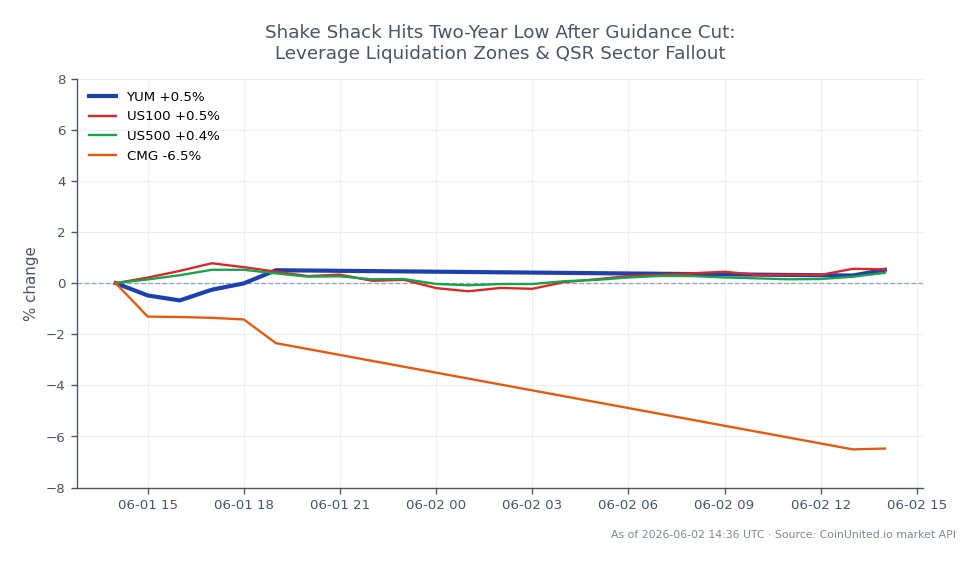
Shake Shack (SHAK) has dropped to its lowest share price in approximately two years following a guidance reduction that disappointed investors expecting continued growth momentum. The company cut its
Event Summary
Shake Shack (SHAK) has dropped to its lowest share price in approximately two years following a guidance reduction that disappointed investors expecting continued growth momentum. The company cut its forward outlook, triggering a sharp sell-off that places SHAK firmly in earnings miss revenue shock territory. While the full magnitude of the guidance cut and specific revenue figures are pending confirmation from primary sources, the price action signals a significant repricing of near-term growth expectations. Traders should verify exact figures via the latest earnings release before sizing positions.
Leverage Impact Analysis
For leveraged CFD traders, a two-year low print on guidance disappointment creates asymmetric risk on both sides. Consider a trader who held a 50x long SHAK CFD entering near recent highs: a 15% drawdown to a two-year low would represent a 750% loss on margin — a near-certain liquidation. Conversely, traders who anticipated the miss with a 30x short position could be sitting on substantial gains, but must now manage the risk of a dead-cat bounce covering shorts aggressively.
Key leverage considerations:
- -Long positions above 20x leverage are highly vulnerable if SHAK continues probing multi-year lows — gap risk on reopening sessions is elevated post-guidance cuts
- -Short-side crowding: After a two-year low print, funding rates on short CFDs may become expensive as bearish sentiment peaks — monitor for short-squeeze setups
- -Traders referencing how to trade earnings misses should note that post-guidance-cut bounces within 48–72 hours are statistically common in QSR names, creating volatile two-way price action that punishes overleveraged positions in either direction
CoinUnited's stock CFDs trade 24/7, meaning traders can respond to any after-hours analyst downgrades or management commentary without waiting for NYSE open.
Cross-Market Impact
SHAK's guidance cut introduces sector-level read-through risk for the broader quick-service restaurant (QSR) space. McDonald's Corporation, Chipotle Mexican Grill, Inc., and Yum! Brands, Inc. may face sympathy pressure if investors interpret the miss as a consumer spending signal rather than a company-specific issue.
- -Consumer spending read-through: A guidance cut citing traffic softness or cost pressures implies discretionary dining budgets are under strain — bearish for mid-tier restaurant chains broadly
- -S&P 500 Index & NASDAQ 100 Index: SHAK's small-cap weighting limits direct index impact, but the consumer discretionary sub-sector weight could face modest headwinds if the QSR narrative widens
- -Macro context: Weak restaurant traffic data historically correlates with broader consumer caution, which can reinforce risk-off positioning across indices. Traders should cross-reference the 2026 Stocks Market Outlook for sector rotation context
Trading Considerations
With SHAK at a two-year low, the immediate technical structure is bearish, but capitulation-style selling often establishes short-term support. Key levels to watch: the current two-year low as immediate support (any close below extends the downtrend), and prior consolidation zones from 2022–2023 as the next structural reference. Volume confirmation on any bounce attempt is critical — low-volume recoveries in post-guidance-cut names frequently fail.
Risk factors include: analyst downgrades (typically follow within 1–5 trading days of guidance cuts), broader consumer sentiment data releases, and any management commentary in follow-up investor calls. Traders referencing earnings miss recovery plays should wait for volume-confirmed base formation before fading the downtrend.
Start Trading on CoinUnited.io
Create Your Free Account → — Trade crypto, stocks, forex, indices, and commodities with up to 2000x leverage and zero fees.
Frequently Asked Questions
At 50x leverage, a 15% price decline from entry wipes out 750% of margin — positions would be liquidated well before reaching current levels. Traders should reduce size significantly or use tight stops given the broken technical structure.
Continue Exploring
Disclaimer: This brief is for educational purposes only and is not investment advice.