Quick Links
SentinelOne Craters ~17% Post-Earnings: Tiny Revenue Miss, Maximum Leverage Pain
Data Snapshot
Key Takeaways
- •A 50x long S CFD entered at $18.00 would have been fully liquidated by the ~17% gap-down — illustrating how earnings gaps erase leveraged positions before traders can react.
- •The miss was numerically tiny (~$0.65M, 0.2% below consensus) but the reaction was disproportionately large, signaling fragile sentiment around SentinelOne's growth/profitability trajectory.
- •CoinUnited's 24/7 stock CFD trading enabled positioning immediately after the extended-session print — before the NYSE open locked in the gap.
- •Cybersecurity peers (CrowdStrike, Zscaler, Palo Alto) face secondary sentiment risk; watch whether upcoming prints confirm sector-wide demand softness.
- •Morgan Stanley's bear-case target of $10 remains a live downside reference from current depressed levels.
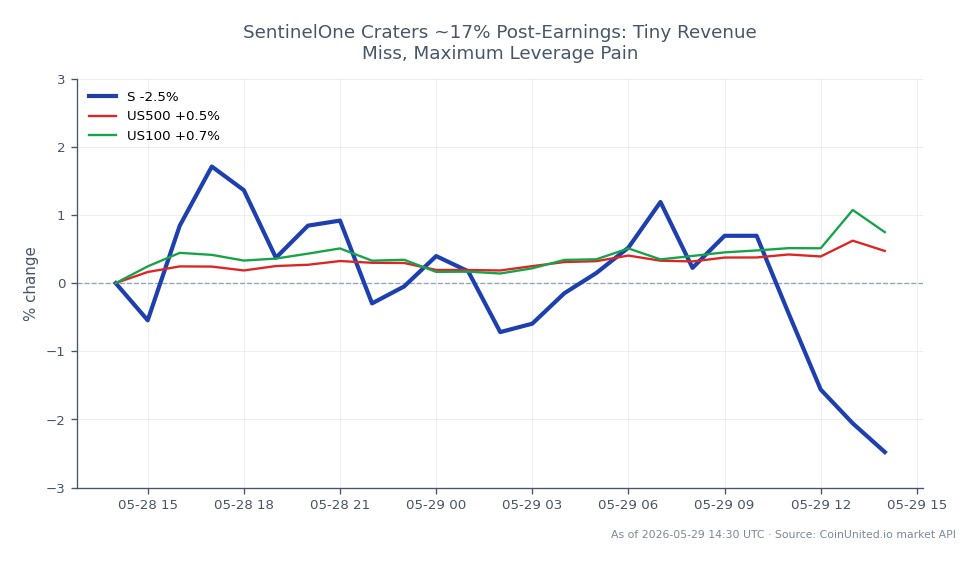
According to Benzinga, SentinelOne Inc. (NYSE: S) reported Q1 FY2027 revenue of $276.66 million, missing the Street consensus of $277.31 million by approximately $0.65 million — a fractional 0.2% shor
Event Summary
According to Benzinga, SentinelOne Inc. (NYSE: S) reported Q1 FY2027 revenue of $276.66 million, missing the Street consensus of $277.31 million by approximately $0.65 million — a fractional 0.2% shortfall. The company did beat on adjusted EPS ($0.04 vs. $0.02 expected). Despite the EPS beat, shares fell approximately 16–17% in extended trading to around $15.05, consistent with the "nearly 20% pre-market" characterization in early session reporting.
The reaction reflects a structural problem beyond one quarter's numbers. As reported by Investing.com, full-year FY27 revenue guidance of $1.20–$1.21 billion came in essentially in-line with consensus — a result the market treated as a de facto growth disappointment. SentinelOne remains unprofitable and is not forecast to reach profitability within three years, making even minor top-line misses trigger aggressive multiple compression. The stock had already fallen nearly 36% from its 52-week high of $21.39 prior to this event.
Leverage Impact Analysis
This is a textbook earnings miss revenue shock scenario where the price reaction vastly outpaces the fundamental miss — creating acute leverage risk on both sides.
Long-side liquidation scenario: A trader holding a 50x long S CFD entered at $18.00 would have faced a liquidation threshold roughly 2% below entry (~$17.64). A 17% gap-down to $15.05 would have triggered full liquidation well before the open — with no opportunity to manage the position through the gap. This is the core danger of holding leveraged single-stock CFDs through earnings without a hedge.
Short-side squeeze risk: Conversely, a 20x short entered near $15.05 faces a ~5% margin buffer before liquidation (~$15.80). Any intraday short-covering rally — common after gap-downs of this magnitude — compresses that buffer rapidly. Traders targeting continuation shorts must size conservatively.
Volatility implication: A ~17% single-session move on a 0.2% revenue miss signals fragile sentiment and elevated realized volatility. Position sizing for leveraged S CFDs should be reduced significantly versus normal conditions. For those studying how to trade earnings misses, this event underscores the asymmetric risk of pre-earnings leverage.
Because this news broke after NYSE hours, CoinUnited's 24/7 stock CFD trading allowed traders to act on the extended-session print immediately — rather than waiting for the 9:30am ET open when the gap would already be set.
Cross-Market Impact
SentinelOne is not an index heavyweight, so direct spillover to the S&P 500 Index and NASDAQ 100 Index is marginal. The more meaningful channel is sector sentiment: the violent reaction to a fractional miss reinforces the broader earnings miss guidance cuts narrative for high-growth, unprofitable SaaS names.
Cybersecurity peers — CrowdStrike, Zscaler, Palo Alto Networks, Okta — face read-through risk. If investors interpret the miss as sector-wide demand softness rather than SentinelOne-specific execution, multiples across the group compress. Thematic cybersecurity ETFs with S exposure may see intraday tracking noise. The event is broadly negative for the unprofitable tech / high-beta growth factor, which can correlate with mild risk-off pressure across tech-heavy indices. No direct macro, FX, or commodity linkage applies here.
Trading Considerations
Key levels to monitor: psychological support at $15.00, with Morgan Stanley's bear-case target of $10 representing the downside anchor if growth concerns deepen. Prior support zones and the 52-week high of $21.39 now serve as distant resistance. Watch for intraday capitulation lows followed by short-covering — a common post-gap dynamic in liquid mid-cap names.
The core risk factor remains valuation: at approximately 3.7× Morgan Stanley's 2027 revenue estimate (per Investing.com), S trades at a peer discount, but ongoing losses and cautious guidance limit the re-rating catalyst. Traders should monitor whether cybersecurity peers confirm or diverge from SentinelOne's demand narrative in upcoming prints.
Trade Sonic (prev. FTM) on CoinUnited.io
Frequently Asked Questions
Any long position with more than ~5x leverage and a standard margin buffer would have been liquidated through the gap before the regular session opened — there is no opportunity to cut or hedge once the gap sets. This is why holding high-leverage single-stock CFDs through earnings without a defined hedge is extremely high-risk.
Continue Exploring
Disclaimer: This brief is for educational purposes only and is not investment advice.