Quick Links
Data Snapshot
Key Takeaways
- •SentinelOne hit a 52-week low of $12.14, down 11–18%, after reporting weak guidance alongside an 8–10% headcount reduction targeting ~300 employees.
- •Leverage risk is severe: a 50x long S CFD at $14.00 faces a ~650% margin loss on a 13% adverse move to $12.14 — well past liquidation thresholds.
- •Management is reallocating resources toward AI investments, but the market reads this as competitive stress from CrowdStrike and Palo Alto Networks rather than strategic strength.
- •Cross-market impact is sector-specific: cybersecurity software peers may reprice on read-through margin concerns, with limited direct macro or forex spillover.
- •The 52-week low at $12.14 is the critical support level; a close below this on elevated volume would signal further distribution risk.
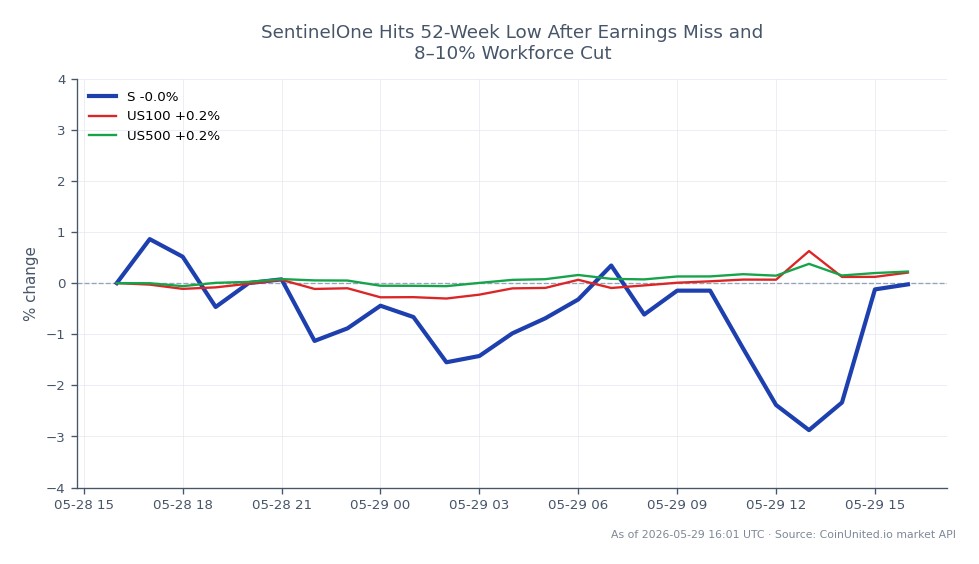
According to reporting from MarketBeat and Stocktwits, SentinelOne, Inc. (NYSE: S) saw its shares plunge 11–18% in premarket and early-session trading after the company announced an 8–10% workforce re
Event Summary
According to reporting from MarketBeat and Stocktwits, SentinelOne, Inc. (NYSE: S) saw its shares plunge 11–18% in premarket and early-session trading after the company announced an 8–10% workforce reduction — approximately 300 employees — alongside its latest earnings release. The restructuring is aimed at reallocating capital toward AI investments while addressing profitability pressure from competitors including CrowdStrike and Palo Alto Networks. As reported by Investing.com, the stock hit a 52-week low of $12.14, compressing the company's market capitalization to roughly $4.18 billion.
Management framed the headcount reduction as a strategic pivot, but the market interpreted the combination of weak forward guidance and restructuring charges as a sign of deeper competitive stress — not routine cost optimization. This is a textbook earnings miss revenue shock scenario compounded by an AI-driven workforce repricing narrative.
Leverage Impact Analysis
This event carries significant leverage risk for traders holding S CFD positions. Note: Live Market Data provided shows S at $0.0406, which appears to be a data feed anomaly inconsistent with the confirmed 52-week low of $12.14 reported by Investing.com. All leverage scenarios below use the verified $12.14 price.
A trader holding a 50x long S CFD opened at $14.00 (pre-earnings) would face a ~13% adverse move to $12.14, translating to a 650% loss on margin — a full liquidation with capital to spare at standard margin levels. Even a more conservative 10x long position at $14.00 would see margin down approximately 130%, triggering a margin call before the stock reached the 52-week low.
On the short side, traders who identified weak guidance pre-earnings and entered 20x short S CFDs near $14.00 would be sitting on roughly 400% return on margin at $12.14 — but must now manage the risk of a dead-cat bounce as retail dip buyers reportedly loaded up intraday per Stocktwits coverage. Check funding rates on CoinUnited.io for current short-side cost.
For context on how AI-driven layoffs historically reprice stock CFDs, the initial gap-down is often followed by a 3–7 session consolidation before directional continuation — position sizing should reflect that uncertainty.
Cross-Market Impact
The direct macro spill is limited, but sector-level read-throughs are meaningful. CrowdStrike and Palo Alto Networks — both explicitly named as competitive pressures by Calcalist/CTech — may see sympathy volatility as the market re-rates endpoint security multiples. Traders watching the NASDAQ 100 and S&P 500 should note that cybersecurity software is a growth-multiple segment; sustained weakness in smaller names like S can weigh on broader software subsectors within the US100 index.
The event also fits within the wider AI infrastructure capital reallocation narrative: companies unable to self-fund AI transitions are cutting headcount to free cash, creating a bifurcation between AI-funded winners and restructuring-mode losers. This is not a macro risk-off event but it does reinforce caution on high-multiple software names.
Trading Considerations
Key levels to watch on S: the confirmed 52-week low of $12.14 is now the primary support reference. A sustained break below this level on volume would signal further institutional distribution. Resistance sits at prior consolidation around $14.00, which also represents the approximate pre-earnings price. Monitor open interest in S options for any unusual activity signaling institutional positioning.
For sector peers, watch CrowdStrike and Palo Alto Networks for sympathy moves — either confirmation of sector-wide margin pressure or a divergence that highlights S-specific execution risk.
Trade Sonic (prev. FTM) on CoinUnited.io
Frequently Asked Questions
With an 11–18% single-session move, positions above 10x leverage face liquidation risk on normal intraday swings. Conservative traders should model maximum adverse excursion against their margin before sizing.
Continue Exploring
Disclaimer: This brief is for educational purposes only and is not investment advice.