Quick Links
Venezuela Tries to Woo Big Oil Back — WTI at $107.41 and the Medium-Term Supply Optionality Map
Data Snapshot
Key Takeaways
- •Venezuela's oil pitch is a medium-term narrative, not an immediate supply catalyst — no binding Big Oil commitments have been made.
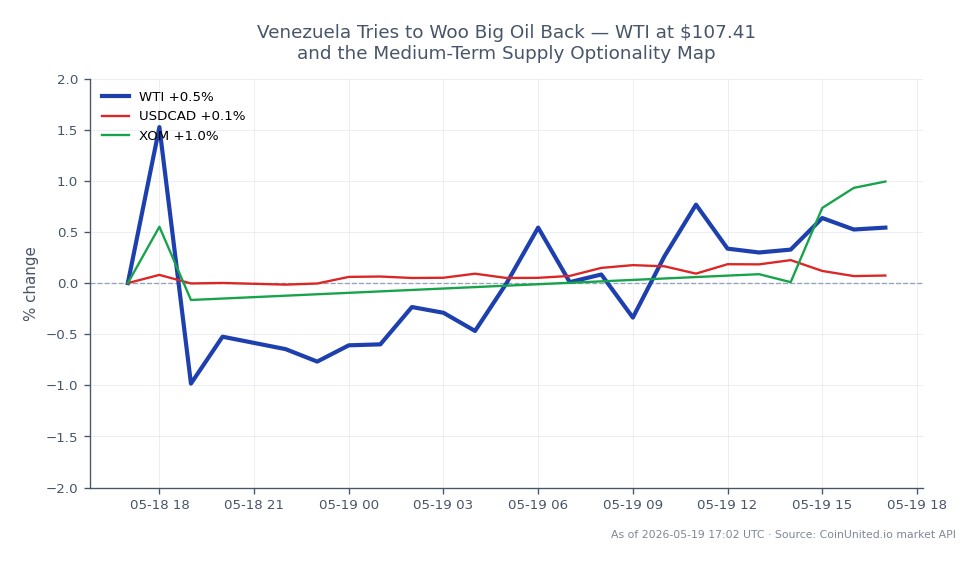
- •WTI trades at $107.41 (+1.10%), driven by Hormuz supply-shock risk, not Venezuelan developments — the two stories are currently decoupled.
- •Leveraged long WTI CFD traders face meaningful intraday volatility: the 24h range of $2.46 equals a ~71% swing on a 50x position if price moves from high to low.
- •Exxon and Chevron CFDs carry mixed optionality — potential reserve access upside versus persistent sanctions and political risk.
- •The Venezuela supply story only becomes market-moving upon confirmed sanctions relief, contract reform, or binding capex commitments — watch OFAC announcements as the leading signal.
Venezuela is actively courting major international oil companies to return to the country, pitching its vast hydrocarbon reserves as an underutilized opportunity. According to reporting corroborated b
Event Summary
Venezuela is actively courting major international oil companies to return to the country, pitching its vast hydrocarbon reserves as an underutilized opportunity. According to reporting corroborated by Energy Intelligence and the Baker Institute, the pitch faces significant structural headwinds: industry experts cite unresolved concerns around security, contract stability, rule of law, and U.S. sanctions as conditions that must be met before large-scale foreign capital can return. Current Venezuelan production sits at approximately 900,000–1,000,000 barrels per day — far below historical peaks — leaving a substantial supply recovery gap that would require tens of billions of dollars in foreign capital to close.
This is not an immediate production catalyst. No binding commitments from major oil companies have been confirmed, and the sanctions regime remains intact. The story is best characterized as a medium-term supply optionality narrative, not a near-term market mover.
Leverage Impact Analysis
WTI Light Crude Oil is trading at $107.41 (24h range: $105.89–$108.35, +1.10%), supported primarily by the ongoing Hormuz supply-shock premium — not Venezuelan headlines. The Venezuela story is a mild bearish optionality overhang on longer-dated crude, not an immediate price depressant.
For leveraged traders on CoinUnited.io's commodity CFDs:
- -50x long WTI CFD opened at $107.41: Each $1.00 move = 50x amplified P&L. The 24h range of $2.46 already represents a ~$123 swing per contract at 50x. A Venezuela-driven sentiment dip toward $105.89 support would represent a -1.42% move, translating to a -71% loss on a 50x long with no buffer.
- -Short-side scenario: Traders positioning for medium-term supply recovery pressure should watch for confirmed sanctions relief before entering short CFDs. Without that catalyst, the Hormuz risk premium keeps WTI elevated and shorts exposed.
- -Venezuela supply recovery is a multi-year thesis — avoid sizing leveraged positions as if this is a near-term catalyst. Volatility from headline risk (sanctions announcements, diplomatic moves) is the real leverage risk here. Monitor funding rates and open interest on CoinUnited.io for confirmation signals before adding exposure.
For deeper context on how cross-border sanctions shape oil market dynamics, the current setup closely mirrors previous geopolitical supply-unlock narratives.
Cross-Market Impact
Energy Equities: Exxon Mobil and Chevron CFDs carry mixed exposure — potential reserve access upside versus political and sanctions risk. Oilfield services stocks would benefit most if capex actually flows, but that remains speculative. Any Venezuela re-entry deal would likely be structured through smaller, risk-tolerant operators first.
Forex: USD/CAD and USD/NOK are the primary oil-sensitive FX pairs to watch. A credible Venezuela supply recovery would be mildly CAD and NOK bearish (softer oil prices over time), but the timeline is too long to trade on this headline alone. Near-term, both pairs remain driven by the Hormuz premium.
Brent Crude Oil: Marginally affected — any Venezuelan export recovery would modestly pressure the Brent curve in the 2–5 year forward contracts, not spot. The 2026 Commodities Market Outlook remains skewed by active supply-shock dynamics that dwarf the Venezuela narrative for now.
Trading Considerations
WTI's immediate technical range sits between $105.89 support (24h low) and $108.35 resistance (24h high). The +1.10% daily gain is Hormuz-driven, not Venezuela-driven. A break above $108.35 with volume would confirm supply-shock momentum; a reversal below $105.89 would open a test of the broader $104–105 zone flagged in recent sessions.
The Venezuela story only becomes a material price driver if one of four conditions is confirmed: (1) sanctions relief, (2) enforceable contract reform, (3) security stabilization, or (4) binding capex commitments from a major operator. Watch U.S. State Department and OFAC announcements as the leading signal.
Trade WTI Light Crude Oil on CoinUnited.io
Trade WTI with up to 1000xx leverage → | Create Free Account
Frequently Asked Questions
The near-term price impact is minimal — WTI's current move is Hormuz-driven. The Venezuela narrative introduces medium-term bearish supply optionality, but without confirmed sanctions relief or capex commitments, it should not alter your immediate leverage sizing.
Continue Exploring
Disclaimer: This brief is for educational purposes only and is not investment advice.