Quick Links
Pakistan CPI Surges to 11.7% on Energy Import Shock — Leverage Map for WTI, USD/PKR, and EM Risk-Off Repricing
Data Snapshot
Key Takeaways
- •Pakistan CPI accelerated to 11.7% YoY in May 2026 — a near two-year high — driven by transport (+36.8% YoY) and energy categories, confirming global oil import cost pass-through.
- •WTI trades at $94.83 (+5.06%), and leveraged short positions with >100x face liquidation within ~1% adverse move; leveraged longs from the $91.05 session low are showing ~210% margin return at current levels.
- •The SBP raised benchmark rates for the first time in nearly three years to stabilize PKR — but structural current-account pressure keeps the currency vulnerable to further energy price escalation.
- •Pakistan's print functions as an EM-wide inflation confirmation signal: fuel-importing frontier sovereigns face spread widening risk, supporting gold and safe-haven flows while pressuring EM HY credit.
- •Core urban inflation at 9.0% YoY is well above the SBP's 5–7% target — monetary tightening will persist, weighing on Pakistan growth-sensitive assets and KSE-100 valuations.
Pakistan's headline CPI inflation accelerated to 11.7% YoY in May 2026, up from 10.9% in April, according to the Pakistan Bureau of Statistics (PBS) — the highest reading in nearly two years. As repor
Event Summary
Pakistan's headline CPI inflation accelerated to 11.7% YoY in May 2026, up from 10.9% in April, according to the Pakistan Bureau of Statistics (PBS) — the highest reading in nearly two years. As reported by Trading Economics and TradingView, monthly inflation slowed sharply to +0.5% MoM from 2.5% prior, indicating base-effect dynamics rather than uncontrolled domestic overheating. Transport costs led the spike at +36.8% YoY (+5.13% MoM), the clearest pass-through channel from oil and gas import costs. Housing, water, electricity, and fuel followed at +16.78% YoY.
According to GuruFocus, the inflation surge is directly linked to rising energy import costs driven by Middle East tensions, prompting the State Bank of Pakistan (SBP) to raise its benchmark interest rate for the first time in nearly three years — an emergency response to stabilize the PKR. Core inflation (urban NFNE) sits at 9.0% YoY, well above the SBP's 5–7% target band, signaling that tightening will persist.
Leverage Impact Analysis
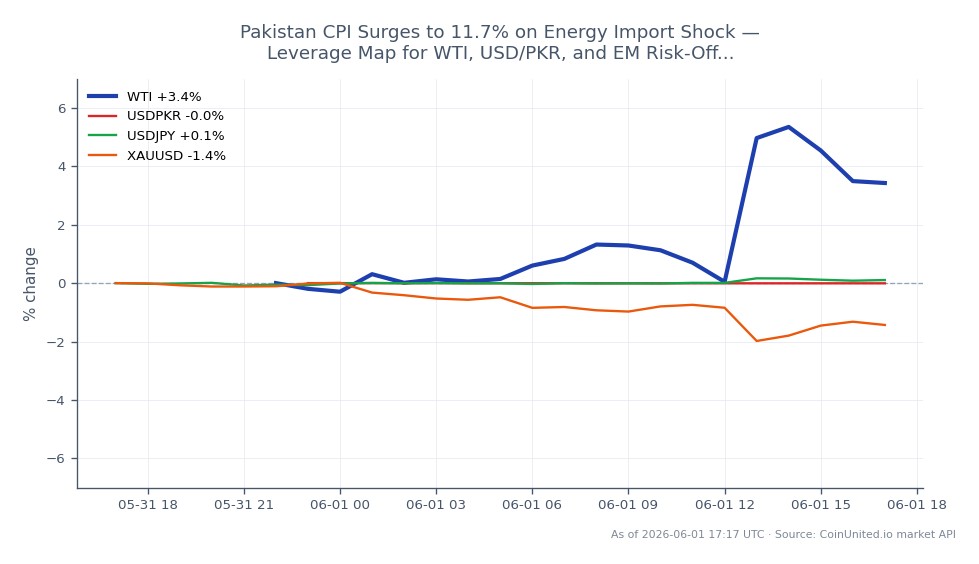
WTI Light Crude Oil is currently trading at $94.83, up +5.06% on the day (24h range: $91.05–$96.74), reflecting the same Hormuz Strait energy supply shock that is feeding Pakistan's import inflation. This is not a coincidence — Pakistan's CPI print is a downstream confirmation signal of sustained tight global energy markets.
WTI leverage scenarios at $94.83:
- -A 50x long WTI CFD entered at $91.05 (session low) now shows approximately +4.2% gain on notional, translating to ~210% return on margin — but the same position faces liquidation if price retraces ~2% from entry without additional margin.
- -A 100x short WTI position opened at $94.83 faces liquidation risk near $95.78 (~1% adverse move) given today's momentum. With 24h high at $96.74, stop placement above that level is structurally logical but requires proportionally larger margin buffers.
- -The macro inflation risk-off repricing dynamic here is bullish for oil (demand for energy hedges, geopolitical premium) — leveraged shorts face asymmetric squeeze risk while supply tension persists.
For USD/PKR traders: the SBP emergency hike offers short-term PKR support, but structural current-account pressure from elevated energy import bills keeps the currency fragile. High-leverage PKR positions face event-driven gap risk if geopolitical escalation accelerates import costs further.
Cross-Market Impact
Pakistan's data functions as a stagflation risk and geopolitical inflation signal for broader EM markets. Fuel-importing frontier economies facing similar pass-through dynamics (Sri Lanka, Bangladesh) may see sovereign spread widening — a negative for EM HY credit baskets and frontier-market ETFs.
Gold benefits from this environment as an inflation hedge asset rotation play — energy-driven EM inflation reinforces the hard-asset bid. USD/JPY faces cross-currents: USD strength from risk-off flows competes with JPY safe-haven demand, creating volatility rather than a clean directional trade. Bitcoin and Ethereum see marginal indirect support from in-country stablecoin demand in high-inflation EM economies, though Pakistan's crypto regulatory restrictions limit this channel materially.
For a broader framework on how energy-driven CPI prints move every market, see our CPI & Inflation Data trading guide.
Trading Considerations
WTI's key resistance sits at the 24h high of $96.74; a clean break opens the path toward the $99–$101 range last traded in late May per recent pulse history. Support is the session low at $91.05. The Pakistan CPI print reinforces the oil geopolitical crypto risk-off bid — traders should monitor whether Middle East tension headlines extend or fade, as Pakistan's inflation trajectory is a lagging indicator of the same shock.
The SBP rate hike introduces PKR NDF volatility. Watch for SBP forward guidance on further tightening and IMF program review milestones, which are the primary catalysts for PKR directional moves beyond the near-term stabilization bounce. For a deeper stagflation trading framework, see our stagflation trading guide.
Trade WTI Light Crude Oil on CoinUnited.io
Trade WTI with up to 1000xx leverage → | Create Free Account
Frequently Asked Questions
The print confirms persistent energy import demand pressure, supporting the WTI bid — a 50x long from $91.05 (session low) sits approximately 210% in profit on margin at $94.83. The risk is a reversal if Middle East tensions de-escalate, so monitor geopolitical headlines as the primary catalyst.
Continue Exploring
Disclaimer: This brief is for educational purposes only and is not investment advice.