Quick Links
SEBI Bars Rajesh Exports Over $158B Revenue Fraud Allegation: Leverage Risks and Cross-Market Fallout
Data Snapshot
Key Takeaways
- •SEBI's interim order bars Rajesh Exports and its promoter from capital markets and orders a forensic audit over alleged ₹15.15 lakh crore (~$158B) revenue misrepresentation across FY21–FY25.
- •Leverage trap alert: The 5% lower-circuit lock means traders with >20x long CFD positions face full margin loss with no orderly exit — position sizing must account for multi-session lock risk.
- •Cross-market gold (XAU/USD) impact is negligible — allegations are accounting-based, not a physical supply shock; any effect is slow-moving via Indian jewellery trade-finance tightening.
- •USD/INR faces marginal governance-sentiment pressure if FPIs broaden their India mid-cap risk assessment, but immediate macro impact is limited to single-firm scope.
- •The broader global regulatory enforcement wave is increasing governance risk premiums for listed companies with opaque overseas subsidiaries and high-volume, low-margin trading structures.
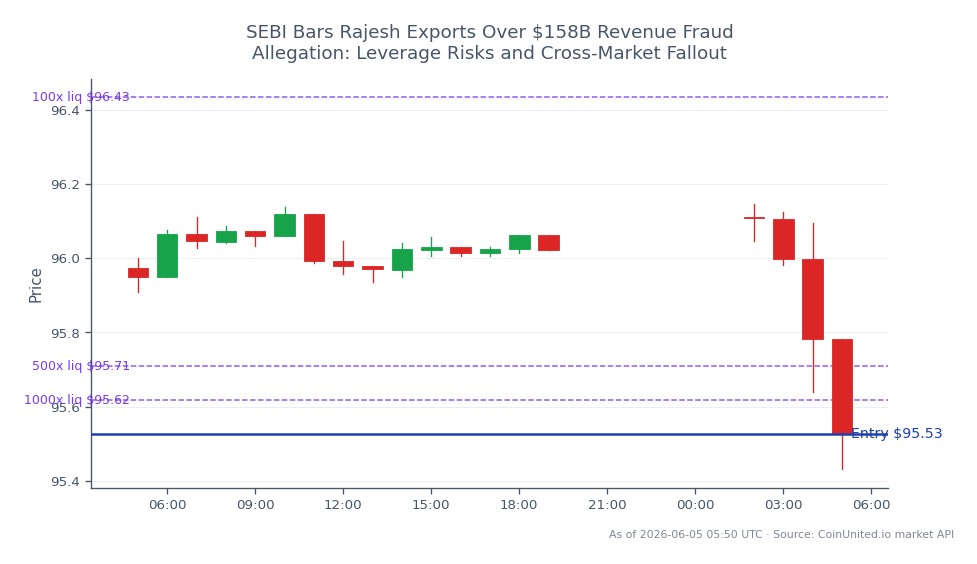
India's Securities and Exchange Board of India (SEBI) issued an interim order on June 3 barring Rajesh Exports Ltd and its promoter-chairman Rajesh Mehta from accessing the securities market, alleging
Event Summary
India's Securities and Exchange Board of India (SEBI) issued an interim order on June 3 barring Rajesh Exports Ltd and its promoter-chairman Rajesh Mehta from accessing the securities market, alleging revenue misrepresentation of approximately ₹15.15 lakh crore (~$158 billion) across five financial years (FY21–FY25). According to SEBI's order, between 97–99% of the company's reported consolidated revenues during this period originated from overseas subsidiaries whose records could not be substantiated. SEBI has ordered a fresh forensic audit and describes the alleged inflation as "egregious and unheard of."
As reported by NDTV and confirmed in SEBI's interim order, the regulator also flagged circular trading patterns — Rajesh Exports recorded ₹114.87 billion in sales and ₹114.88 billion in purchases with a single related entity (Affluence Shares and Stocks Pvt Ltd) — and noted the use of the promoter's personal bank accounts to route corporate funds. SEBI's findings are prima facie and the probe remains ongoing; final adjudication is pending. This case fits squarely within the broader global regulatory enforcement wave reshaping governance expectations for listed entities.
Leverage Impact Analysis
Rajesh Exports shares immediately hit the 5% lower circuit following the SEBI order, triggering an acute liquidity crisis for existing holders. For leveraged CFD traders on CoinUnited.io (up to 2000x leverage available on stock CFDs), this event illustrates two asymmetric risks:
Long squeeze scenario: A trader holding a 20x long CFD on Rajesh Exports entering near pre-order levels faces a ~100% margin wipe on a 5% adverse move — precisely the lower-circuit print. At 50x leverage, even a 2% gap wipe exhausts the position. With the stock already down over 80% in three years per SEBI's order documentation, any incremental negative forensic audit disclosure could trigger successive circuit-down sessions, making orderly exit structurally impossible.
Short-side constraints: Traditional borrow availability for short exposure is likely impaired given the SEBI market-access ban and illiquidity. Traders eyeing short CFD exposure should monitor whether circuit-breakers reset daily, creating intermittent exit windows. Position sizing discipline is critical — sizing to survive multiple locked sessions is essential before any forensic audit catalyst resolves.
For context on how cross-border enforcement repricing creates these leverage traps across markets, the pattern is consistent: initial circuit-lock, forensic audit timeline uncertainty, then stepwise derating as facts emerge.
Cross-Market Impact
Nifty 50 / Indian Indices: Rajesh Exports carries limited direct index weight as a mid/small-cap name, so mechanical index drag is negligible. The systemic risk is governance perception — if foreign portfolio investors (FPIs) treat this as a signal of broader disclosure weakness in Indian mid-caps, expect a widening equity risk premium for opaque export-oriented names, creating headwinds for the broader index.
Gold (XAU/USD): Rajesh Exports operates in the gold/jewellery value chain, but SEBI's allegations concern revenue misreporting — not physical supply disruption. Direct impact on gold spot prices is negligible. The indirect angle: tighter trade-finance for Indian gold importers/exporters could modestly compress Indian jewellery demand over time, but this is a slow-moving, second-order effect.
USD/INR: The US Dollar/Indian Rupee pair faces marginal risk if this case amplifies FPI outflow concerns from Indian equities. A systemic governance narrative — particularly if additional audit failures emerge — could incrementally pressure INR through reduced equity inflows, but the immediate macro impact is limited given the single-firm nature of the event.
Trading Considerations
The primary risk for leveraged traders is not directional — it is liquidity lock risk. Successive lower-circuit sessions can prevent exit regardless of conviction. Key watchpoints: SEBI's forensic audit timeline and any bank lender disclosures on Rajesh Exports exposure, which could catalyse credit-channel contagion into lending banks' NPAs. Governance-focused investors may apply a broader discount to Indian mid-caps with high overseas revenue concentration and opaque audit trails — a basket-level theme consistent with cross-border enforcement market repricing dynamics.
Monitor open interest and funding rates on related India-equity instruments for confirmation signals before adding directional exposure in the sector.
Start Trading on CoinUnited.io
Create Your Free Account → — Trade crypto, stocks, forex, indices, and commodities with up to 2000x leverage and zero fees.
Frequently Asked Questions
A 5% lower-circuit move wipes 100% of margin on a 20x long CFD and proportionally more at higher leverage — and with circuit locks preventing exit, losses can compound across consecutive sessions before any trade is possible.
Continue Exploring
Disclaimer: This brief is for educational purposes only and is not investment advice.