Quick Links
OFAC Sanctions 4 Iranian Crypto Exchanges: Precedent-Setting Action Adds Regulatory Overhang for Leveraged Crypto Traders
Data Snapshot
Key Takeaways
- •OFAC's first-ever crypto exchange designation under Iran's financial-sector E.O. sets a precedent: regulators now treat exchanges as core financial infrastructure subject to full blocking sanctions.
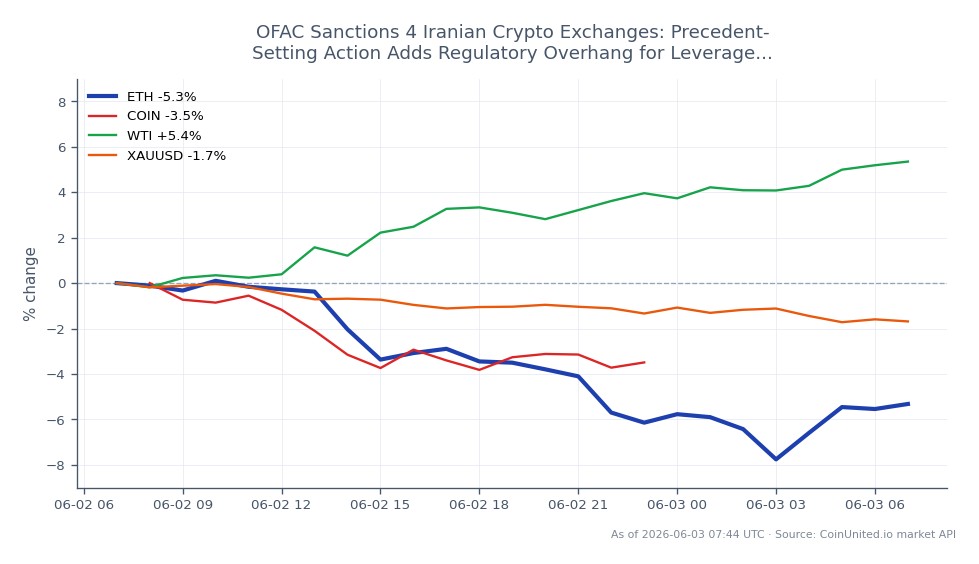
- •Leveraged ETH longs opened near yesterday's $1,909 high face ~85% margin erosion at 50x leverage with ETH at $1,876 — monitor CoinUnited.io funding rates for confirmation of crowded positioning.
- •Nobitex processed over 50% of Iranian digital asset inflows in 2025; its effective shutdown removes a major sanctions-evasion rail, incrementally supporting an oil risk premium in WTI.
- •Coinbase (COIN) is a relative beneficiary: OFAC-compliant exchanges gain structural competitive advantage as unregulated rivals face de-risking pressure.
- •The terrorism-finance angle (E.O. 13224 / IRGC designation) elevates compliance risk beyond routine sanctions, historically triggering brief but sharp crypto deleveraging events.
The U.S. Department of the Treasury's Office of Foreign Assets Control (OFAC) has designated four Iranian-linked crypto exchanges — Zedcex Exchange, Ltd., Zedxion Exchange, Ltd., Nobitex, and at least
Event Summary
The U.S. Department of the Treasury's Office of Foreign Assets Control (OFAC) has designated four Iranian-linked crypto exchanges — Zedcex Exchange, Ltd., Zedxion Exchange, Ltd., Nobitex, and at least one additional platform — under Executive Orders 13902, 13224, and 13553. According to OFAC's official press release, Nobitex alone processed more than half of all Iranian digital asset inflows in 2025 and facilitated payments tied to Iran-designated terrorist entities including the Islamic Revolutionary Guard Corps (IRGC).
OFAC explicitly notes this is its first-ever designation of a digital asset exchange for operating in the financial sector of the Iranian economy — a precedent that elevates crypto exchanges to the same sanctions-enforcement tier as traditional banks. All U.S. persons and entities are now prohibited from transacting with these platforms; entities 50%+ owned by blocked persons are automatically blocked as well.
Leverage Impact Analysis
ETH is trading at $1,876.40, down 5.31% over 24 hours (24h range: $1,816.34–$1,909.00), already reflecting a broader risk-off tone that this sanctions action amplifies.
For leveraged traders, the key risk is a regulatory overhang cascade rather than a direct flow shock. Consider: a trader holding a 50x long ETH perpetual opened at $1,909.00 (yesterday's high) is now sitting on an unrealized loss of ~$32.60/ETH. At 50x, that represents a ~85% drawdown on margin — dangerously close to liquidation territory depending on the platform's maintenance margin threshold.
The more critical leverage risk is indirect: as this global regulatory enforcement wave narrative intensifies, compliance-sensitive institutional desks reduce gross exposure, tightening liquidity and widening spreads. This compresses the buffer between entry price and liquidation for high-leverage longs. Traders should monitor funding rates on CoinUnited.io — if they flip negative, it signals crowded short positioning that could snap back sharply.
The IRGC terrorism-finance designation (E.O. 13224) adds a second layer: any exchange or service provider seen as insufficiently screened faces secondary sanctions pressure, which historically triggers brief but sharp deleveraging events in crypto markets as compliance teams reassess exposure. This fits the cross-border enforcement repricing pattern.
Cross-Market Impact
Crypto-proxy stocks: Coinbase (COIN) is a relative beneficiary — OFAC's action structurally advantages KYC-heavy, OFAC-compliant incumbents over unregulated competitors. Watch COIN as a sentiment divergence signal against BTC/ETH.
Commodities: The sanctions target Iran's financial infrastructure within a broader program that already covers petroleum. Tighter enforcement on crypto payment rails used for sanctioned oil exports incrementally increases friction on Iranian crude flows. WTI and Gold both benefit modestly from elevated Middle East risk premium; see the Hormuz Strait energy supply shock theme for the broader oil-sanctions nexus.
Forex: USD/JPY is the clearest macro read — geopolitical sanctions escalation supports mild USD safe-haven demand while JPY strengthens on risk-off flows. No direct macro catalyst here, but combined with Iran-linked energy risk, this fits the stagflation risk framework.
Stablecoins: USDC and regulated stablecoin issuers face ongoing pressure to demonstrate OFAC address screening — medium-term this favors institutional stablecoin infrastructure over unregulated alternatives.
Trading Considerations
ETH's 24h low of $1,816.34 is the immediate support level to watch — a break below this on volume would confirm bearish continuation, likely testing the $1,750–$1,780 range. Resistance sits at the $1,909.00 session high. The crypto regulatory & tax reckoning theme suggests this regulatory overhang is persistent, not a one-session event.
Key risk factor: OFAC actions trigger rapid address blacklisting by Chainalysis-type vendors, which can cause sudden on-chain flow disruptions. Monitor blockchain analytics for unusual wallet migration patterns from Iranian exchange addresses — these can front-run short-term volatility spikes across BTC and ETH.
Trade Ethereum on CoinUnited.io
Trade ETH with up to 2000xx leverage → | Create Free Account
Frequently Asked Questions
ETH is already down 5.31% to $1,876.40, meaning a 50x long opened at yesterday's $1,909 high has lost roughly 85% of its margin. The primary ongoing risk is regulatory-overhang-driven liquidity tightening, which compresses the buffer between entry and liquidation — reduce position sizing or widen stop-loss buffers accordingly.
Continue Exploring
Disclaimer: This brief is for educational purposes only and is not investment advice.