Quick Links
SEBI Alleges Rajesh Exports Inflated Revenue by $158bn — Leverage Traders Face Sharp Downside Risk
Key Takeaways
- •SEBI alleges Rajesh Exports inflated revenue by ~$158bn — one of India's largest alleged accounting frauds, triggering immediate bearish repricing risk.
- •Leveraged long CFD holders face acute liquidation risk: a 50x position requires only a 2% adverse move to wipe margin, while historical SEBI enforcement cases have seen 20–60% single-session drops.
- •Exchange trading halts are a real risk — leveraged traders may be unable to exit positions at target prices once a suspension is imposed.
- •USD/INR may see modest INR weakness as foreign investors reprice Indian equity risk; monitor the 83.50–84.50 range for acceleration.
- •Gold spot (XAU/USD) faces a marginal bullish micro-catalyst if Rajesh Exports' refining operations face disruption, but global impact is limited.
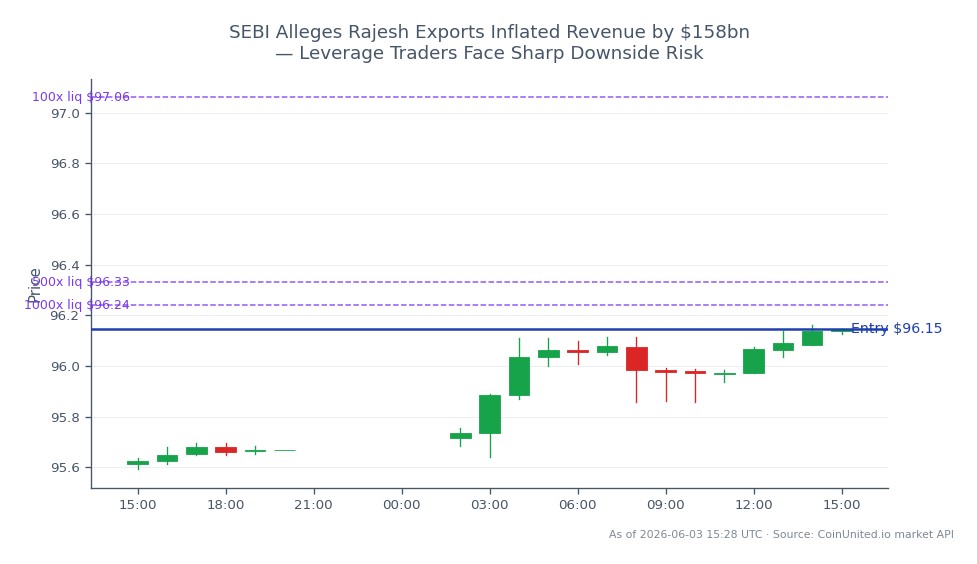
India's securities regulator has alleged that Rajesh Exports, one of the world's largest gold refining and jewellery manufacturing conglomerates, inflated its reported revenue by approximately $158 bi
Event Summary
India's securities regulator has alleged that Rajesh Exports, one of the world's largest gold refining and jewellery manufacturing conglomerates, inflated its reported revenue by approximately $158 billion. The Securities and Exchange Board of India (SEBI) is the authority behind the enforcement action, which represents one of the largest alleged accounting frauds ever investigated in Indian corporate history. The scale of the alleged misstatement — relative to India's ~$3.5 trillion GDP — makes this a systemic credibility event for Indian capital markets, not just an isolated corporate matter. Independent verification of full case details remains pending as research data was unavailable at time of publication; traders should monitor official SEBI filings and financial newswires for confirmed figures.
Rajesh Exports has historically reported revenues that placed it among India's top companies by turnover, with its gold-refining subsidiary Valcambi (a Swiss operation) adding international credibility. If SEBI's allegations are substantiated, the revenue base underpinning years of analyst models and index weightings would be rendered unreliable — a classic cross-border enforcement repricing scenario.
Leverage Impact Analysis
This is a high-severity event for leveraged long positions in Rajesh Exports CFDs. Accounting fraud allegations of this magnitude typically trigger immediate circuit-breaker halts on Indian exchanges, followed by sustained multi-session selling once trading resumes.
Consider a concrete scenario: a trader holding a 50x long Rajesh Exports CFD position would face full liquidation with a move of just 2% against their position (assuming standard 2% margin). Indian stocks implicated in SEBI enforcement actions have historically dropped 20–60% in the sessions following initial disclosure — well beyond any leveraged long's survival range without active stop-loss management. Conversely, traders with short CFD exposure who entered before the announcement could be sitting on significant unrealised gains, but should watch for volatility-driven reversals and exchange halts that could impede orderly exit.
Given the global regulatory enforcement wave context, position sizing must be conservative. Avoid sizing into any single enforcement-linked stock at more than 1–2% of account equity, regardless of leverage level. Monitor SEBI's official order for trading suspension notices before attempting any entry.
Cross-Market Impact
The ripple effects extend across three asset classes:
USD/INR (Forex): A high-profile fraud allegation of this scale adds to foreign investor risk perception of Indian equities. The US Dollar / Indian Rupee pair may see modest INR weakness as FII (Foreign Institutional Investor) outflows reprice Indian market credibility risk. Watch the 83.50–84.50 zone on USD/INR for any acceleration.
Nifty 50 (Index): If Rajesh Exports carries index weighting or if the news triggers broad financials/conglomerates selling, the Nifty 50 faces incremental bearish pressure. The impact is likely contained unless SEBI's investigation broadens to systemic audit failures.
Gold (XAU/USD): Rajesh Exports' core business is gold refining. A forced operational disruption or asset freeze could theoretically tighten Indian physical gold supply in the short term — a marginal bullish catalyst for spot Gold / US Dollar prices. However, the effect is unlikely to be material at global scale given India's diverse refining ecosystem.
Trading Considerations
Key risk factors: SEBI may impose a trading halt on Rajesh Exports shares pending the investigation — making any open leveraged long position impossible to exit at desired levels. Traders should treat this as an untradeable long until SEBI's formal order is public and exchange status is confirmed. For short-side traders, gap risk on resumption of trading is the primary concern — ensure stops are placed wide enough to survive intraday volatility spikes exceeding 15–20%.
Watch for: SEBI's formal show-cause notice, any auditor statements from Deloitte or BSR (Rajesh Exports' audit history), and Nifty 50 financials sub-index reaction as a broader sentiment gauge.
Start Trading on CoinUnited.io
Create Your Free Account → — Trade crypto, stocks, forex, indices, and commodities with up to 2000x leverage and zero fees.
Frequently Asked Questions
Extreme caution is warranted — SEBI enforcement actions frequently trigger exchange trading halts, making orderly exits impossible. Wait for SEBI's formal order and exchange status confirmation before any entry.
Continue Exploring
Disclaimer: This brief is for educational purposes only and is not investment advice.