Quick Links
South Korea April CPI Jumps to 2.6% — BoK Hike Alert Keeps USD/KRW Elevated and KOSPI Under Pressure
Data Snapshot
Key Takeaways
- •South Korea April CPI rose to 2.6% y/y (core: 2.2%), the sharpest monthly gain since September — above the BoK's comfort zone.
- •USD/KRW at 1,512.44 faces structural downside pressure as a hawkish BoK repricing is KRW-bullish; 1,500.35 is the key near-term support.
- •Leverage traders: a 100x short USD/KRW at 1,512 captures ~80% margin gain on a move to 1,500, but a spike to 1,517 creates ~30% drawdown — size accordingly.
- •KOSPI 200 rate-sensitive sectors face multiple compression; export-oriented semiconductor names are relatively resilient per KDI data.
- •Sticky APAC inflation adds marginal support to gold's inflation-hedge bid and is modestly risk-off for crypto on a cross-market basis.
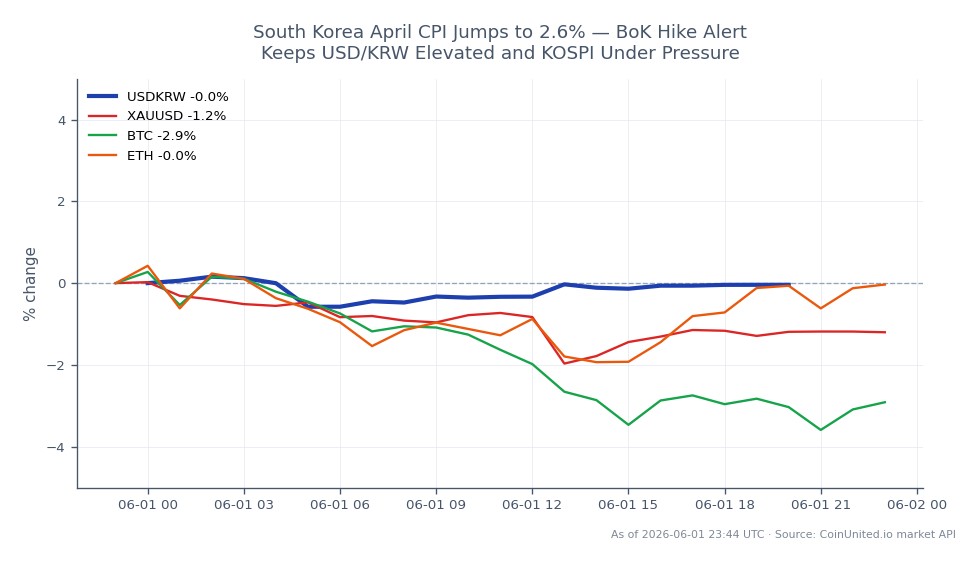
According to ICIS and Trading Economics, South Korea's consumer price index rose to 2.6% year-on-year in April 2026, accelerating from 2.2% in March — the fastest monthly gain (+0.5% m/m) since late S
Event Summary
According to ICIS and Trading Economics, South Korea's consumer price index rose to 2.6% year-on-year in April 2026, accelerating from 2.2% in March — the fastest monthly gain (+0.5% m/m) since late September. Core inflation held at 2.2% y/y, confirming underlying price stickiness beyond energy. Higher oil and petroleum prices were the primary driver. As reported by ICIS, the Bank of Korea (BoK) is now on hike alert rather than easing mode, even as markets had priced in a pause to assess energy-price pass-through effects.
This fits squarely within the APAC Hawkish Pivot & Inflation Surge theme and reinforces the broader CPI Shock & Central Bank Repricing dynamic playing out across Asia in 2026.
Leverage Impact Analysis
USD/KRW is trading at 1,512.44 (24h range: 1,500.35–1,517.32) — up +0.39% on the day. A hawkish BoK repricing is fundamentally KRW-bullish (won strengthens, USD/KRW falls), creating a directional tension: the pair is elevated but faces policy-driven downside pressure.
Worked scenario — Short USD/KRW (KRW bull trade): A trader opens a 100x short USD/KRW CFD at 1,512.44. Each 1-pip move equals amplified PnL at that leverage tier. A move to 1,500 (the 24h low, ~12 pips) represents a 0.80% spot move — at 100x leverage, that's an 80% gain on margin. However, if USD/KRW spikes toward 1,517 (24h high) before reversing, the same position faces a ~30% margin drawdown before the BoK thesis plays out.
Liquidation risk: High-leverage long USD/KRW positions (USD bulls) face macro inflation pressure headwinds. At 200x leverage, a 0.5% adverse move (to ~1,505) would wipe the margin. Monitor the BoK May 28 decision — already flagged as a potential whipsaw event — before sizing aggressively. Check live funding rates on CoinUnited.io before entry.
Cross-Market Impact
KOSPI 200: Higher-than-expected inflation raises rate-hold or hike probability, compressing equity multiples for rate-sensitive domestic sectors (real estate, utilities, leveraged cyclicals). Export-heavy semiconductor names (Samsung, SK Hynix) are relatively insulated given strong export momentum noted by KDI. Traders can access KOSPI 200 CFDs on CoinUnited.io.
Gold (XAU/USD): The oil-driven inflation print reinforces the inflation hedge bid for gold. Korean CPI data alone won't move gold materially, but as part of the sticky APAC inflation narrative, it adds marginal support to the gold bull case.
Bitcoin & Crypto: Risk-off pressure from tighter BoK expectations is modestly negative for high-beta risk assets including Bitcoin and Ethereum, though the correlation to Korean macro is indirect and unlikely to be the dominant driver.
Regional FX: KRW strength signals can pressure other high-beta APAC currencies through relative carry repricing. Watch USD/CNY for broader APAC FX contagion signals.
Trading Considerations
Key levels for USD/KRW: immediate support at 1,500.35 (24h low); resistance at 1,517.32 (24h high). A confirmed break below 1,500 on BoK hawkish follow-through would open the next technical zone. The May 28 BoK meeting is the next major catalyst — holding with hawkish guidance could accelerate KRW strength.
For a fuller macro inflation trading framework, see the CPI & Inflation Data trading guide and the APAC Currency Crisis guide.
Trade US Dollar / South Korean Won on CoinUnited.io
Trade USDKRW with up to 1000xx leverage → | Create Free Account
Frequently Asked Questions
A hawkish BoK outcome is KRW-bullish, meaning USD/KRW falls — long USD/KRW positions lose value. At 200x leverage, even a 0.5% move against you (~7.5 pips) can liquidate a position, so tight stop-loss placement around 1,517 resistance is critical.
Continue Exploring
Disclaimer: This brief is for educational purposes only and is not investment advice.