Quick Links
BOJ's Koeda: Inflationary Risk Already Materialising — JPY Squeeze Builds for Leveraged USD/JPY Longs
Data Snapshot
Key Takeaways
- •Leveraged USD/JPY longs at 159.04 face ~1% liquidation buffer at 100x — hawkish BOJ rhetoric materially raises squeeze risk near the 160 intervention threshold.
- •BOJ board member Koeda joins Masu and Takata in the hawkish camp; this narrows the gap with Governor Ueda's cautious tone and increases odds of near-term rate hike.
- •JPY-funded carry trades across AUD/JPY, EUR/JPY, and NZD/JPY face unwind risk as BOJ terminal rate expectations shift toward or above 1%.
- •Nikkei 225 exporter-heavy names (autos, electronics) face FX headwinds; Japanese bank stocks are relative beneficiaries of a steeper JGB curve.
- •Gold and Bitcoin may see short-term safe-haven or volatility demand if carry unwinds spill into broader risk-off sentiment.
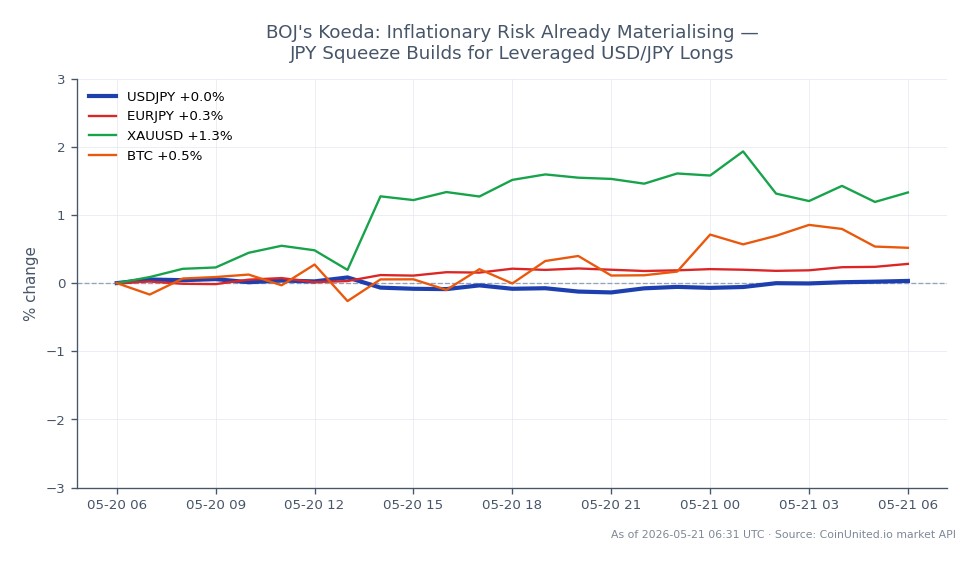
Bank of Japan board member Koeda has stated that inflationary risk is already materialising — a remark consistent with a broader hawkish shift across the BOJ's nine-member board. As reported by Reuter
Event Summary
Bank of Japan board member Koeda has stated that inflationary risk is already materialising — a remark consistent with a broader hawkish shift across the BOJ's nine-member board. As reported by Reuters and Bloomberg wires, fellow board members Masu and Takata have similarly called for timely rate hikes to prevent inflation from overshooting the 2% target. Japan's core CPI sits around 2.4%, above the BOJ's 2% target for nearly four years, with the current policy rate at 0.75% — a multi-decade high after gradual normalisation from negative rates.
Koeda's framing that risk is "already materialising" narrows the gap between Governor Ueda's cautious tone and the hawkish camp, reinforcing CPI shock and central bank policy repricing dynamics. Markets were already pricing roughly 60–80% probability of a further hike in the near term, per prior reporting. This statement adds conviction to that path.
Leverage Impact Analysis
USD/JPY is trading at 159.04 (24h range: 158.81–159.06) — essentially pinned at the top of its daily range. For leveraged longs, this is a high-risk entry zone into a hawkish BOJ headline.
Worked example — 100x long USD/JPY at 159.04: A 100x long position entered at 159.04 requires only a ~1% adverse move (to ~157.45) to trigger full liquidation. Given that prior BOJ intervention episodes have produced 3–5 figure JPY spikes intraday, such leverage leaves almost zero buffer. Even a 50x long faces liquidation near 157.45 if no stop is placed.
Short USD/JPY scenario — 50x short at 159.04: A 50x short entered here profits if USD/JPY drops toward 157.00–156.00 on accelerated BOJ repricing. Each 100-pip move = 2x account move at 50x leverage. Traders positioning for a hawkish BOJ pivot should monitor the macro inflation pressure theme for confirmation triggers.
Funding rate implications: JPY-funded carry trades face compressing yield differentials if BOJ moves toward 1%+. Check live funding rates on CoinUnited.io for current perpetual/CFD holding costs before sizing positions.
Cross-Market Impact
EUR/JPY & Yen Crosses: EUR/JPY faces directional JPY strength pressure across all major pairs — AUD/JPY, GBP/JPY, and NZD/JPY carry trades funded in yen are most vulnerable to unwind.
Nikkei 225 (JP225): A stronger yen is a headwind for Japan's export-heavy index. Auto manufacturers and electronics names with large overseas revenue will face FX translation pressure. Domestic financials (banks, securities) benefit from a steeper JGB yield curve.
Gold: Gold typically benefits when BOJ tightening triggers risk-off carry unwinds globally. If JPY strength accelerates and compresses global risk appetite, Gold CFDs on CoinUnited.io may see safe-haven inflows. The inflation hedge asset rotation theme remains relevant here.
WTI Crude: A stronger yen reduces Japan's import cost in local currency terms, but WTI pricing is USD-denominated — direct commodity impact from this specific BOJ comment is limited.
Bitcoin: BTC faces indirect pressure if JPY carry-unwind triggers broader risk-off sentiment. No direct on-chain impact, but monitor open interest on CoinUnited.io for position flush signals.
Trading Considerations
USD/JPY is trading at 159.04, effectively at the 24h high, with limited upside room before prior intervention-zone resistance. The USD/JPY trading guide notes that 160.00 has historically been a trigger level for MOF/BOJ verbal or physical intervention. Bulls need to clear 159.06 (24h high) with conviction; failure to do so while BOJ rhetoric hardens is a bearish setup.
For the macro inflation risk-off repricing thesis to fully play out, watch upcoming Japanese CPI/wage data and any BOJ policy meeting signals. The Japanese yen intervention guide provides historical precedents for sizing risk around these events.
Trade US Dollar / Japanese Yen on CoinUnited.io
Trade USDJPY with up to 2000xx leverage → | Create Free Account
Frequently Asked Questions
At 100x leverage, a ~1% adverse move (approximately to 157.45) would trigger full liquidation — well within the range of a single BOJ-driven intraday JPY spike.
Continue Exploring
Disclaimer: This brief is for educational purposes only and is not investment advice.