Quick Links
South Korea May CPI Hits Two-Year High: USD/KRW Leverage Scenarios and KOSPI Cross-Market Impact
Data Snapshot
Key Takeaways
- •South Korea's May CPI reached a two-year high, extending three consecutive months of re-acceleration driven by transport (+9.7% YoY) and housing costs.
- •USD/KRW is trading at $1,513.89 with a compressed 24h range — a CPI-driven volatility spike is likely, creating high risk for heavily leveraged positions in either direction.
- •At 100x leverage on a short USD/KRW CFD, a 0.3% KRW strengthening move generates ~30% margin return; a 0.5% reversal at 200x leverage triggers liquidation.
- •KOSPI faces bearish pressure as higher discount rates hit domestic-demand sectors; gold gets a mild inflation-hedge tailwind from the persistent APAC inflation narrative.
- •The BoK's policy path is now firmly hawkish — near-term rate cuts are effectively priced out, with front-end KTB yields biased higher.
According to Statistics Korea, South Korea's May 2026 Consumer Price Index rose to a two-year high, exceeding analyst forecasts. The print extends a multi-month re-acceleration trend — April CPI had a
Event Summary
According to Statistics Korea, South Korea's May 2026 Consumer Price Index rose to a two-year high, exceeding analyst forecasts. The print extends a multi-month re-acceleration trend — April CPI had already surged to 2.6% YoY (the highest since July 2024), driven by transport costs (+9.7% YoY), housing and utilities (+1.7%), and recreation (+3.4%), per Trading Economics. May's beat pushes inflation further above the Bank of Korea's target, with energy and transport again the primary culprits, linked in part to elevated global oil prices amid Middle East tensions.
Critically, this is not a one-off shock. Inflation has re-accelerated for three consecutive months, shifting the BoK narrative firmly toward APAC hawkish pivot territory. Markets are now pricing out near-term rate cuts, with front-end Korean Treasury Bond (KTB) yields biased higher.
Leverage Impact Analysis
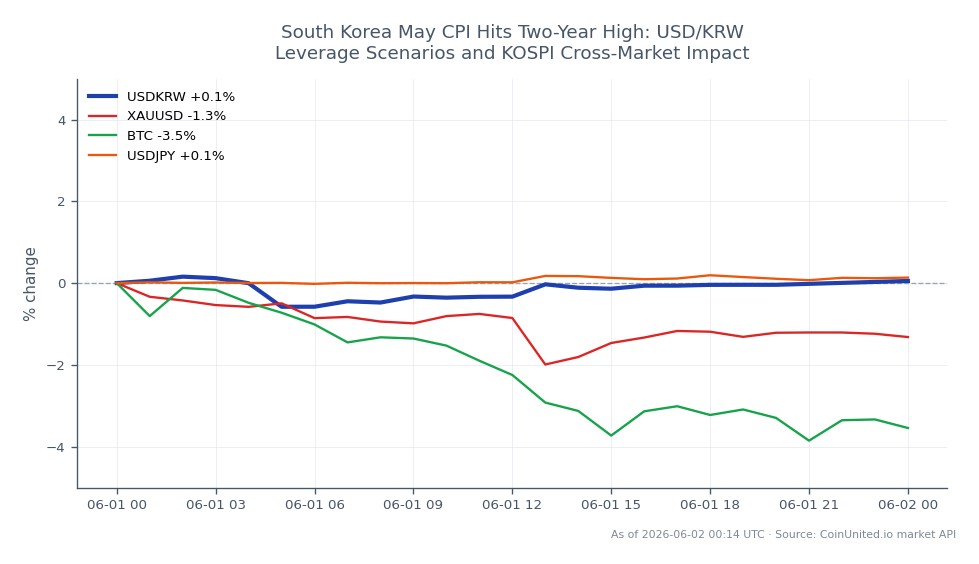
USD/KRW is trading at $1,513.89 (24h range: $1,512.72–$1,514.91), per live market data. An upside CPI surprise typically generates initial KRW strength — meaning USD/KRW moves lower — before potential reversal if equity risk-off takes hold.
Worked example — Short USD/KRW (KRW bullish): A trader opening a 100x short USD/KRW CFD at $1,513.89 controls a notional position of $151,389 per lot. A 0.3% KRW strengthening move (USD/KRW to ~$1,509.34) would yield approximately 3,000 pips of profit — a 30% return on margin at 100x. However, a reversal back toward $1,514.91 (the 24h high) would trigger roughly a 0.07% adverse move, consuming ~7% of margin at 100x leverage in minutes.
Liquidation watch: Highly leveraged long USD/KRW positions (traders expecting KRW weakness) face compression if the hawkish BoK narrative dominates. At 200x leverage, a mere 0.5% adverse move liquidates the position. Given the tight 24h range ($2.19 spread), volatility is currently compressed — but CPI surprises historically spike intraday ranges 3–5x. Monitor funding rates and open interest on CoinUnited.io for confirmation signals before sizing up.
For traders aligned with the broader macro inflation pressure theme, this print reinforces the structural case for KRW strength — but position sizing must account for potential equity-led risk-off reversals.
Cross-Market Impact
KOSPI: Rate-sensitive Korean equities face headwinds as higher discount rates compress valuations. Domestic demand sectors (real estate, consumer discretionary, construction) are most exposed. Export-oriented semiconductors and tech are mixed — KRW strength marginally hurts competitiveness, but global tech demand provides an offset.
Gold (XAU/USD): The gold-dollar dynamic gets a mild tailwind. Persistent Asian inflation reinforces the inflation hedge asset rotation thesis. If BoK hawkishness triggers regional risk-off, safe-haven gold demand could spike.
USD/JPY: Indirect pressure via the broader "sticky APAC inflation" narrative. A hawkish BoK reinforces pressure on the Bank of Japan to maintain its own tightening path, which would support yen strength. See our USD/JPY trading guide for detailed yen dynamics.
Bitcoin: The crypto link is indirect. Persistent inflation supports the long-term BTC inflation-hedge thesis, but short-term risk-off from KOSPI weakness could pressure Bitcoin alongside other high-beta assets.
Trading Considerations
USD/KRW's current tight range ($1,512.72–$1,514.91) suggests the market has not yet fully repriced the CPI surprise. Key watch: Does USD/KRW break below $1,512 (KRW strengthening decisively) or rebound toward $1,516+ on equity risk-off? The BoK's next policy meeting guidance will be the primary catalyst for sustained directional movement. For a deeper look at how CPI prints move currency markets, see our CPI inflation trading guide.
For KOSPI CFD traders, the rate-sensitive domestic sectors are the clearest short candidates, while global exporters may hold up better if U.S. tech demand remains strong.
Trade US Dollar / South Korean Won on CoinUnited.io
Trade USDKRW with up to 1000xx leverage → | Create Free Account
Frequently Asked Questions
An upside CPI surprise is initially KRW-bullish (USD/KRW moves lower), pressuring long USD/KRW positions. At 100x leverage, even a 0.3% adverse move consumes 30% of margin — size accordingly and monitor for reversals if KOSPI sells off sharply.
Continue Exploring
Disclaimer: This brief is for educational purposes only and is not investment advice.