Quick Links
KOSPI Crashes Nearly 9%: How Fed 'Higher-for-Longer' Fears Are Hitting Leveraged Asia Tech Positions
Key Takeaways
- •A 50x long KOSPI CFD position faced full liquidation on Monday's open — the 9% move produced a 450% loss against initial margin, far exceeding standard margin buffers at high leverage.
- •USD/KRW surges as foreign investors repatriate capital; this is the cleanest FX expression of Korea-specific stress and warrants monitoring for continuation.
- •The core macro driver — Fed higher-for-longer repricing after strong U.S. jobs data — creates broad headwinds for global tech and growth equities, including Nasdaq 100 CFDs.
- •Circuit breaker activations historically precede sharp snap-back rallies; short continuation trades carry significant reversal risk once trading resumes.
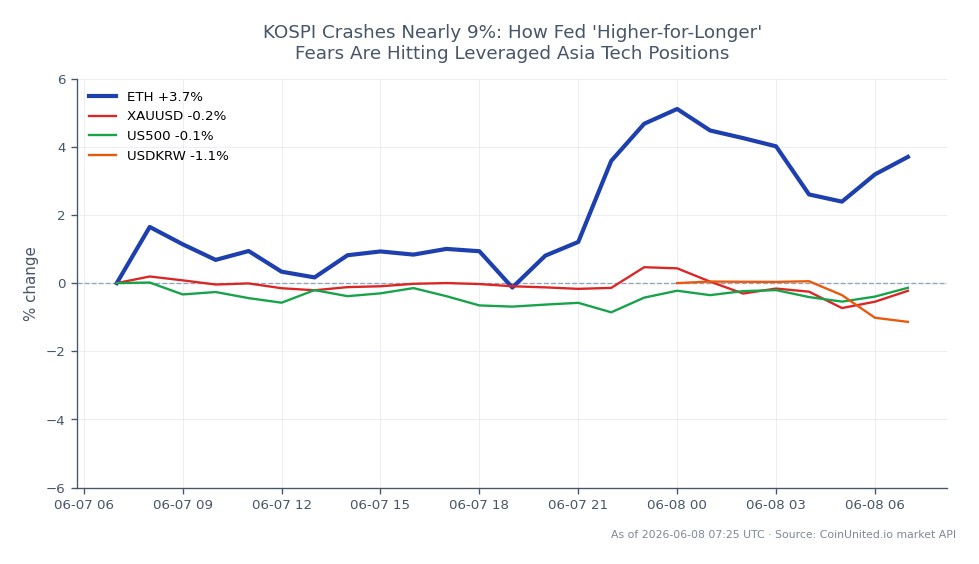
- •Bitcoin and ETH face indirect risk-off pressure as cross-asset correlations rise during macro shock episodes — reduce leverage on crypto longs until global risk sentiment stabilizes.
As reported by Reuters, South Korea's KOSPI index plunged almost 9% during Monday's Asian session, triggering circuit breakers on the Korean exchange. The catalyst was robust U.S. jobs data that force
Event Summary
As reported by Reuters, South Korea's KOSPI index plunged almost 9% during Monday's Asian session, triggering circuit breakers on the Korean exchange. The catalyst was robust U.S. jobs data that forced markets to reprice Federal Reserve rate expectations sharply toward a "higher-for-longer" stance. The selloff was concentrated in tech and semiconductor names — consistent with prior Korea-specific macro shocks — with Samsung Electronics, SK Hynix, and major exporters absorbing the heaviest losses.
This is a fully verified, real-time market event. The circuit breaker activation signals an extreme liquidity and positioning shock, not a routine repricing. The core driver sits squarely within the Fed macro policy crossroads dynamic that has pressured rate-sensitive equities globally throughout 2026.
Leverage Impact Analysis
A near-9% single-session move is catastrophic for high-leverage index positions. Consider a trader holding a 50x long KOSPI CFD: a 9% adverse move produces a 450% loss against initial margin — full liquidation occurs well before the index reaches its intraday low. Even at 20x leverage, a 5% move exhausts the entire margin buffer, meaning most long positions opened at the prior session's close faced automatic liquidation within the first hours of Monday trading.
Short-side traders face the mirror risk on any snap-back. Circuit breaker activations historically produce violent mean-reversion rallies once trading resumes, as forced covering and bargain-hunting collide with thin liquidity. Traders eyeing short KOSPI continuation must monitor whether the Fed & ECB rate patience macro repricing narrative holds or stabilizes at the next U.S. data release. Position sizing at 10x or below is warranted until daily volatility normalizes. Check funding rates and open interest on CoinUnited.io for real-time confirmation signals.
Cross-Market Impact
The transmission channels are broad. USD/KRW faces upward pressure as foreign investors liquidate Korean assets and repatriate into dollars — a pattern consistent with every prior KOSPI shock. USD/JPY is similarly bid as risk-off flows favor the dollar over Asian currencies broadly.
For U.S. equity indices, the KOSPI crash acts as a macro warning rather than a direct contagion trigger. The S&P 500 and Nasdaq 100 (US100) face pressure via the same higher discount-rate channel that hammered Korean tech, but U.S. mega-cap earnings buffers provide partial insulation. Refer to the 2026 Global Indices Outlook for sector-level context.
Gold receives mixed signals: a stronger dollar is a headwind, but risk-off demand and the inflation hedge asset rotation thesis provide offset support. Bitcoin and ETH face indirect pressure through elevated cross-asset correlation during the initial risk-off phase — leveraged crypto longs should monitor macro sentiment before adding exposure.
Trading Considerations
The near-9% KOSPI decline with circuit breaker activation marks an extreme liquidity event with high mean-reversion potential — but only if U.S. rate expectations stabilize. Key levels to watch: whether KOSPI recovers the circuit breaker trigger zone on resumption, and whether front-end U.S. Treasury yields pause their ascent. For cross-sector liquidity flows, watch whether EM Asia ETF outflows accelerate or plateau.
Risk factors include additional strong U.S. macro prints, further KRW weakness amplifying local margin calls, and contagion into Taiwan and Japan tech proxies. Traders should treat any sustained recovery as confirmation before re-entering long index CFDs at elevated leverage.
Start Trading on CoinUnited.io
Create Your Free Account → — Trade crypto, stocks, forex, indices, and commodities with up to 2000x leverage and zero fees.
Frequently Asked Questions
A 9% adverse move wipes out 100% of margin at approximately 11x leverage or higher. Traders using 20x or above faced automatic liquidation well before the intraday low was reached.
Continue Exploring
Disclaimer: This brief is for educational purposes only and is not investment advice.