Quick Links
Strong Jobs Report Hammers S&P 500 2.86% — Leverage Liquidation Risk Spikes Across Indices, Tech & Crypto
Data Snapshot
Key Takeaways
- •S&P 500 fell 2.86% to $7,357.05 with a $227 intraday range — leveraged long positions at session highs face margin calls at 20x+ leverage.
- •Strong jobs data reduces Fed rate-cut urgency, pushing yields higher and compressing tech/growth multiples — Nasdaq 100 is the highest-risk index exposure.
- •Gold faces dual headwinds: higher real yields and a stronger USD reduce its appeal as a near-term hedge in this macro regime.
- •Bitcoin and Ethereum are elevated-correlation risk assets in yield-repricing selloffs — monitor open interest for leveraged long liquidation cascades.
- •Immediate support at $7,347.55 (session low); a break lower with sustained selling could accelerate forced liquidations in leveraged index CFDs.
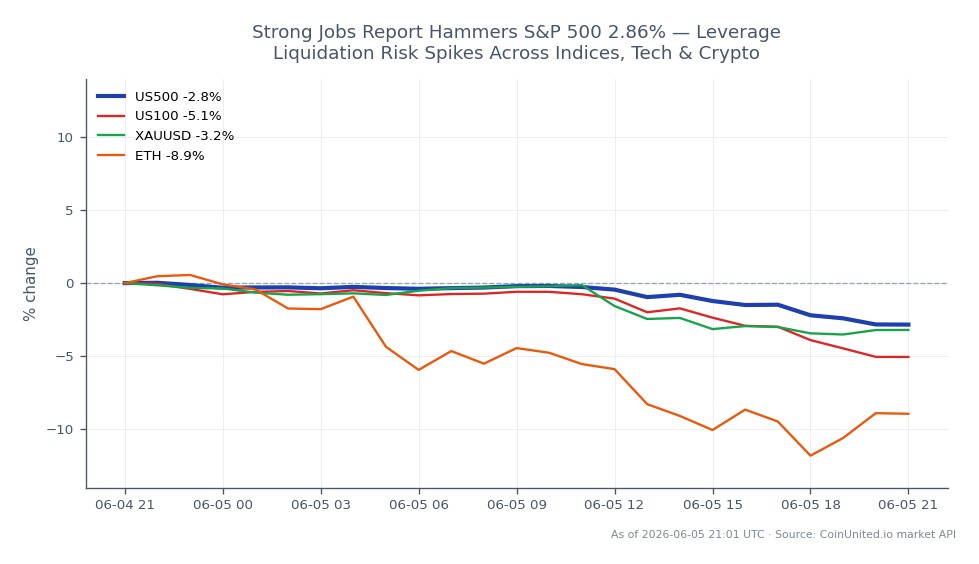
According to Business Insider and multiple market sources, a stronger-than-expected US nonfarm payrolls report has triggered a broad selloff in US equities, with the S&P 500 Index falling 2.86% to $7,
Event Summary
According to Business Insider and multiple market sources, a stronger-than-expected US nonfarm payrolls report has triggered a broad selloff in US equities, with the S&P 500 Index falling 2.86% to $7,357.05 — off a 24-hour high of $7,574.85. The Nasdaq 100 bore the brunt as technology stocks led the decline, with mega-cap names including Microsoft and Alphabet each falling more than 2% and approximately 2.5% respectively, per documented market action from comparable episodes.
The mechanism is straightforward: robust labor data reduces the urgency for Federal Reserve rate cuts, pushing Treasury yields higher and compressing valuation multiples on long-duration growth assets. This sits squarely within the Fed Macro Policy Crossroads theme that has dominated 2026 market narratives, and reinforces the Fed & ECB Rate Patience Macro Repricing playbook.
Leverage Impact Analysis
With the US500 printing $7,357.05 after a $217.80 intraday swing (high $7,574.85, low $7,347.55), leveraged index traders are facing severe mark-to-market pressure.
Worked example — long US500 CFD: A trader entering a 50x long US500 CFD at the session high of $7,574.85 now faces a move of -$217.80, or roughly -2.88% on the underlying. At 50x leverage, that translates to approximately -144% on margin — a full liquidation and margin call scenario. Even at 20x leverage, the same position is down ~57.6% on equity, requiring immediate top-up or facing forced closure.
Short squeeze risk: Conversely, traders holding short US500 CFDs established near recent lows around $7,347.55 are sitting on gains, but any surprise Fed dovish commentary or data revision could trigger a violent short squeeze. Options markets have historically priced ~1.3% one-day implied swings around major payroll releases — today's actual move exceeded that, meaning vol sellers were caught offside.
Position sizing guidance: At current volatility levels, traders using CoinUnited's up to 2000x leverage on indices CFDs should size positions so a 3% adverse move does not exceed 20–30% of allocated margin. Check live funding rates on CoinUnited.io for US500 perpetual positioning costs.
Cross-Market Impact
Nasdaq 100: As reported, software and cloud names are disproportionately affected given their higher duration sensitivity. The NASDAQ 100 Index typically amplifies S&P moves on rate-repricing days — expect beta of 1.3–1.5x relative to US500.
Gold: Higher real yields and a stronger USD are a headwind for Gold. The gold vs. US dollar inverse relationship means gold longs face dual pressure today — rising opportunity cost and dollar strength.
EUR/USD: Strong US data typically bids the DXY, pressuring EUR/USD. Forex traders should monitor whether the pair breaks below key support as rate differentials widen further.
Bitcoin & Crypto: Bitcoin and Ethereum trade as high-beta risk assets in this macro regime. Rate-repricing risk-off episodes have historically correlated with short-term crypto drawdowns. Monitor BTC open interest on CoinUnited.io for signs of leveraged long unwinding.
Trading Considerations
The US500 is trading near its 24-hour low of $7,347.55, which represents the immediate support to watch. A decisive break below this level could open a vol-expansion move with reduced liquidity acting as an accelerant for leveraged positions. Key resistance to reclaim is the $7,574.85 session high; only a full recovery above that level would neutralize today's bearish signal.
The key macro variable to watch is Fed funds futures repricing — if implied rate-cut probabilities for the next FOMC meeting decline materially post-report, expect sustained tech underperformance and further pressure on growth-heavy indices. Traders should review the 2026 Global Indices Outlook for broader context on multiple compression risk.
Trade S&P 500 Index on CoinUnited.io
Trade US500 with up to 2000xx leverage → | Create Free Account
Frequently Asked Questions
Today's peak-to-trough move of ~2.88% means any long US500 CFD position using 35x leverage or above — entered near the session high — would have been fully liquidated assuming standard 100% margin-call thresholds. At 20x, margin erosion hits roughly 57%, requiring an urgent top-up.
Continue Exploring
Disclaimer: This brief is for educational purposes only and is not investment advice.