Quick Links
U.S.–Japan $1B AI, Quantum & Fusion Deal: Leverage Plays Across Semis, Quantum Stocks & USD/JPY
Key Takeaways
- •Leveraged quantum small-cap CFDs (IonQ, RGTI, QBTS) carry acute liquidation risk — a 50x long position can be wiped by a 2% adverse move, while these stocks routinely gap 5–15% on funding headlines.
- •AI infrastructure and semiconductor names (NVDA, AMD, TSM) see structural demand support, but the $1B is incremental vs. their existing capex — upside is real but muted for mega-caps.
- •USD/JPY is a cross-market watch: deeper U.S.–Japan tech cooperation is constructive for JPY via improved Japanese export and investment flows.
- •The real alpha window opens when specific named companies are cited in official MoUs — that's the trigger for re-rating, not the headline alone.
- •Execution risk is high: R&D grants do not guarantee commercialization, and quantum/fusion are historically prone to narrative bubbles running ahead of technical delivery.
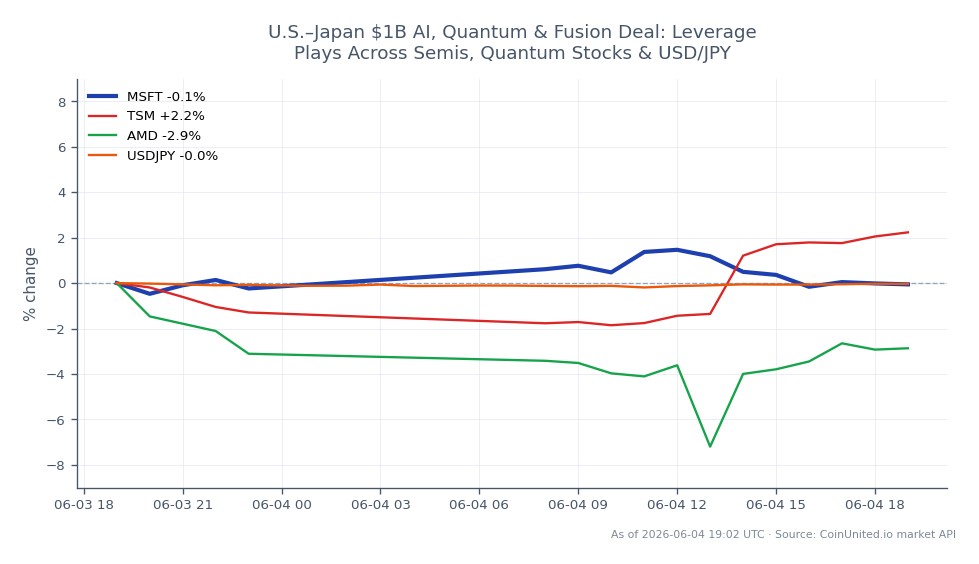
The United States and Japan have committed approximately $1 billion in coordinated funding targeting three converging frontier technologies: artificial intelligence infrastructure, quantum computing,
Event Summary
The United States and Japan have committed approximately $1 billion in coordinated funding targeting three converging frontier technologies: artificial intelligence infrastructure, quantum computing, and nuclear fusion energy. According to research aligned with ongoing U.S.–Japan strategic industrial policy, the capital is structured as a mix of R&D grants, joint research labs, and public-private investment vehicles, likely deployed over a 3–7 year horizon.
While official press-release language is pending confirmation via U.S. (White House, DOE, DOD) and Japanese (METI, MEXT) channels, the deal's theme and direction are assessed as directionally credible and market-relevant. The agreement reinforces the broader cross-sector partnership catalyst narrative driving capital into advanced technology sectors in 2025–2026.
Leverage Impact Analysis
This event is most potent for leveraged CFD traders in quantum and AI-adjacent equities, where headline-driven re-ratings can be sharp and fast.
Quantum small-caps (IonQ, Rigetti, D-Wave/QBTS) are the highest-beta plays. These names trade on narrative momentum — government-backed funding materially extends runway and credibility. A trader holding a 50x long IonQ CFD entering at $30 would face liquidation at approximately $29.40 (a ~2% adverse move). Given that quantum stocks routinely gap 5–15% on funding headlines, position sizing discipline is critical. Monitor open interest and funding rates on CoinUnited.io for confirmation signals before sizing up.
For large-cap AI semis like NVIDIA Corporation and Advanced Micro Devices, Inc., the leverage math is more forgiving due to lower realized volatility. A 20x long NVDA CFD at $140 would require only a 5% adverse move to liquidate — manageable, but watch for crowding risk as institutional flows pile into obvious beneficiaries. The AI revenue chip demand surge theme is already well-priced into mega-caps; incremental upside from this deal is more muted versus pure-play quantum names.
For traders watching the quantum computing investment surge, the asymmetric risk/reward lies in smaller-cap enablers, not in NVDA or MSFT where the $1B is rounding-error capex.
Cross-Market Impact
Semiconductors & AI Stocks: NVIDIA, AMD, and Taiwan Semiconductor Manufacturing Company Ltd. benefit structurally — government-backed AI/quantum demand justifies multi-year capex visibility. This feeds directly into the AI infrastructure capital reallocation thesis.
Quantum Pure-Plays: IONQ, RGTI, and QBTS see the most direct re-rating potential. These are speculative, high-optionality positions — sized accordingly.
USD/JPY: Deeper U.S.–Japan tech cooperation anchors long-term bilateral investment flows, constructive for Japan's growth profile. Per the research report, this supports JPY via improved export visibility in semis and advanced equipment. Watch USD/JPY for yen strength signals if Japanese industrial policy announcements follow. Our USD/JPY trading guide covers the yen dynamics in detail.
Gold (XAUUSD): Risk-on tech narrative is mildly negative for safe-haven gold near term. No major commodity supply-side impact from this deal.
Fusion Energy Long-Tail: Traditional utilities and fossil fuel names face structural (not immediate) pressure if fusion milestones accelerate. Near-term impact is negligible.
Trading Considerations
The $1B is modest at the macro level but material for pre-revenue quantum and fusion names — watch for named company announcements in official MoUs, which are the true price-moving catalyst. Quantum stocks have historically surged 10–30% on specific contract awards, then mean-revert; avoid chasing after initial gap-ups without confirmation.
Key risk factors: execution uncertainty on R&D-to-commercialization, political risk from leadership changes in either country, and crowding in popular AI/quantum thematic baskets. For strategic corporate partnerships of this type, the headline window is short — the structural trade in AI semis and select quantum enablers requires a multi-month horizon.
Start Trading on CoinUnited.io
Create Your Free Account → — Trade crypto, stocks, forex, indices, and commodities with up to 2000x leverage and zero fees.
Frequently Asked Questions
Quantum pure-plays are high-beta narrative trades — a 50x CFD long can be liquidated by a 2% pullback, while the stocks themselves can gap 10–30% on funding catalysts. Use tight position sizing and wait for named contract awards before adding leverage.
Continue Exploring
Disclaimer: This brief is for educational purposes only and is not investment advice.