Quick Links
DOJ's Anti-Scam Strike Force Pulls In Coinbase, Meta & SpaceX — $3.8M Frozen, 1.4M Accounts Wiped
Data Snapshot
Key Takeaways
- •The DOJ Scam Center Strike Force's coordinated operation with Coinbase, Meta, Microsoft, and Starlink marks a new cross-industry enforcement model targeting crypto fraud infrastructure — not just individual bad actors.
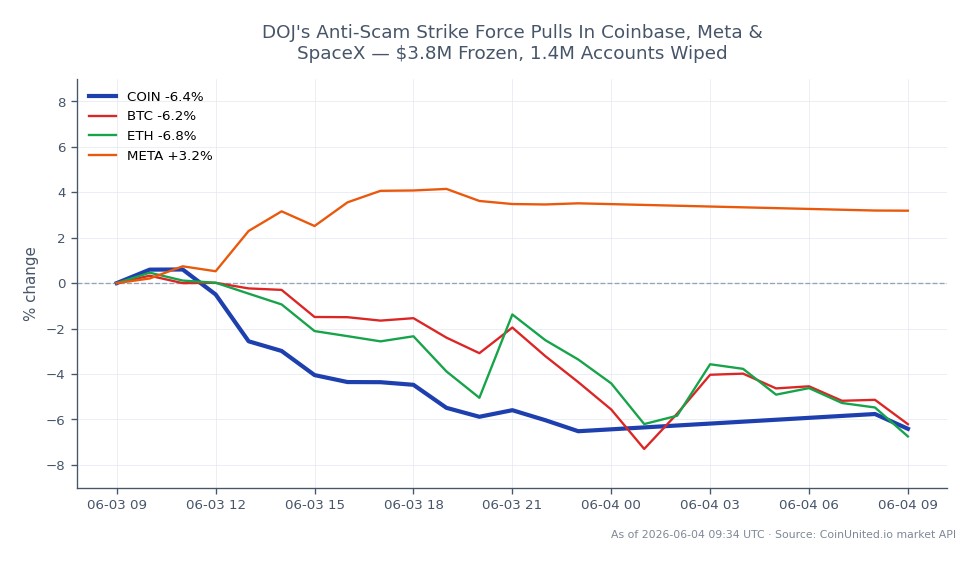
- •Coinbase froze >$3M in criminal crypto assets voluntarily; at $161.68, COIN shows no adverse reaction, with the cooperation narrative mildly supportive of its regulated-exchange valuation multiple.
- •Meta's removal of 1.4M+ scam accounts and contribution to 63 arrests reinforces its online safety posture, potentially easing regulatory pressure on the platform.
- •The enforcement template — spanning financial rails, social media, cloud, and internet connectivity — signals intensifying KYC/AML obligations for centralized crypto on-ramps globally.
- •Privacy-focused and non-KYC venues may see incremental user interest as centralized platforms demonstrate willingness to freeze funds on law enforcement request.
The U.S. Department of Justice's newly formed Scam Center Strike Force, working alongside the FBI, Secret Service, and international law enforcement from the UK, Australia, Canada, New Zealand, and Th
Event Analysis
The U.S. Department of Justice's newly formed Scam Center Strike Force, working alongside the FBI, Secret Service, and international law enforcement from the UK, Australia, Canada, New Zealand, and Thailand, executed a coordinated crackdown on Southeast Asia-based crypto fraud networks beginning May 18, 2026. According to Meta's official newsroom and DOJ-aligned reporting, the operation resulted in 63 arrests, the disabling of over 1.4 million scam accounts across Facebook and Instagram, and the voluntary freezing of approximately $3.8 million in crypto assets — with Coinbase alone accounting for more than $3 million of that figure.
What distinguishes this operation from prior enforcement actions is the breadth of voluntary private-sector participation. As reported by cybersecurity outlets covering the DOJ initiative, partners included Meta Platforms, Microsoft, SpaceX/Starlink, Google, blockchain analytics firm TRM Labs, and others. Starlink terminated connectivity for thousands of satellite kits linked to unlawful scam center operations. This multi-layered enforcement — spanning social media, financial rails, cloud infrastructure, and internet connectivity — signals a structural shift: regulators are now treating crypto fraud as a cross-industry infrastructure problem, not just a financial crime.
The event sits squarely within the broader crypto enforcement and accountability wave and the global regulatory enforcement wave reshaping platform liability norms. The DOJ's Scam Center Strike Force framing is notable — it implies an institutionalized, recurring enforcement posture rather than a one-off operation. For the cross-border enforcement repricing theme, this validates that U.S. authorities are projecting enforcement reach into Southeast Asia with allied-nation coordination, a pattern that will intensify KYC/AML obligations on centralized on-ramps globally.
The dollar amount frozen ($3.8M) is negligible relative to Coinbase's balance sheet or daily crypto market volumes, but the policy signal is disproportionately large. FBI data cited in DOJ-aligned coverage frames crypto investment scams — particularly pig-butchering schemes — as a multi-billion-dollar annual loss problem. This operation establishes a template for future, potentially much larger, enforcement actions.
What This Means for Traders
For Coinbase (COIN) equity traders, this event is marginally constructive. Being named as a proactive DOJ partner — voluntarily freezing criminal funds — reinforces Coinbase's "regulated, safe gateway" positioning at a moment when institutional adoption is a key valuation driver. There are no fines, no misconduct allegations, and no punitive actions directed at Coinbase. According to live market data, COIN is trading at $161.68 (+0.12% on the day, intraday range $160.47–$163.85), reflecting the market's neutral-to-mildly-positive read. The compliance narrative can marginally compress the regulatory risk discount embedded in COIN's multiple over the medium term.
For broader crypto markets — Bitcoin, Ethereum, and USDC — the impact is thematic rather than price-moving in the short term. The operation does, however, reinforce a trajectory toward tighter KYC/AML requirements on centralized on-ramps and custodians. Traders should monitor whether follow-on legislative or regulatory guidance emerges from this enforcement template, as that could meaningfully affect friction costs and compliance overhead for exchanges. The demand signal for blockchain analytics and crypto enforcement accountability tooling (TRM Labs and peers) is incrementally positive.
Trade Coinbase Global, Inc. Class A Common Stock on CoinUnited.io
Trade COIN with up to 500xx leverage → | Create Free Account
Frequently Asked Questions
No. All of Coinbase's actions were voluntary and cooperative with U.S. authorities. The DOJ reporting frames Coinbase as a partner, not a subject of enforcement.
Continue Exploring
Disclaimer: This brief is for educational purposes only and is not investment advice.