Quick Links
SEC Charges Texas Man in $12M AI Crypto Bot Ponzi: What It Signals for the Broader Market
Data Snapshot
Key Takeaways
- •The SEC sued Nathan Fuller in Texas federal court over a $12M Ponzi scheme marketed as an AI crypto trading bot, per Law360 — the dollar amount is small but the enforcement signal is significant.
- •Regulators are explicitly targeting 'AI' branding as a fraud enabler in crypto — promises of algorithmic price prediction and outsized yields are now primary enforcement triggers.
- •Multi-jurisdictional coordination (SEC, Texas, Alabama, Montana, Kentucky, New Jersey) indicates this is a structured crackdown campaign, not isolated enforcement.
- •AI-narrative altcoins and DeFi protocols marketing algorithmic yield face the highest sentiment and regulatory risk premium; BTC and ETH benefit from relative flight to legitimacy.
- •Medium-term, repeated shutdowns of unlicensed AI-crypto schemes can be marginally constructive for regulated exchanges capturing displaced retail flow.
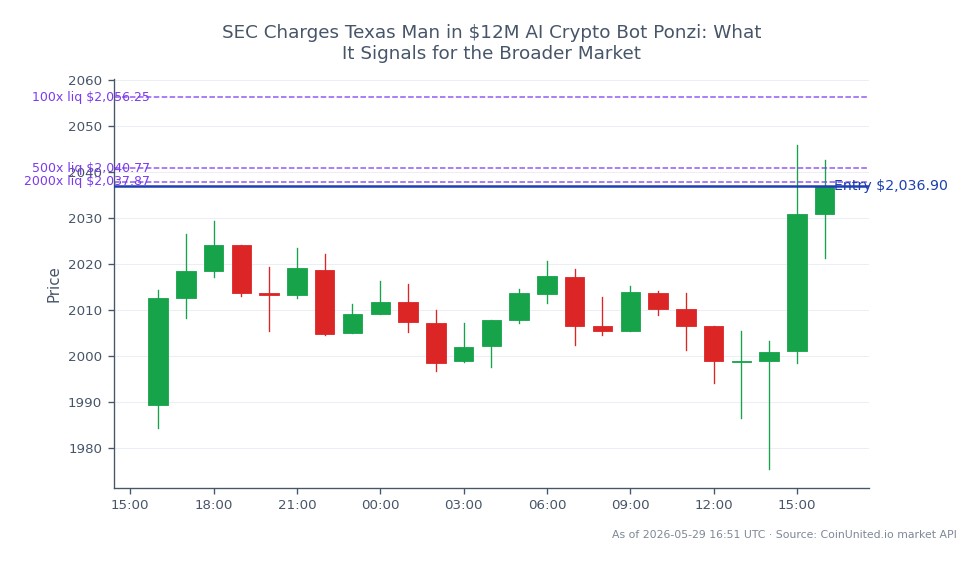
The U.S. Securities and Exchange Commission has filed suit in Texas federal court against Nathan Fuller, alleging he operated a $12 million Ponzi scheme disguised as an AI-powered crypto trading bot,
Event Analysis
The U.S. Securities and Exchange Commission has filed suit in Texas federal court against Nathan Fuller, alleging he operated a $12 million Ponzi scheme disguised as an AI-powered crypto trading bot, according to Law360. The scheme allegedly promised investors automated, largely risk-free returns generated by machine learning — a claim regulators say bore no resemblance to reality, with new investor capital simply used to pay earlier participants. The case sits within a broader crypto industry enforcement and accountability wave, alongside the Texas State Securities Board's emergency cease-and-desist against the TruthGPT Coin operation, which fabricated endorsements from Elon Musk and promised yields up to 2,000% per year.
What makes this enforcement cycle distinct from prior SEC crypto actions is the explicit targeting of "AI" as a marketing mechanism. Regulators are not merely pursuing yield fraud — they are systematically dismantling the narrative architecture that AI branding provides to fraudulent crypto products. The Texas State Securities Board, coordinating with Alabama, Montana, Kentucky, and New Jersey, demonstrates that this is a structured, multi-jurisdictional campaign rather than isolated enforcement. The global regulatory enforcement wave is increasingly converging on AI-crypto product intersections.
This matters beyond the $12 million headline figure. The DOJ has pursued multi-tens-of-millions crypto fraud cases resulting in extraditions, and the SEC has a documented history of escalating crypto Ponzi enforcement since the Bitcoin-era Trendon Shavers case. The current wave signals regulatory ratcheting: AI branding, algorithmic yield promises, and celebrity impersonation are now explicit red flags that trigger coordinated federal-state response. Traders and platforms operating in the cross-border enforcement repricing environment should treat this as a structural shift, not a one-off action.
What This Means for Traders
The direct price impact on Bitcoin and Ethereum is minimal — $12 million is negligible against their market depth. However, the enforcement signal carries asymmetric weight for AI-narrative altcoins and DeFi protocols marketing algorithmic or AI-driven yield strategies. Tokens whose value proposition centers on "AI trading," "ML price prediction," or outsized algorithmic returns now carry a measurable regulatory risk premium that the market has not yet fully priced. Sentiment tilts modestly risk-off for higher-beta, speculative crypto — particularly long-tail AI tokens — while BTC and ETH benefit from relative flight to perceived legitimacy. Traders can explore the 2026 Crypto Market Outlook for broader context on how enforcement cycles historically reshape altcoin relative value.
For medium-term positioning, repeated shutdowns of unregulated AI-crypto schemes can be constructive for regulated exchanges and compliant platforms, as displaced retail flow tends to migrate toward regulated on-ramps. The risk to watch is escalation: if the SEC bundles multiple AI-crypto cases into a thematic enforcement campaign analogous to the 2017-2019 ICO wave crackdown, expect sustained multiple compression across AI-narrative tokens and increased headline risk for any platform marketing AI-assisted trading features. Traders monitoring this theme should track further SEC and state securities board actions against AI-branded crypto products as leading indicators.
Start Trading on CoinUnited.io
Create Your Free Account → — Trade crypto, stocks, forex, indices, and commodities with up to 2000x leverage and zero fees.
Frequently Asked Questions
No — $12 million is too small to impact BTC or ETH market depth materially. The effect is sentiment-driven, with a modest risk-off tilt in speculative altcoins rather than crypto majors.
Continue Exploring
Disclaimer: This brief is for educational purposes only and is not investment advice.