Quick Links
South Korea's First DEX Rug-Pull Prosecution Sets Criminal Precedent for DeFi Fraud
Data Snapshot
Key Takeaways
- •South Korea's prosecution of the CATFI rug pull is the first criminal case applying the Virtual Asset User Protection Act to a DEX — extending enforcement from centralized to decentralized venues.
- •CATFI surged 1,001x in 26 hours via circular trading and fake influencer promotion before operators dumped; ~256 investors lost approximately $650,000 according to prosecutors.
- •On-chain anonymity is no longer a legal shield in South Korea — authorities demonstrated the ability to trace multi-wallet circular trading patterns and identify real-world suspects.
- •Incremental bearish sentiment for DeFi tokens and Solana's memecoin ecosystem in Korean markets; longer-term, credible anti-fraud enforcement is constructive for institutional crypto adoption.
- •Crypto influencers and KOLs promoting tokens without disclosure of financial interest now face explicit criminal risk in South Korea, raising compliance costs across the sector.
South Korean prosecutors have charged five individuals connected to CATFI, a Solana-based memecoin launched via Pump.fun, in what authorities are calling the first criminal prosecution of a decentrali
Event Analysis
South Korean prosecutors have charged five individuals connected to CATFI, a Solana-based memecoin launched via Pump.fun, in what authorities are calling the first criminal prosecution of a decentralized exchange rug pull under the country's Virtual Asset User Protection Act (effective July 2024). As reported by crypto.news and The Cryptonomist, the Seoul Southern District Prosecutors' Office — through its dedicated Joint Investigation Department for Virtual Asset Crimes — arrested and indicted the lead suspect, operating online as "Eth Father," along with co-conspirators. This marks only the second case brought under the Act overall, following an earlier market manipulation case on a centralized exchange.
The mechanics of the scheme underscore its calculated nature. According to reporting by Bankless Times, CATFI was seeded with approximately 10 million KRW (~$7,000–$8,000) and then pumped to a staggering 1,001x its launch price within 26 hours using multiple wallets, circular trading to fake liquidity, and coordinated false promotional posts — while the lead suspect publicly posed as an independent influencer. Roughly 6,000 buyers participated; 256 suffered confirmed losses totaling approximately 900 million KRW (~$650,000), while operators extracted around 400 million KRW (~$260,000) in illegal gains.
What distinguishes this case from prior crypto enforcement actions is the jurisdictional leap: Korean authorities have now demonstrated they can trace on-chain wallet structures, decode circular trading patterns on a DEX, and apply criminal fraud statutes to fully permissionless, on-chain activity. This feeds directly into the broader crypto enforcement accountability wave reshaping how regulators worldwide approach DeFi. The global regulatory enforcement wave is no longer confined to centralized intermediaries — it is reaching into the on-chain layer. For a deeper look at how enforcement actions reprice crypto assets across borders, see our cross-border enforcement repricing analysis.
What This Means for Traders
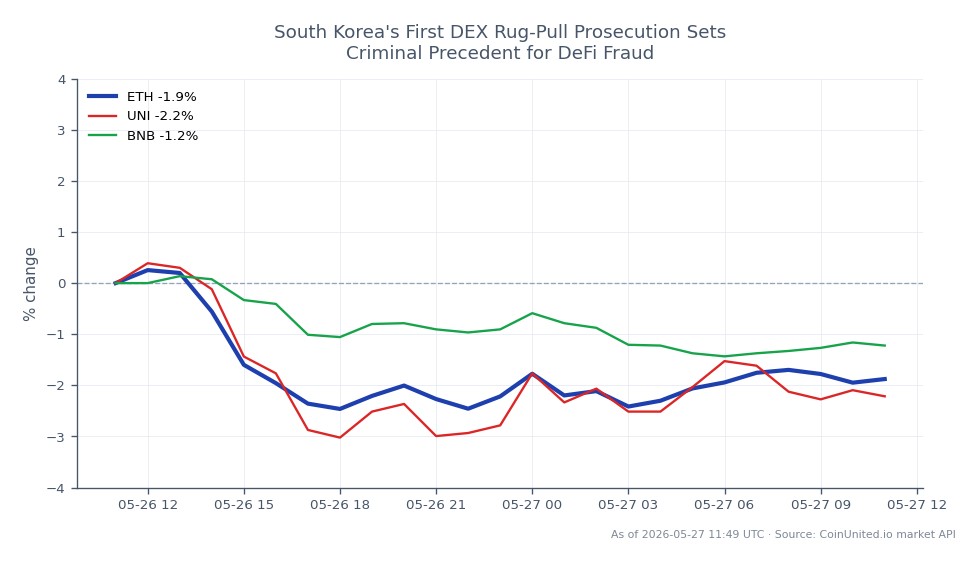
The direct price impact on major assets is limited — CATFI has no meaningful liquidity on established venues, and the absolute dollar figures involved are small. However, the regulatory risk repricing for DeFi-adjacent tokens is real and incremental. DEX governance tokens (such as Uniswap) and platforms with substantial Korean user bases may absorb mild sentiment headwinds if markets extrapolate a tightening enforcement posture across Asia. Ethereum and the broader DeFi ecosystem, already navigating the DeFi structural reset, now face an additional data point that on-chain anonymity does not confer legal anonymity in G20 markets.
For traders active in the memecoin and low-cap altcoin space, the signal is clearer: influencer-driven launch mechanics, wash trading to manufacture liquidity, and undisclosed token control are now explicitly prosecutable in a major Asian crypto market. Expect Korean-facing exchanges to tighten listing standards incrementally, and watch whether other APAC regulators adopt the "Virtual Asset User Protection" framing. The longer-term constructive read — consistent with our 2026 Crypto Market Outlook — is that credible fraud enforcement, focused on clear scams rather than blanket bans, improves institutional confidence in the sector over time.
Start Trading on CoinUnited.io
Create Your Free Account → — Trade crypto, stocks, forex, indices, and commodities with up to 2000x leverage and zero fees.
Frequently Asked Questions
The direct price impact on SOL is modest since this is a single small-cap enforcement case. However, it adds regulatory overhang to Solana's memecoin and DEX ecosystem, particularly for Korean users, which could weigh on DeFi volumes if enforcement intensifies.
Continue Exploring
Disclaimer: This brief is for educational purposes only and is not investment advice.