Quick Links
OFAC Sanctions Six Sinaloa Cartel ETH Addresses: Regulatory Overhang Builds for Leveraged ETH Traders
Data Snapshot
Key Takeaways
- •OFAC added six Ethereum addresses linked to the Sinaloa Cartel's fentanyl networks to the SDN list — a verified, on-the-record enforcement action, not speculation.
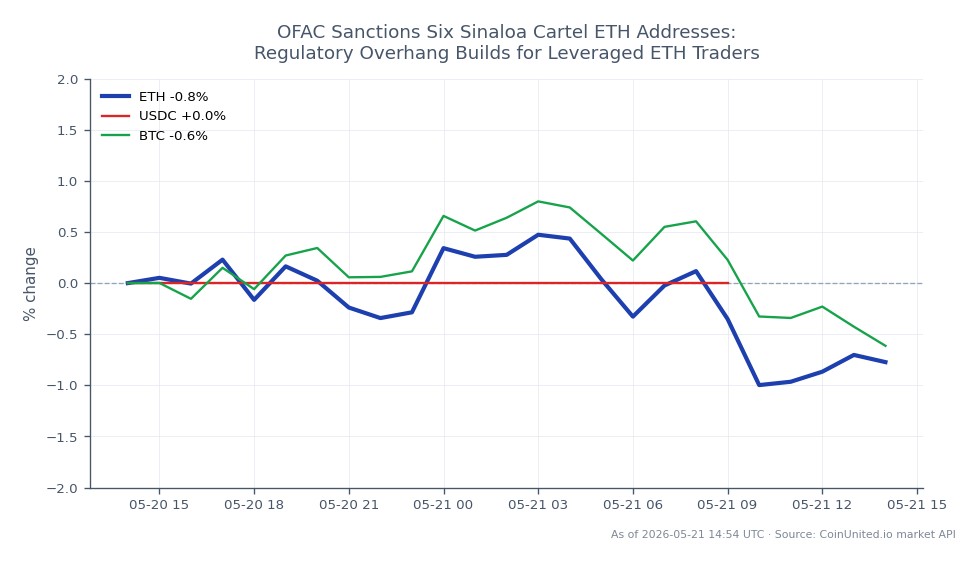
- •ETH is trading at $2,118.60 with minimal immediate reaction; targeted wallet sanctions rarely move major crypto prices unless a systemic actor is implicated.
- •Leverage-specific risk: 100x ETH longs opened at current price face liquidation on a ~1% move — intraday volatility ($52.90 range) already exceeds that threshold without any additional headline risk.
- •Cross-market: COIN and HOOD face incremental compliance cost headwinds; USDC must freeze SDN-listed addresses but is fundamentally unaffected; privacy coins and mixers face ongoing structural pressure.
- •The medium-term bearish case for ETH is regulatory overhang accumulation — each enforcement action strengthens the policy case for tighter KYC/AML rules and raises institutional tail risk perception.
As reported by MEXC and confirmed via U.S. Treasury OFAC primary sources, the U.S. Office of Foreign Assets Control has added six Ethereum addresses to its Specially Designated Nationals (SDN) list, l
Event Summary
As reported by MEXC and confirmed via U.S. Treasury OFAC primary sources, the U.S. Office of Foreign Assets Control has added six Ethereum addresses to its Specially Designated Nationals (SDN) list, linking them to the Sinaloa Cartel's fentanyl networks. Key operative Armando de Jesus Ojeda Aviles is named as converting bulk cash into crypto for the cartel. At least one address — `0x7CEd75026204aC29C34bEA98905D4C949F27361e` — is explicitly documented in OFAC material, with secondary sanctions risk cited under Section 11 of Executive Order 14024.
This action is part of a broader campaign: Treasury has now targeted over 290 individuals and entities tied to Sinaloa Cartel synthetic opioid operations. U.S. persons are prohibited from transacting with any listed addresses, and civil penalties apply on a strict-liability basis — meaning exchanges face enforcement risk even without intent. This sits squarely within the accelerating crypto enforcement and accountability wave reshaping how regulators treat on-chain activity.
Leverage Impact Analysis
ETH is trading at $2,118.60 (24h range: $2,103.84–$2,156.74, -0.06%) — largely unmoved by this headline, consistent with the research finding that targeted wallet sanctions rarely produce immediate price shocks unless a major liquidity provider or exchange is implicated.
For leveraged ETH perpetual traders on CoinUnited.io, the risk here is asymmetric and slow-burn rather than immediate:
- -A 100x long ETH position opened at $2,118.60 requires only a ~1% adverse move (~$21) to approach liquidation. With ETH's 24h range already spanning $52.90, intraday volatility alone creates meaningful liquidation risk — enforcement headlines can amplify short-term wicks.
- -A 20x long ETH has more buffer (~5% move to liquidation), but repeated regulatory headlines can compress funding rates and suppress recovery rallies.
- -Short-side positioning: Traders fading regulatory overhang via leveraged shorts should note that this event is incremental, not systemic — aggressive short leverage on this catalyst alone carries significant squeeze risk given ETH's recent institutional buying backdrop (per recent Bitmine treasury accumulation).
Monitor open interest and funding rates on CoinUnited.io for confirmation of any positioning shift. Check the crypto enforcement trader's guide for framework on sizing around enforcement events.
Cross-Market Impact
The direct macro spillover is negligible — no FX, commodity, or equity index impact is expected. However, the cross-border enforcement repricing narrative has targeted second-order effects:
- -COIN (Coinbase), HOOD (Robinhood): Compliance cost headwinds increase structurally. Each OFAC SDN expansion forces exchanges to update screening systems and absorb legal risk. This is a slow margin drag, not an acute shock.
- -USDC / Stablecoins: Stablecoin issuers operating under U.S. jurisdiction (Circle for USDC) must freeze any SDN-listed addresses. This reinforces the regulated stablecoin vs. permissionless DeFi divide — net neutral for USDC itself but adds friction to open DeFi flows.
- -Bitcoin: BTC faces the same long-run regulatory overhang narrative but is not directly implicated here. Correlation to ETH on regulatory sentiment remains high.
- -Privacy coins / mixers: Each ETH-address sanctions action incrementally pressures XMR, ZEC, and cross-chain bridge valuations — reinforcing the global regulatory enforcement wave.
Trading Considerations
ETH's $2,103.84 24h low represents immediate short-term support; the $2,156.74 high is near-term resistance. This event alone is unlikely to break either level — position sizing should reflect that. The medium-term risk is a regulatory premium being baked into ETH valuations as the crypto regulatory and tax reckoning intensifies, particularly if future OFAC actions target DeFi front-ends or validators.
Watch for: (1) any OFAC action naming a major exchange or DeFi protocol — that would be a material catalyst; (2) Congressional hearings referencing this action in stablecoin or crypto market structure bills; (3) ETH funding rates turning persistently negative as a signal of leveraged sentiment shift.
Trade Ethereum on CoinUnited.io
Trade ETH with up to 2000xx leverage → | Create Free Account
Frequently Asked Questions
Not directly — ETH moved only -0.06% on the news. However, 100x long ETH perpetuals opened near $2,118.60 have a liquidation threshold roughly $21 away, meaning any regulatory-driven volatility spike could trigger forced exits even on incremental headlines.
Continue Exploring
Disclaimer: This brief is for educational purposes only and is not investment advice.