Quick Links
OFAC Sanctions Iran's Nobitex: What the Crypto Enforcement Escalation Means for Leveraged Traders
Data Snapshot
Key Takeaways
- •OFAC designated Nobitex (11M users, >50% of Iran's 2025 digital asset inflows) and three other Iranian exchanges, citing IRGC financing and sanctions evasion.
- •Secondary sanctions exposure is the key transmission mechanism — global exchanges and OTC desks must aggressively screen Nobitex-linked wallets or face U.S. correspondent banking loss.
- •Leveraged BTC/ETH longs above 50x face heightened liquidation risk from enforcement-driven sentiment spikes; funding rates may skew negative — monitor before sizing.
- •Brent crude carries a modest incremental Iran risk premium as Treasury tightens all financial vectors, including crypto-oil proceeds recycling channels.
- •Compliant CEXs (COIN) and stablecoin issuers (USDT blacklisting) face short-term headline noise but medium-term structural benefit from regulatory moat widening.
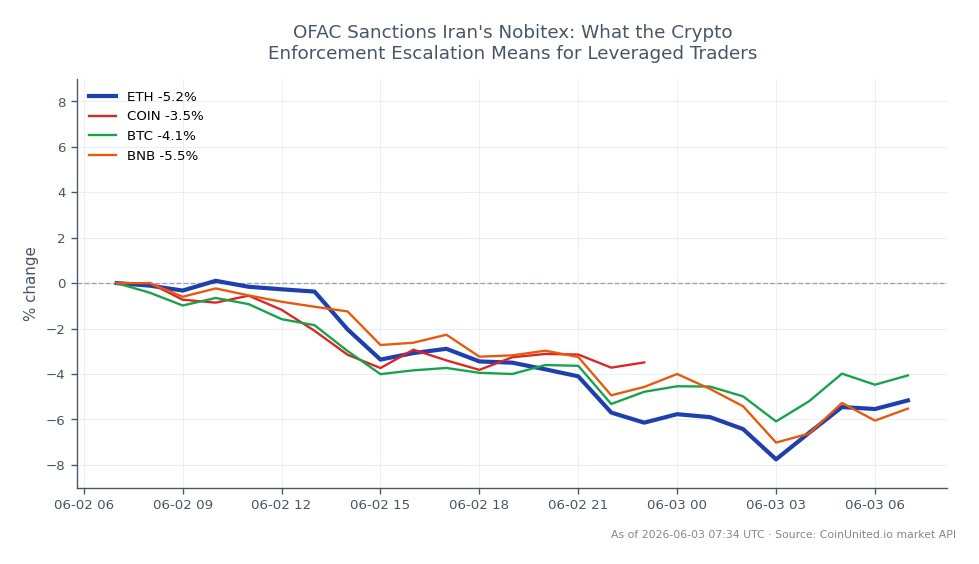
The U.S. Department of the Treasury's Office of Foreign Assets Control (OFAC) has designated Nobitex — Iran's largest cryptocurrency exchange with over 11 million users — along with exchanges Wallex,
Event Summary
The U.S. Department of the Treasury's Office of Foreign Assets Control (OFAC) has designated Nobitex — Iran's largest cryptocurrency exchange with over 11 million users — along with exchanges Wallex, Bitpin, and Ramzinex, and several executives including CEO Amir Hossein Rad. According to Treasury, Nobitex processed more than 50% of Iranian digital asset inflows in 2025, handling significant volumes in Bitcoin, Tether (USDT), and other assets while providing "significant support" to the IRGC and Central Bank of Iran.
As reported by Reuters (whose prior investigation was explicitly cited by Treasury), Nobitex operated as a critical node in Iran's parallel financial system — continuing to move regime assets even during wartime internet blackouts. The action blocks any U.S.-jurisdiction assets, bans U.S. persons from transacting with designated entities, and critically, exposes foreign financial institutions to secondary sanctions for facilitating these flows.
Leverage Impact Analysis
This event falls into the crypto enforcement accountability wave pattern: enforcement headlines compress sentiment, spike short-term implied volatility, and can trigger cascading liquidations in thin overnight markets — especially on high-leverage positions.
Consider a trader holding a 100x long BTC perpetual entered near recent highs. A 1% adverse move equals 100% of margin. Enforcement-driven sentiment spikes historically generate 2–4% BTC drawdowns within hours of breaking headlines. At 100x, that translates to full liquidation on a 1% move against the position. Traders running >50x leverage on BTC or ETH should note that funding rates may shift negative (bearish skew) as short interest rises on regulatory headlines — check live funding rates on CoinUnited.io before sizing positions.
For Ethereum leveraged longs, the DeFi compliance angle adds a secondary risk layer: stablecoin freezes and wallet blacklisting can temporarily reduce on-chain liquidity, widening spreads and increasing slippage risk for leveraged unwinds.
Cross-Market Impact
The cross-border enforcement repricing channel extends well beyond crypto spot markets:
- -COIN (Coinbase) CFDs: Repeated crypto-sanctions headlines reinforce the compliance moat narrative for regulated exchanges but can weigh on near-term sentiment. The Coinbase stock CFD may face headline-driven volatility; a 50x long COIN CFD opened near recent levels would require close stop management given crypto regulatory noise.
- -Oil / Brent Crude: Treasury's action is part of a broader financial squeeze on Iran, including sanctions on Iranian oil sales. This incrementally supports the Iran geopolitical risk premium in Brent crude, particularly if interpreted as part of an escalation path. Monitor the Hormuz Strait energy supply shock theme for tail-risk scenarios.
- -BNB: Secondary sanctions risk raises compliance costs across all global CEXs. Exchanges with lighter regulatory frameworks face heightened scrutiny — a mild bearish overhang for exchange tokens.
- -Stablecoins: Expect accelerated USDT address blacklisting. This is structurally relevant to the institutional stablecoin buildout thesis — compliant issuers benefit from demonstrated enforcement, while offshore alternatives face elevated risk.
This is part of the broader global regulatory enforcement wave — directional crypto impact is modest, but regulatory risk premium persists.
Trading Considerations
The immediate tradeable signal is elevated volatility risk, not a strong directional move. BTC and ETH macro trends are driven by institutional flows and macro liquidity — Nobitex's disruption is regionally significant but not a systemic liquidity event for global crypto markets. Key levels to monitor: any breakdown in BTC below near-term support coinciding with further OFAC enforcement headlines would amplify selling pressure through liquidation cascades. Watch open interest on BTC and ETH perpetuals for signs of leveraged long buildup that could be at risk.
For oil, a sustained move higher in Brent on Iran risk premium requires corroborating signals — additional sanctions on Iranian shipping or energy exports would be the catalyst to watch.
Start Trading on CoinUnited.io
Create Your Free Account → — Trade crypto, stocks, forex, indices, and commodities with up to 2000x leverage and zero fees.
Frequently Asked Questions
Enforcement headlines typically generate 2–4% short-term BTC/ETH volatility, which at 50–100x leverage can mean margin calls within hours. Reduce position size or widen stops ahead of any follow-on OFAC announcements, and check live funding rates for bearish skew signals.
Continue Exploring
Disclaimer: This brief is for educational purposes only and is not investment advice.