Quick Links
US Sanctions Iran's Largest Crypto Exchange: Leverage Exposure & Cross-Market Fallout
Key Takeaways
- •OFAC has sanctioned Iran's largest crypto exchange for IRGC links, triggering secondary sanctions risk for any entity maintaining exposure — a hard stop for US-person interaction.
- •Leveraged long positions (50x+) on BTC and ETH face elevated liquidation risk during the initial 2–6 hour volatility window; reduce sizing or widen stops until contagion scope is confirmed.
- •Crypto-proxy stocks COIN and BNB face sentiment drag from compliance cost concerns and potential guilt-by-association headlines.
- •Iran sanctions events historically inject a modest oil risk premium — watch Brent crude for secondary commodity spillover if US-Iran tensions are perceived to be escalating.
- •This action fits the established cross-border enforcement repricing pattern: volatility typically compresses within 24–48 hours if no major global exchange exposure is confirmed.
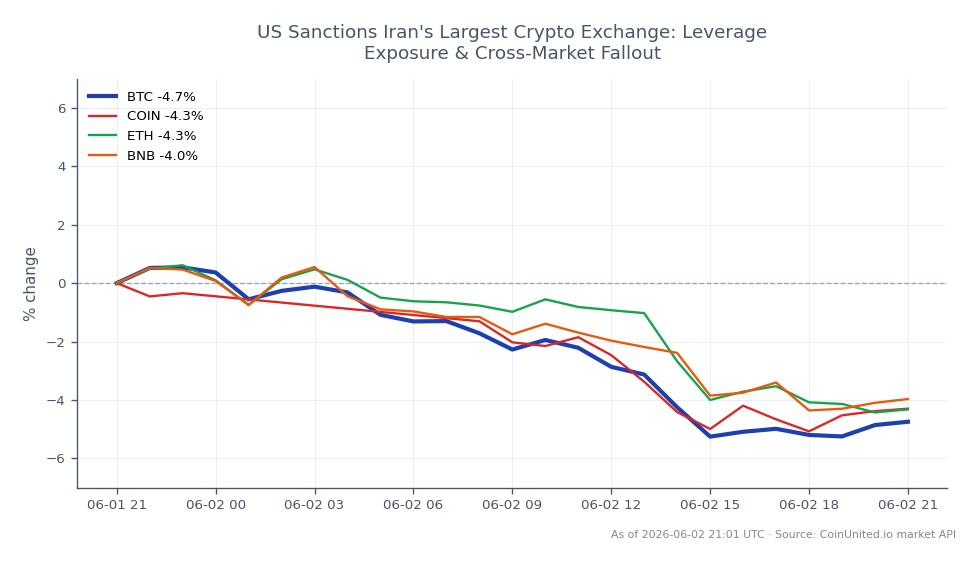
The United States government has sanctioned Iran's largest cryptocurrency exchange, citing links to the Islamic Revolutionary Guard Corps (IRGC). The action, coordinated through the US Treasury's Offi
Event Summary
The United States government has sanctioned Iran's largest cryptocurrency exchange, citing links to the Islamic Revolutionary Guard Corps (IRGC). The action, coordinated through the US Treasury's Office of Foreign Assets Control (OFAC), targets the exchange's role in facilitating transactions that allegedly circumvent international financial restrictions and fund IRGC-linked operations. This follows an established pattern within the broader crypto enforcement accountability wave — OFAC has previously sanctioned Garantex (Russia) and Tornado Cash in similar cross-border enforcement actions.
The designation effectively freezes any US-person interaction with the exchange and its identified wallets, and triggers secondary sanctions risk for any non-US entity continuing to transact with the platform. As part of the global regulatory enforcement wave, this action signals that US authorities remain willing to use financial warfare tools against crypto infrastructure tied to adversarial state actors.
Leverage Impact Analysis
Sanctions events targeting crypto infrastructure typically generate a sharp, short-duration volatility spike — most acute in the 2–6 hours following the announcement — before markets reprice based on actual contagion scope. For leveraged traders on Bitcoin and Ethereum, this creates a two-sided risk window.
High-leverage long positions are exposed to the initial sentiment shock. A trader holding a 100x BTC long sees a 1% adverse move translate to a 100% margin loss — meaning even a brief dip driven by headline fear can trigger liquidation before any recovery. Conversely, traders entering short positions post-announcement risk rapid reversal if the market determines contagion is limited to Iranian users, not global liquidity.
The more significant leverage risk here is indirect: if sanctioned wallets hold or liquidate large BTC or stablecoin positions, forced on-chain selling could compress spot prices momentarily, cascading into leveraged liquidations across exchanges. Monitor open interest and funding rates on CoinUnited.io for real-time confirmation of directional pressure. Given the cross-border enforcement repricing pattern, post-sanction volatility tends to compress within 24–48 hours absent secondary exchange exposure.
Cross-Market Impact
Crypto-proxy stocks: Coinbase Global (COIN) faces sentiment drag — any regulatory escalation raises compliance cost fears for US-listed crypto firms. Binance Coin (BNB) warrants monitoring given Binance's historical exposure to OFAC compliance scrutiny.
Commodities: Iran sanctions events historically correlate with oil price sensitivity via Hormuz Strait supply risk. Brent crude and WTI may see a modest risk-premium bid if markets interpret this as broader US-Iran tension escalation. Traders can reference the Iran conflict energy markets guide for the macro framework.
Forex/DXY: USD typically strengthens modestly on geopolitical enforcement actions as risk-off flows dominate short-term. This is marginal but relevant for crypto/USD pairs.
Limited equity index spillover: Unless this escalates into broader Iran-US tension, S&P 500 and NASDAQ impact is expected to be minimal and confined to crypto-adjacent names.
Trading Considerations
The key risk factor is secondary contagion scope — whether any major global exchange or liquidity provider has material exposure to the sanctioned entity. Until that is confirmed or denied, uncertainty creates elevated volatility risk unsuitable for maximum leverage positions. Reduce position sizing or widen stop-loss buffers during the initial 6-hour post-announcement window.
Watch on-chain wallet flow data and any Treasury follow-up designations for additional named entities. The crypto exchange legal enforcement surge theme suggests further actions in this cycle remain probable, making risk management discipline — not directional conviction — the priority posture.
Start Trading on CoinUnited.io
Create Your Free Account → — Trade crypto, stocks, forex, indices, and commodities with up to 2000x leverage and zero fees.
Frequently Asked Questions
Sanctions announcements generate short-duration sentiment shocks that can move prices 1–3% within hours — at 100x leverage, a 1% move equals full margin loss, so high-leverage longs are at acute liquidation risk in the initial window. Reduce leverage or use tighter stops until market direction stabilizes.
Continue Exploring
Disclaimer: This brief is for educational purposes only and is not investment advice.