Quick Links
US Sanctions Nobitex & Iranian Crypto Exchanges: Leverage Risks in the Global Regulatory Enforcement Wave
Key Takeaways
- •OFAC's sanctioning of Nobitex is part of an accelerating global regulatory enforcement wave — not a one-off event — meaning persistent headline volatility risk for crypto leveraged positions.
- •Leverage warning: A 100x BTC long requires only a 1% adverse move to face liquidation; regulatory-linked headlines historically produce 2–5% BTC intraday swings.
- •USDC flows touching sanctioned addresses can be frozen by Circle's compliance layer — a structural differentiator from less-regulated stablecoins.
- •Secondary commodity signal: Iranian sanctions actions historically correlate with Brent crude volatility; monitor Hormuz Strait risk escalation as a follow-on catalyst.
- •Compliant centralized exchanges and regulated markets may ultimately benefit as gray-market crypto corridors are shut down — watch for capital rotation into regulated venues.
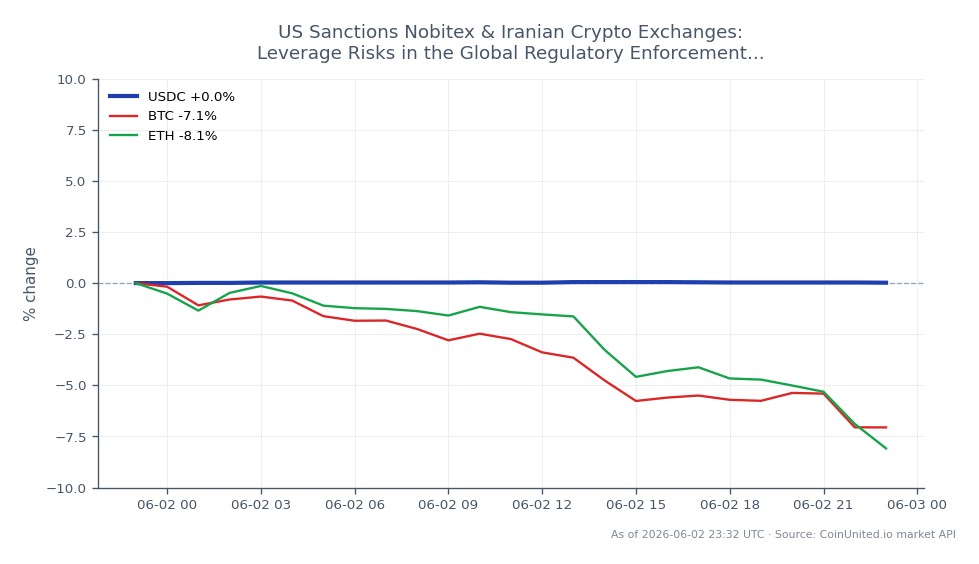
The US Treasury's Office of Foreign Assets Control (OFAC) has sanctioned Nobitex and other Iranian cryptocurrency exchanges as part of a broader 'Economic Fury' campaign targeting Iran's financial inf
Event Summary
The US Treasury's Office of Foreign Assets Control (OFAC) has sanctioned Nobitex and other Iranian cryptocurrency exchanges as part of a broader 'Economic Fury' campaign targeting Iran's financial infrastructure. Nobitex is Iran's largest domestic crypto exchange and has previously been flagged for facilitating transactions that allegedly circumvent US sanctions. The action designates these platforms as Specially Designated Nationals (SDNs), effectively blocking any US persons or entities from transacting with them and freezing any US-held assets.
This enforcement action fits squarely within the global regulatory enforcement wave and the broader pattern of cross-border enforcement repricing that has been tightening around crypto's gray-market corridors throughout 2025–2026.
Leverage Impact Analysis
Sanctions events of this type create asymmetric volatility spikes — often brief but sharp — that are especially dangerous for high-leverage crypto positions. The key risk is not a structural market break, but a sudden wick-driven liquidation cascade.
Consider a trader holding a 100x long BTC perpetual position: even a 1% adverse move equals a 100% margin loss, triggering liquidation. Sanctions-linked headlines historically produce 2–5% intraday BTC swings as market participants reprice compliance risk and potential exchange access disruptions. A 50x long ETH position faces similar vulnerability — a 2% drop would wipe 100% of margin.
The crypto regulatory & tax reckoning theme suggests these enforcement actions are becoming more frequent, meaning leveraged traders must treat regulatory headline risk as a persistent volatility input, not a one-off event. Monitor funding rates on CoinUnited.io for confirmation — elevated positive funding during a regulatory scare signals overleveraged longs vulnerable to a flush.
Cross-Market Impact
Bitcoin & Ethereum: BTC and ETH face short-term sentiment pressure as sanctions remind markets that state-level enforcement can restrict exchange liquidity. Historically, OFAC crypto actions cause brief dips (1–4%) before recovering if the action is geographically contained.
USDC & Stablecoins: USDC is directly relevant here — Circle's compliance infrastructure means USDC flows touching sanctioned addresses can be frozen. This reinforces USDC's regulatory robustness for compliant users but flags counterparty risk for any trader using non-KYC rails. See our institutional stablecoins guide for deeper context.
Oil & Commodities: Iranian sanctions actions have historically correlated with Brent crude volatility, given Iran's role as a marginal OPEC+ supplier. Traders should monitor Hormuz Strait supply risk as a secondary signal — an escalation beyond financial sanctions into energy could shift Oil CFDs sharply.
Forex (DXY): Mild USD-positive as sanctions reinforce dollar hegemony in global settlement. No major DXY move expected from this specific action alone.
Trading Considerations
Key levels to watch on BTC: any break below near-term support zones on elevated volume could signal that regulatory fear is catalyzing broader deleveraging — check open interest for confirmation. For ETH, watch whether the dip attracts institutional buy-the-dip behavior consistent with the crypto enforcement accountability pattern where compliant markets ultimately benefit from gray-market crackdowns.
Risk factor: If the 'Economic Fury' campaign expands to target additional exchanges or OTC desks with wider market exposure, volatility persistence increases materially beyond the current 0.68 persistence score.
Start Trading on CoinUnited.io
Create Your Free Account → — Trade crypto, stocks, forex, indices, and commodities with up to 2000x leverage and zero fees.
Frequently Asked Questions
Regulatory headline events like this typically trigger 2–5% intraday crypto volatility spikes, which can wipe 100%+ margin on positions above 50x leverage. Reduce position size or widen stop buffers during active regulatory news cycles.
Continue Exploring
Disclaimer: This brief is for educational purposes only and is not investment advice.