Quick Links
Kiwibank Warning: RBNZ's Oil-Inflation Dilemma Puts NZD/USD Leverage Traders on High Alert
Data Snapshot
Key Takeaways
- •RBNZ holds OCR at 2.25% but faces conditional hawkish pressure as CPI risks exceeding 4% on oil shock — policy language is the next binary catalyst.
- •Leverage traders on NZD/USD must size carefully: at 100x, a 0.59% adverse move triggers liquidation — well within realistic range given RBNZ meeting volatility.
- •Oil trajectory (USD 100 vs. USD 130/bbl) is the primary macro variable — it directly determines whether RBNZ 'looks through' inflation or pivots hawkish.
- •Cross-market read-through: AUD/USD and Gold are co-indicators — AUD weakness confirms APAC stagflation risk-off; Gold strength confirms inflation hedge rotation.
- •New Zealand's net oil-importing status means an oil shock is a negative terms-of-trade event for NZD regardless of rate direction, creating medium-term downside bias.
Kiwibank has issued a pointed warning that the Reserve Bank of New Zealand risks "crushing an already weakened economy" in its effort to contain oil-driven inflation. As reported across multiple macro
Event Summary
Kiwibank has issued a pointed warning that the Reserve Bank of New Zealand risks "crushing an already weakened economy" in its effort to contain oil-driven inflation. As reported across multiple macro previews and policy trackers, the RBNZ is currently holding its Official Cash Rate (OCR) at 2.25%, while headline CPI is expected to exceed 4% by mid-year — with oil scenarios near USD 130/bbl potentially pushing inflation closer to 5%, according to investinglive.com.
The RBNZ's stated strategy is to "look through" the initial oil-driven spike, focusing instead on whether second-round effects (wages, broad price-setting) emerge. However, RBNZ has explicitly warned it may need "decisive and timely" OCR increases if inflation expectations drift — a hawkish conditional that markets are now actively pricing, per mpamag.com. With economic recovery pushed into 2027 and spare capacity persisting, this is a classic macro inflation risk-off repricing setup in a fragile small open economy.
Leverage Impact Analysis
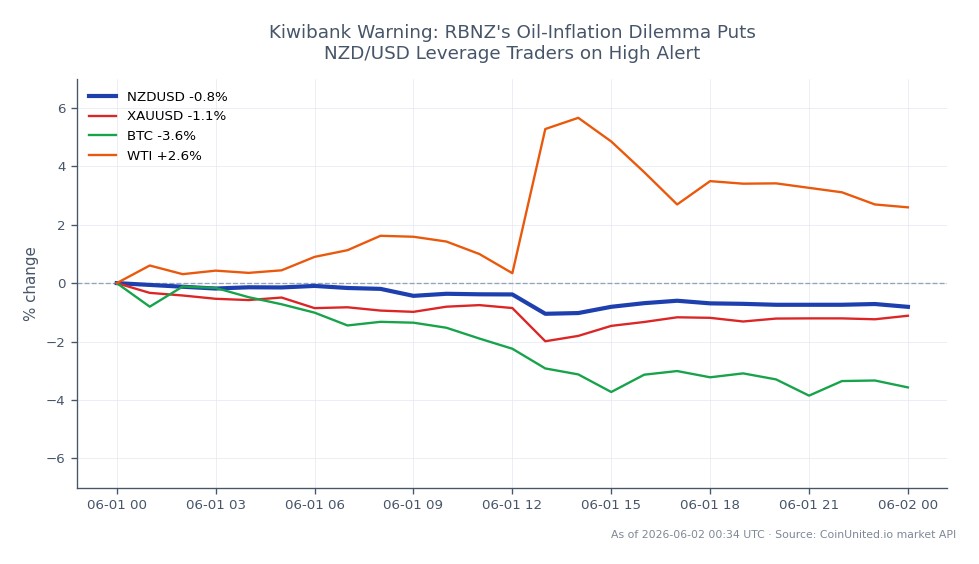
NZD/USD is trading at $0.5929 (24h range: $0.5928–$0.5936), reflecting subdued volatility but elevated policy sensitivity. This tightly compressed range masks a binary risk: a hawkish RBNZ pivot could spike NZD sharply, while a policy-mistake narrative accelerates NZD weakness.
Long NZD/USD scenario: A trader with 100x leverage long at $0.5929 faces liquidation if NZD/USD drops roughly 0.59% to approximately $0.5894 (assuming 1% margin). Given the bearish growth outlook and oil shock, this is a realistic intraday move around RBNZ communications.
Short NZD/USD scenario: A 100x short at $0.5929 faces liquidation near $0.5988 — a level that could be tested quickly if RBNZ rhetoric shifts more hawkish than expected, triggering a short squeeze. At 200x leverage, liquidation bands compress to just ±0.30%, meaning even routine statement language can force exits. Traders should size conservatively and monitor OCR OIS pricing closely — any move from "hold through 2026" to "earlier hikes" is the trigger event. This is precisely the type of APAC currency inflation supply shock dynamic where position sizing discipline is paramount.
Cross-Market Impact
AUD/USD: As a fellow commodity-linked, oil-importing APAC currency, the Australian Dollar faces parallel stagflation pressures. NZD weakness tends to drag AUD, though Australia's LNG export profile offers a partial offset versus New Zealand's pure import exposure.
Gold: Risk-off repricing and inflation persistence are classically supportive for Gold. If Kiwibank's policy-mistake narrative gains traction globally, a flight to inflation hedges accelerates — watch Gold as a confirmation signal.
WTI Crude: The entire scenario is oil-contingent. WTI holding or pushing through the USD 100–130/bbl range referenced in macro commentary would materially shift RBNZ's reaction function and extend NZD downside. Traders following the Hormuz Strait energy supply shock theme should treat oil trajectory as the lead indicator.
S&P 500 / Bitcoin: Second-order risk-off effects could spill into the S&P 500 and Bitcoin if RBNZ overtightening becomes a template narrative for other central banks, suppressing global risk appetite.
Trading Considerations
NZD/USD's 24h range of just 8 pips ($0.5928–$0.5936) signals that markets are in a holding pattern ahead of the next RBNZ Monetary Policy Statement. The critical levels to watch are $0.5880 (downside if policy-mistake narrative gains traction) and $0.5970–$0.6000 (resistance if hawkish repricing supports NZD). Oil price trajectory relative to USD 100 vs. USD 130/bbl scenarios is the primary macro input — track this alongside OIS-implied OCR pricing for directional conviction. For deeper APAC stagflation context, the Iran Conflict & APAC Stagflation guide provides useful macro framing.
Trade New Zealand Dollar / US Dollar on CoinUnited.io
Trade NZDUSD with up to 2000xx leverage → | Create Free Account
Frequently Asked Questions
RBNZ policy statements can move NZD/USD 0.5–1.5% within minutes of release. At 100x leverage, a 0.6% move against your position triggers liquidation — traders should either reduce leverage significantly or use tight stop-losses placed outside the anticipated volatility range.
Continue Exploring
Disclaimer: This brief is for educational purposes only and is not investment advice.