Quick Links
RBNZ Hold, Softer Oz CPI, BoJ Spadework: Asia-Pac Triple Play Reshapes NZD, AUD & JPY Leverage Setups
Data Snapshot
Key Takeaways
- •RBNZ held OCR at 2.25% for a third consecutive meeting — conditional tightening language limits NZD upside; NZDUSD 24h range $0.5836–$0.5879 defines immediate structure.
- •Softer Australian headline CPI shifts RBA pricing dovishly — AUD-negative vs USD and JPY; AUDNZD direction depends on relative central bank surprise magnitude.
- •BoJ 'spadework' is the highest leverage risk: 100x short USDJPY positions face liquidation from a ~1% JPY strengthening move if intervention language escalates.
- •Cross-market: Oz disinflation read is modestly supportive for rate-sensitive equities (ASX, NASDAQ); Gold and BTC face no direct catalyst but monitor global risk-appetite shifts.
- •All three events broke during the Asia session — CoinUnited's 24/7 forex trading provided immediate entry access before London/NY session reaction windows opened.
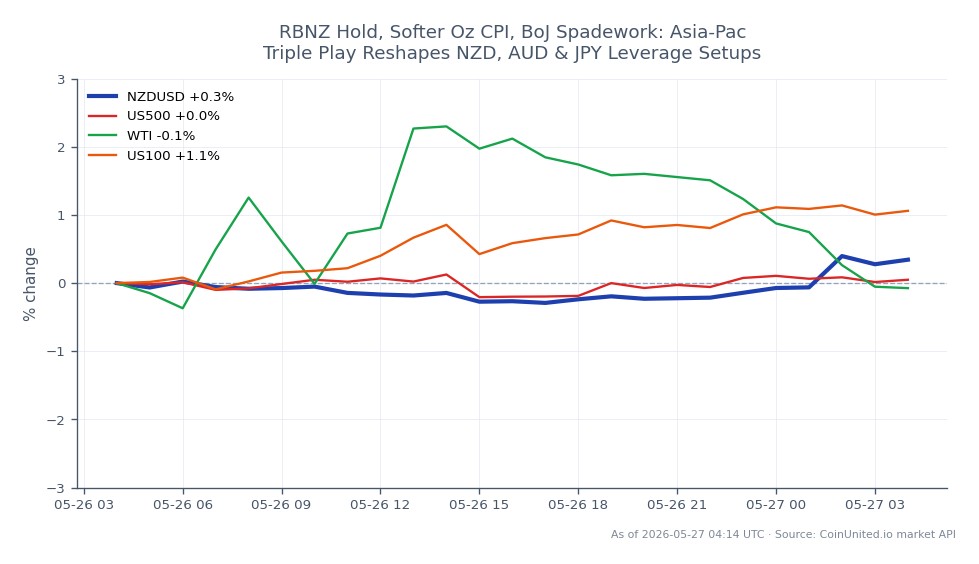
Three macro events hit Asia-Pacific markets in rapid succession. According to Investing.com's Asia FX wrap, the Reserve Bank of New Zealand held its Official Cash Rate unchanged at 2.25% for a third c
Event Summary
Three macro events hit Asia-Pacific markets in rapid succession. According to Investing.com's Asia FX wrap, the Reserve Bank of New Zealand held its Official Cash Rate unchanged at 2.25% for a third consecutive meeting — in line with consensus — but Governor commentary maintained a conditional tightening bias, stating rate hikes would follow decisively if core inflation rises. Separately, Australian headline CPI printed softer than expected, shifting RBA rate-path pricing in a dovish direction. Completing the trifecta, the Bank of Japan conducted preparatory communications ("spadework") signaling readiness to tighten if medium-term inflation firms, raising intervention risk for JPY pairs.
NZD/USD is trading at $0.5869 (+0.57%), with a 24h range of $0.5836–$0.5879, suggesting markets are still digesting the net directional signal from these three overlapping central bank events.
Leverage Impact Analysis
With NZDUSD at $0.5869, leveraged NZD positions face asymmetric risk from the RBNZ's conditional guidance. The RBNZ hold was priced, but traders positioned for a hawkish tilt face immediate squeeze — a 100x long NZDUSD opened at $0.5870 sees only ~$0.0009 of upside to the 24h high before facing resistance, while a move back to the 24h low at $0.5836 would generate a ~0.56% adverse move — sufficient to liquidate positions with insufficient margin buffer at extreme leverage.
For AUD/USD traders, the softer Oz CPI is a negative impulse. A 50x short AUDUSD trade gains if AUD weakens on dovish RBA repricing, but position sizing must account for the competing AUDNZD dynamic: if the RBNZ is relatively more dovish than the RBA, AUD could outperform NZD even as both weaken versus USD and JPY. Monitor funding rates on CoinUnited.io for confirmation of directional positioning bias.
BoJ spadework is the sharpest tail risk for USD/JPY leverage traders. A 100x short USDJPY is acutely exposed to intervention language — a 1% JPY strengthening move (roughly 150 pips at current levels) could liquidate positions with under 1% margin. Traders following our Japanese yen intervention guide will recognize this as a classic pre-intervention communication phase. As this news hit during the Asia session, CoinUnited's 24/7 forex trading allowed immediate positioning before any London or NY session reaction.
Cross-Market Impact
The macro inflation pressure narrative shifts modestly dovish for AUD and neutral-to-hawkish for NZD and JPY. For equities, softer Oz CPI is supportive for rate-sensitive ASX sectors (REITs, utilities, high-duration tech), with positive spillover to NASDAQ 100 if the global disinflation read gains traction. BoJ normalization signals, however, pressure Nikkei exporters via JPY strength risk.
Gold faces mixed inputs: a stronger JPY and softer regional inflation data can reduce the urgency of inflation hedging, while global real-rate recalibration is marginal without a Fed signal. Bitcoin has no direct link here — impact is limited to second-order risk-appetite shifts from Asia-Pacific equity repricing. For a deeper framework on how CPI data flows into trading decisions across asset classes, see our CPI inflation trading guide.
Trading Considerations
For NZDUSD, the 24h range ($0.5836–$0.5879) defines the immediate structure. A confirmed hold above $0.5856 (mid-range) with no incremental dovish RBNZ commentary would support the current +0.57% bid. AUDNZD is the relative-value vehicle to watch: yield-spread dynamics favor AUDNZD upside if the RBNZ is read as less hawkish than the RBA baseline, as detailed in our AUD/USD trading guide.
For USDJPY, the key risk is escalating BoJ language around "excessive" or "one-sided" moves — classic triggers for intervention or formal policy signaling per our USD/JPY strategy guide. Watch open interest on JPY pairs for confirmation of positioning crowding.
Trade New Zealand Dollar / US Dollar on CoinUnited.io
Trade NZDUSD with up to 2000xx leverage → | Create Free Account
Frequently Asked Questions
The hold was consensus, so directional impact depends on whether the conditional tightening tone is read as more or less hawkish than OIS pricing — NZD/USD's narrow 24h range ($0.5836–$0.5879) reflects this uncertainty. Positions above 100x leverage have less than 0.6% buffer before hitting the 24h range extremes.
Continue Exploring
Disclaimer: This brief is for educational purposes only and is not investment advice.