Quick Links
Saylor's 411 BTC Transfer to Coinbase Prime: Treasury Model Cracks — Leverage Liquidation Zones & Cross-Market Impact
Data Snapshot
Key Takeaways
- •Strategy transferred 411.48 BTC (~$30.3M) to Coinbase Prime on May 29, operationally consistent with Saylor's Q1 guidance that BTC may be sold for dividends, debt service, or cash needs.
- •Leveraged BTC long traders face asymmetric headline risk: even a 3–5% drawdown triggered by 'Saylor selling' narrative can liquidate 50x+ positions — monitor on-chain flows for repeat tranches.
- •MSTR's NAV premium faces structural compression as the 'permanent HODL' valuation model weakens; MSTR CFDs currently trading at $159.59 with key support at $148.21.
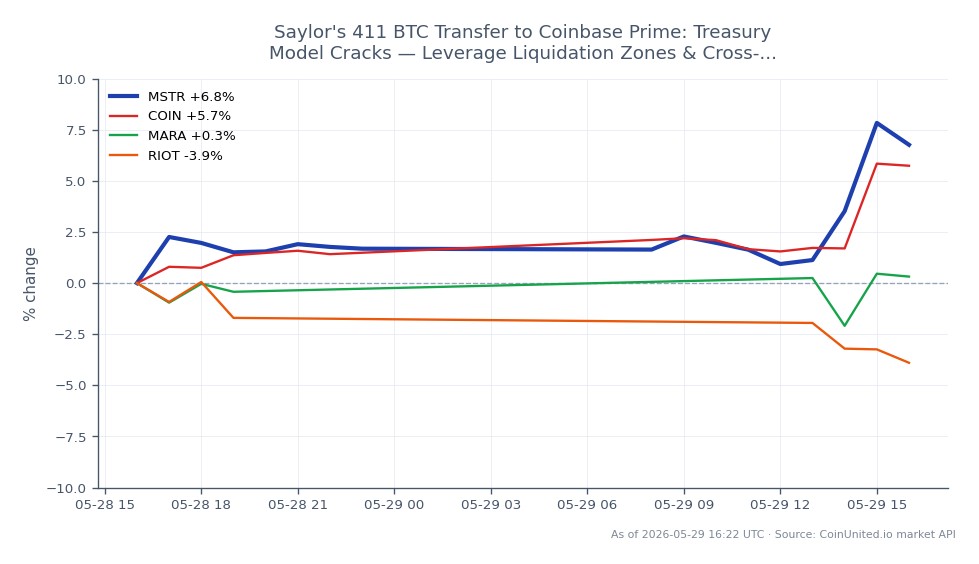
- •Cross-market: Coinbase (COIN) is a relative beneficiary as the receiving venue and a credible contrast to Strategy's model; miner stocks (MARA, RIOT) face dual pressure from BTC sentiment drag.
- •Macro spillover to FX, commodities, and broad indices is negligible at this transfer size — this remains a crypto equity narrative event.
As reported by Intellectia AI and corroborated by on-chain tracking services, Strategy transferred 411.48 BTC (~$30.3M) to Coinbase Prime on May 29 — a sell-enabled institutional venue, not cold stora
Event Summary
As reported by Intellectia AI and corroborated by on-chain tracking services, Strategy transferred 411.48 BTC (~$30.3M) to Coinbase Prime on May 29 — a sell-enabled institutional venue, not cold storage. The move follows Michael Saylor's explicit Q1 earnings call admission (May 5) that Strategy "may sell some Bitcoin if it helps the company" after recording a $12.54B net loss while holding 818,334 BTC, per Cryptopolitan.
This marks a structural break from Saylor's historically maximalist never-sell stance. Management has reframed BTC as a monetizable corporate asset — potentially liquidated for dividends, debt service, or cash flow needs — rather than a sacred reserve. Notably, as reported by Binance Square, Coinbase itself evaluated and rejected an aggressive Saylor-style BTC treasury strategy, citing cash flow and stability risks, making this contrast particularly sharp.
Leverage Impact Analysis
The 411 BTC transfer is small (~0.05% of Strategy's stack), but the directional signal is what matters for leveraged positions. This event creates asymmetric risk for high-leverage BTC longs.
Worked example — leveraged BTC long: A trader with 50x long BTC perpetuals opened at $73,800 (recent cycle low) now faces increased headline risk. If the "Saylor selling" narrative triggers even a 3–5% BTC drawdown, a 50x position requires only a 2% adverse move to approach margin thresholds. At 100x leverage, the liquidation buffer shrinks to roughly $738 per BTC move.
Key risk: If on-chain monitors detect repeat tranches of Strategy BTC moving to Coinbase Prime, that could trigger a sentiment cascade — short-side gamma pressure could compress BTC price rapidly, flushing leveraged longs. Monitor funding rates on CoinUnited.io for crowding signals. Elevated put skew in BTC options is a leading indicator to watch.
For MSTR CFD traders on CoinUnited (currently trading at $159.59, up +5.08% on the day, 24h range $148.21–$161.78): a 50x long MSTR CFD opened at $155 carries a ~$0.31/share liquidation buffer per dollar of adverse move at that leverage. The stock's premium-to-NAV compression risk is real if markets reprice Strategy's "permanent HODL" valuation model — see our full MSTR Bitcoin Premium NAV gap trading guide for level-by-level analysis.
Cross-Market Impact
This is a crypto treasury liquidation signal with targeted equity spillover rather than broad macro contagion.
MSTR (Strategy): The core risk is premium compression. Strategy's equity has historically traded at a significant NAV premium based on its "levered BTC accumulation" narrative. Willingness to sell — even modestly — undermines that premium. For a deeper read on how this bitcoin treasury strategy works across corporate balance sheets, context matters here.
BTC-Proxy Miners (Marathon Digital, Riot Platforms): Miners face dual pressure: BTC price sentiment drag AND potential capital rotation *toward* production-based BTC exposure if the leveraged-treasury model loses credibility. Net effect is likely modestly negative near-term given BTC price sensitivity.
Coinbase: Paradoxically positive — as the receiving venue for institutional flows, Coinbase benefits from volume/fee income. Its rejection of the Saylor model also strengthens its risk-management narrative vs. Strategy. A long COIN / short MSTR relative value position aligns with the crypto corporate treasury exchange listings theme repricing.
FX / Indices / Commodities: Macro spillover is negligible. The 411 BTC (~$30.3M) is immaterial for DXY or commodity markets. Index-level MSTR weight is too small to move S&P 500 or NASDAQ meaningfully.
Trading Considerations
Key levels for MSTR: the 24h low of $148.21 is immediate support; a break below signals accelerating premium compression. Resistance sits at $161.78 (24h high). For BTC, watch on-chain flows — repeated Strategy wallet-to-exchange movements would confirm a supply overhang narrative and are the primary trigger for a sentiment-driven drawdown.
The event's persistence score is moderate (0.46), meaning this is a narrative catalyst, not yet a confirmed selling program. Actual BTC sale disclosures or debt-event announcements would elevate urgency. Monitor Strategy's next 8-K filing for realized BTC disposal confirmation.
Trade MicroStrategy Inc on CoinUnited.io
Trade MSTR with up to 500xx leverage → | Create Free Account
Frequently Asked Questions
At 50x leverage on MSTR CFDs (current price $159.59), a ~3% drop to ~$154.80 would approach liquidation for positions opened near current levels — the NAV premium compression narrative is the primary driver to watch, not just BTC spot price.
Continue Exploring
Disclaimer: This brief is for educational purposes only and is not investment advice.