Quick Links
Paxos Wins SEC Clearing Agency Registration: Blockchain Enters the U.S. Post-Trade Stack
Key Takeaways
- •PSSC is now the only blockchain-native firm holding full SEC clearing agency (CSD) registration in the U.S. — a step change from regulatory sandbox to production status.
- •Leverage traders: ETH perpetual longs carry narrative upside but monitor funding rates carefully; avoid oversized positions ahead of market confirmation.
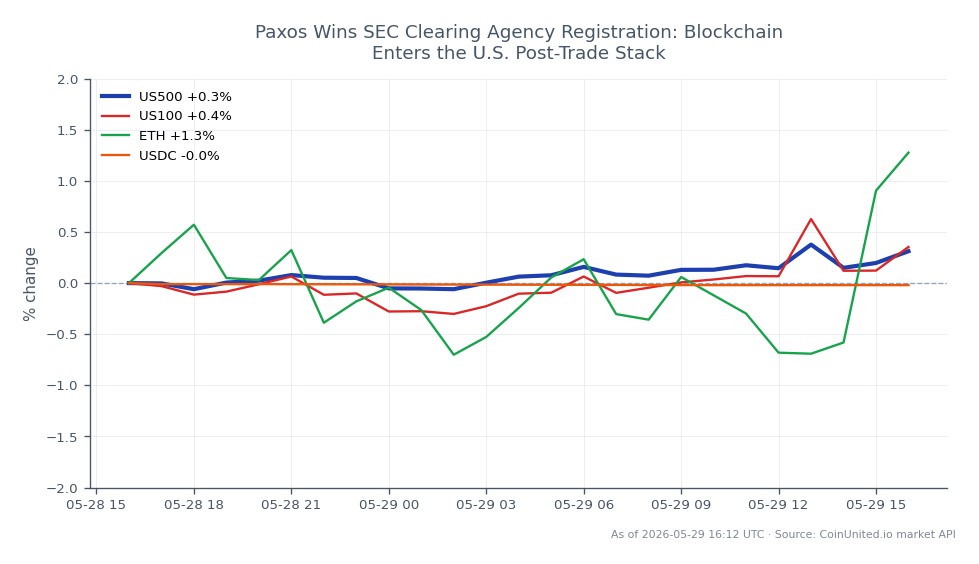
- •Cross-market: FinTech/market-infrastructure equities and RWA-linked tokens are the sharpest beneficiaries; broad indices (S&P 500, NASDAQ 100) see minimal direct impact.
- •The approval reinforces the stablecoin institutional buildout and crypto-banking integration themes, supporting medium-term flows into tokenization platforms and institutional blockchain infrastructure.
- •This is a slow-burn catalyst — adoption pace and participant onboarding announcements are the key triggers to watch before scaling positions.
Paxos has announced that its subsidiary, Paxos Securities Settlement Company, LLC (PSSC), has been granted full registration as a clearing agency by the U.S. SEC under Section 17A of the Securities Ex
Event Summary
Paxos has announced that its subsidiary, Paxos Securities Settlement Company, LLC (PSSC), has been granted full registration as a clearing agency by the U.S. SEC under Section 17A of the Securities Exchange Act of 1934. According to Paxos' official press release, PSSC is now the only blockchain-native firm registered as a clearing agency and central securities depository (CSD) in the United States — a status previously held exclusively by traditional entities such as DTCC.
As documented in the Federal Register, this follows a multi-year path: a 2019 no-action relief allowed Paxos to run a time-limited feasibility study for distributed-ledger-based delivery-versus-payment (DVP) settlement in publicly traded equities. Full Section 17A registration marks the transition from regulatory sandbox to production-capable infrastructure, enabling PSSC to clear and settle eligible U.S. securities on a blockchain ledger with the same legal standing as incumbent clearing agencies.
Leverage Impact Analysis
This event carries a leverage relevance score of 0.58 — meaningful but not an immediate volatility spike trigger. The primary leverage risk is narrative-driven: sudden sentiment swings in crypto and fintech-adjacent equities can generate outsized moves in leveraged positions.
For CoinUnited traders, the most direct scenario involves Ethereum and tokenization-adjacent tokens. ETH, as the dominant smart-contract layer underlying most institutional tokenization pilots, could see funding rate pressure if narrative momentum builds. Traders running 50x–100x ETH perpetual longs should monitor funding rates closely — a rapid narrative squeeze on low-liquidity periods can shift funding costs significantly within hours.
On the equity side, FinTech and market-infrastructure CFDs are the sharpest leverage plays. A trader holding a 50x long US500 CFD should be aware that while broad index impact is diffuse, sector rotation into financial-infrastructure names could temporarily widen the index's intraday range, increasing margin exposure near key support levels. USDC and stablecoin-adjacent assets may also catch a narrative bid given Paxos' stablecoin background — but position sizing should remain conservative until market confirmation materializes.
Cross-Market Impact
The stablecoin institutional buildout and crypto banking institutional integration themes are directly reinforced. The approval signals that U.S. regulators are willing to embed blockchain infrastructure at the core of equity market plumbing — a structural positive for tokenized real-world assets and for institutional stablecoins used as settlement cash.
Equities: Crypto-proxy stocks (MSTR, COIN) and FinTech infrastructure names carry the most immediate headline sensitivity. The S&P 500 and NASDAQ 100 are unlikely to see index-level impact, but sector-level rotation into DLT-adjacent names is plausible within days.
Crypto: ETH benefits most as the leading institutional tokenization layer. RWA-linked tokens and Layer-1/Layer-2 chains marketed for institutional settlement may see incremental narrative flows.
Forex & Commodities: No direct impact. The event is U.S. financial-infrastructure specific with no near-term FX or commodity transmission.
Trading Considerations
This is a structural, slow-burn catalyst — not a gap-up trigger. Market confirmation is required before treating it as a directional trade. Key levels to watch: ETH resistance and open interest shifts on perpetuals (check live on CoinUnited.io), and intraday volume in FinTech infrastructure equities for signs of institutional accumulation.
The primary risk factor is adoption pace — PSSC holds the license but has no guaranteed volume. Traders should avoid heavy leverage on pure narrative exposure and wait for participant onboarding announcements or volume data as confirmation signals.
Start Trading on CoinUnited.io
Create Your Free Account → — Trade crypto, stocks, forex, indices, and commodities with up to 2000x leverage and zero fees.
Frequently Asked Questions
ETH is the leading institutional tokenization layer, so this approval adds narrative tailwind — but it's not an immediate price catalyst. Traders with high-leverage ETH perpetual longs should watch for funding rate shifts and avoid overexposure until open interest confirms directional momentum.
Continue Exploring
Disclaimer: This brief is for educational purposes only and is not investment advice.