Quick Links
Mastercard's BitLicense Approval Signals TradFi's Deepening Crypto Commitment
Key Takeaways
- •A Mastercard subsidiary receiving a NYDFS BitLicense is a permanent operating authorization — not a pilot — signaling serious regulated crypto infrastructure buildout.
- •This reinforces the stablecoin institutional buildout theme; Mastercard's global merchant network could become a major distribution channel for USDC-style settlement.
- •Bullish for Mastercard stock as it expands into regulated digital asset revenue streams, creating competitive pressure on fintech rivals.
- •Constructively positive for BTC, ETH, and stablecoins as another TradFi giant formally enters the regulated crypto ecosystem, lowering systemic risk perception.
- •Watch for downstream partnership announcements with stablecoin issuers like Circle as the key confirming catalyst for this thesis.
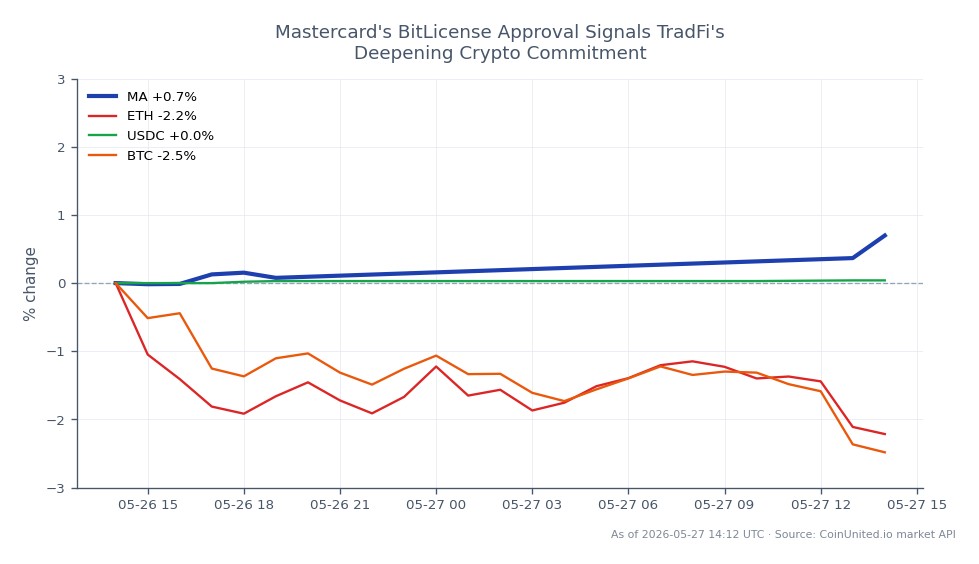
A Mastercard Incorporated subsidiary has received approval for a New York BitLicense — the state's rigorous virtual currency business license administered by the New York Department of Financial Servi
Event Analysis
A Mastercard Incorporated subsidiary has received approval for a New York BitLicense — the state's rigorous virtual currency business license administered by the New York Department of Financial Services (NYDFS). The BitLicense is widely regarded as one of the most demanding crypto regulatory frameworks in the United States, requiring applicants to meet strict capital, cybersecurity, anti-money-laundering, and consumer protection standards. For a unit of a global payments giant like Mastercard to formally obtain this license signals a deliberate, compliance-first entry into regulated crypto services within the largest US financial market.
This development sits squarely within the crypto banking institutional integration trend that has been accelerating through 2025–2026. What differentiates this from earlier TradFi crypto experiments is the regulatory depth: a BitLicense is not a partnership announcement or a pilot program — it is a permanent operating authorization. Mastercard is not dabbling; it is building durable infrastructure. This is consistent with the broader stablecoin institutional buildout theme, where payment networks seek to embed themselves directly into crypto settlement rails.
The strategic implication is significant. Mastercard's network connects over 3 billion cards and tens of thousands of financial institutions globally. A licensed crypto operation in New York positions the company to offer crypto custody, conversion, or stablecoin-based payment services at scale — potentially routing USDC or similar instruments through its existing merchant network. For deeper context on how this fits the evolving stablecoin payment rails expansion theme, the competitive pressure on pure-play crypto payment firms could intensify materially. Our institutional stablecoins guide provides further context on how licensed incumbents are reshaping settlement infrastructure.
What This Means for Traders
For Mastercard Incorporated equity traders, this is a medium-term positive catalyst. The BitLicense unlocks regulated crypto revenue streams in a jurisdiction that has historically restricted such activity, expanding Mastercard's total addressable market in digital payments. It also reinforces Mastercard's positioning relative to Visa and emerging fintech rivals in the crypto-payments race. The market implication is broadly bullish for MA stock, though near-term price action will depend on whether Mastercard announces specific product launches tied to this license.
For crypto markets, the signal is constructively bullish — particularly for Bitcoin and Ethereum as institutional on-ramp demand grows, and most directly for USDC and the stablecoin ecosystem given Mastercard's likely interest in dollar-denominated digital settlement. Institutional entrants of this caliber reduce systemic regulatory risk perceptions for the asset class. Volatility impact is likely modest and sustained rather than a sharp spike — this is a structural, slow-burn positive rather than a headline pump catalyst. Traders should monitor whether Mastercard announces partnership tie-ups with Circle or other stablecoin issuers as a confirming signal.
Start Trading on CoinUnited.io
Create Your Free Account → — Trade crypto, stocks, forex, indices, and commodities with up to 2000x leverage and zero fees.
Frequently Asked Questions
A BitLicense permits the holder to conduct virtual currency business activities in New York, including custody, exchange, and transmission of crypto assets. This would enable Mastercard's subsidiary to legally offer crypto-related financial services to NY-based clients and institutions.
Continue Exploring
Disclaimer: This brief is for educational purposes only and is not investment advice.