Quick Links
Australia March CPI Surges to 4.6% on Fuel Shock — AUD/USD Leverage Scenarios at $0.7164
Data Snapshot
Key Takeaways
- •Headline CPI re-accelerated to 4.6% YoY in March 2026 (from 3.7% in Feb), the highest since September 2023, per the ABS.
- •Automotive fuel surged 24.2% annually — the strongest monthly increase since the ABS series began in 2017 — as the primary shock driver.
- •Trimmed mean inflation held at 3.3%, above the RBA's 2–3% target, removing near-term rate-cut optionality.
- •Leveraged AUDUSD traders face a compressed 27-pip range ($0.7153–$0.7180) — at 100x leverage, a full range move equals roughly $270/lot; manage size accordingly.
- •Cross-market: hawkish RBA repricing supports AUD vs. EUR, provides marginal tailwind for gold's inflation-hedge bid, and tightens the global 'higher for longer' narrative affecting equities.
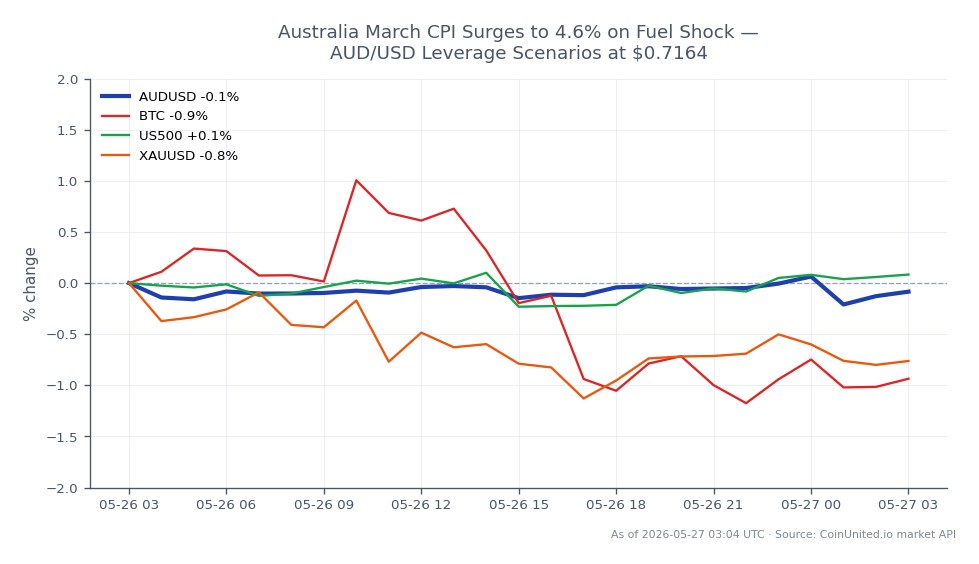
According to the Australian Bureau of Statistics, Australia's headline CPI accelerated to 4.6% year-on-year in March 2026, up sharply from 3.7% in February — the highest annual reading since September
Event Summary
According to the Australian Bureau of Statistics, Australia's headline CPI accelerated to 4.6% year-on-year in March 2026, up sharply from 3.7% in February — the highest annual reading since September 2023 and firmly above the Reserve Bank of Australia's 2–3% target band. Trimmed mean inflation held steady at 3.3%, unchanged from February. As reported by TradingEconomics, the primary drivers were Housing (+6.5%), Transport (+8.9%), and automotive fuel, which surged 24.2% annually — the strongest monthly fuel increase since the ABS series began in 2017.
The print complicates the RBA's policy calculus. With core inflation anchored above target and headline re-accelerating, the case for near-term rate cuts weakens considerably. Traders should review our AUD/USD trading guide and the broader macro inflation pressure theme for structural context.
Leverage Impact Analysis
At the current AUDUSD price of $0.7164 (24h range: $0.7153–$0.7180), this inflation beat introduces asymmetric risk for leveraged positions.
Long AUD scenario (hawkish RBA repricing): A trader opening a 100x long AUDUSD CFD at $0.7164 controls $71,640 notional per standard lot. A 30-pip move to $0.7194 — consistent with a hawkish RBA re-pricing — would yield approximately +$300 per lot at 100x. However, a reversal to the 24h low of $0.7153 (11 pips) would trigger near-total margin erosion at maximum leverage.
Short AUD scenario (stagflation concern): If markets interpret sticky core inflation alongside rising unemployment (per recent ABS data) as a stagflation signal, AUD could face selling pressure despite the hot print. Traders with >200x short exposure face liquidation risk on any hawkish RBA headline. Position sizing below 50x is advisable given the policy uncertainty window ahead of the next RBA meeting.
Funding rate implications: monitor overnight swap costs on AUDUSD positions, as hawkish repricing typically widens AUD carry differentials.
Cross-Market Impact
The macro inflation risk-off repricing dynamic has clear spillovers:
- -EUR/AUD: A hawkish RBA read supports AUD, compressing EUR/AUD. Watch for tests of key support if RBA rate-cut expectations are pushed further out.
- -Gold (XAU/USD): Australia's fuel-driven inflation reinforces the global inflation hedge bid. Gold may benefit if markets interpret this as a broader commodity-inflation signal.
- -S&P 500 / US500: Limited direct impact, but persistent APAC inflation data tightens the global "higher for longer" narrative, pressuring rate-sensitive sectors in the S&P 500.
- -Bitcoin: Indirect risk-off sensitivity. A hawkish macro tilt globally tends to compress crypto risk appetite at the margin — monitor BTC funding rates for confirmation.
For a broader framework on trading CPI releases across asset classes, see our CPI inflation data trading guide.
Trading Considerations
AUDUSD is trading at $0.7164 with a narrow 24h range ($0.7153–$0.7180), signaling consolidation as markets digest the print. Key resistance sits at the 24h high of $0.7180; a sustained break higher would require RBA officials to explicitly signal a pause in cuts. Support at $0.7153 is the immediate downside reference — a close below this level on elevated volume would shift the near-term bias bearish despite the hot CPI.
Watch for RBA communication in the coming days. The combination of 4.6% headline and 3.3% core (above target) materially reduces the probability of a near-term cut. Confirm open interest shifts on AUDUSD before sizing leveraged positions.
Trade Australian Dollar / US Dollar on CoinUnited.io
Trade AUDUSD with up to 2000xx leverage → | Create Free Account
Frequently Asked Questions
A hawkish RBA repricing on the back of this beat could push AUDUSD toward and above the 24h high of $0.7180, generating ~$160/lot profit at 100x leverage. However, if the market treats this as a stagflation signal (hot inflation + rising unemployment), AUD could reverse sharply — keep leverage below 50x until the direction is confirmed.
Continue Exploring
Disclaimer: This brief is for educational purposes only and is not investment advice.