Quick Links
RBA Rate Cycle Nearing Peak: AUD/USD Leverage Scenarios and Cross-Market Spillover
Data Snapshot
Key Takeaways
- •RBA cash rate has risen to 4.35% across three 2026 hikes but analyst consensus now sees the cycle nearing its terminal stage, which is bearish for AUD/USD.
- •Leveraged AUD/USD shorts at 100x face liquidation within 50 pips — high-impact RBA/CPI events can move the pair 80–150 pips intraday, making position sizing critical.
- •AUD/USD at $0.7151 sits near a pivotal zone; a break below 0.7100 would open the 0.6950–0.7000 range, while failure to break that level may invite mean-reversion longs.
- •NZD/USD and USD/JPY are the most directly affected cross-market instruments — a broad USD-strength wave could pressure both APAC commodity currencies simultaneously.
- •Gold may benefit from dual tailwinds: higher local AUD prices for Australian producers and safe-haven flows if APAC growth fears accelerate.
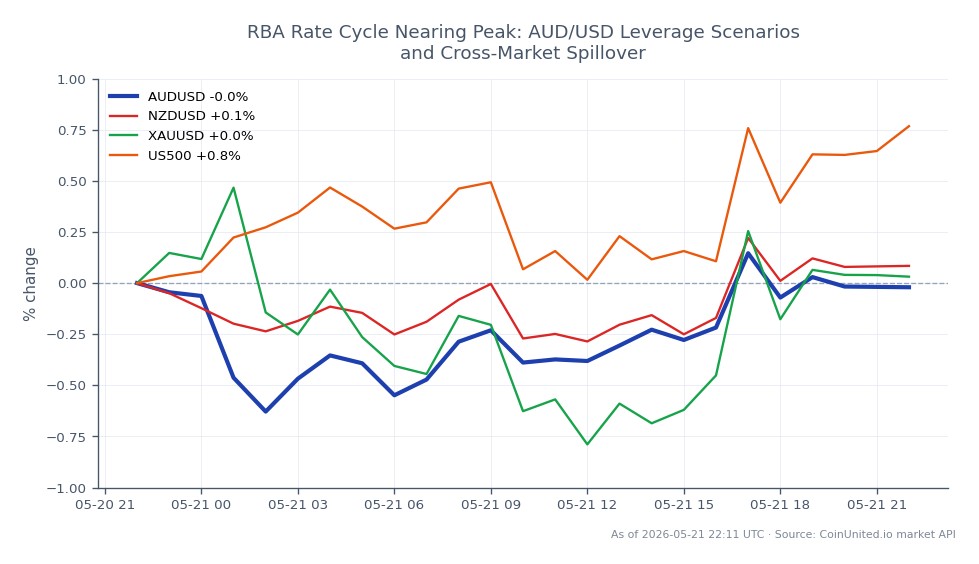
According to analyst commentary covered by FXStreet, AMP, and Trading Economics, the Reserve Bank of Australia's tightening cycle appears to be approaching its terminal stage. The RBA raised its cash
Event Summary
According to analyst commentary covered by FXStreet, AMP, and Trading Economics, the Reserve Bank of Australia's tightening cycle appears to be approaching its terminal stage. The RBA raised its cash rate 25 bps to 3.85% in February 2026, followed by a move to 4.10% in March and a further hike to 4.35% in May, per Trading Economics. AMP notes that AUD/USD had risen to just under 0.71 from an average of 0.64 in 2025 — a substantial recovery now at risk of reversal. The Australian Dollar / US Dollar pair currently trades at $0.7151.
While no formal pause has been announced, FX markets are forward-looking. Analysts interpreting peak-rate signals are beginning to reprice AUD lower, as the rate-differential advantage that drove the currency's 2025–2026 rally starts to fade. This fits squarely within the APAC Stagflation & Currency Stress theme: sticky inflation met by a policy ceiling creates a classic stagflationary squeeze on the currency.
Leverage Impact Analysis
At the live price of $0.7151, AUD/USD leverage scenarios on CoinUnited.io (up to 2000x) are highly sensitive to even small repricing moves.
Bearish scenario — short AUD/USD:
- -A trader opening a 100x short at $0.7151 with $500 margin controls $50,000 notional. A 50-pip move to 0.7101 generates ~$500 in profit (100% margin return). However, a 50-pip adverse spike to 0.7201 triggers full liquidation — there is essentially zero buffer.
- -At 50x leverage, the liquidation buffer widens: a 100-pip move against position (~$0.7251) would be required to force a stop-out, giving traders more room to hold through short-term volatility.
Funding rate note: As peak-rate narratives dominate, short AUD positions may face elevated funding costs if market positioning skews heavily bearish. Monitor funding rates on CoinUnited.io before sizing in.
Key risk: The 24h range of $0.7151–$0.7152 signals extremely low realized volatility at this snapshot — but macro repricing events (RBA minutes, CPI, Fed commentary) can spike AUD/USD 80–150 pips intraday. High-leverage shorts entered near current levels face asymmetric liquidation risk during such events.
Cross-Market Impact
The APAC Currency & Inflation Supply Shock theme has broad tentacles:
- -NZD/USD: Closely correlated with AUD. If RBA peak-rate fears spread to RBNZ expectations, NZD faces similar selling pressure. Watch for AUD/NZD compression as a relative-value signal.
- -USD/JPY: A weaker AUD environment typically supports the USD broadly. If USD firms against AUD, USD/JPY upside pressure may also build — though BOJ policy divergence complicates this. See our USD/JPY Trading Guide for context.
- -Gold (XAU/USD): A weaker AUD raises local gold prices for Australian producers, potentially supporting equities in that sector. Macro risk-off flows triggered by APAC growth fears could also boost gold as a safe haven.
- -S&P 500: Limited direct linkage, but a broad USD strengthening wave — driven partly by AUD weakness — typically creates headwinds for US multinationals with APAC revenue exposure.
For deeper macro context, our stagflation trading guide covers how peak-rate cycles play out across asset classes.
Trading Considerations
Key levels to monitor on AUD/USD: The 0.7100 round-number level represents near-term support; a confirmed break below opens toward 0.7000–0.6950, the zone where AUD/USD traded prior to the RBA hiking cycle. Resistance sits at 0.7200–0.7250 (recent highs per FXStreet). Catalysts to watch: RBA June meeting guidance, Australian Q1 CPI revisions, and any shift in Fed easing expectations that could tighten or widen the AUD/USD rate differential.
Trade Australian Dollar / US Dollar on CoinUnited.io
Trade AUDUSD with up to 2000xx leverage → | Create Free Account
Frequently Asked Questions
Peak-rate pricing removes the forward rate support that drove AUD higher, creating a directional tailwind for shorts — but low current volatility means entries near $0.7151 sit close to key support, and any hawkish RBA surprise can liquidate tight stops instantly.
Continue Exploring
Disclaimer: This brief is for educational purposes only and is not investment advice.