Quick Links
Safe & Squid $3.2M Exploit: Module-Layer Risk Reprices Smart-Wallet Infrastructure
Data Snapshot
Key Takeaways
- •~$3.2M was drained from 86 Gnosis Safe wallets via a delegate impersonation flaw in a third-party SquidRouterModule — Safe and Squid core contracts confirmed unaffected.
- •SQD trades at $0.0398 (+6.53%); leveraged longs above 20x face liquidation within a 1% adverse move given current volatility profile.
- •The exploit is a module-layer event, not a base-protocol failure — but it reprices risk across the broader smart-wallet and account-abstraction narrative on Ethereum and Base.
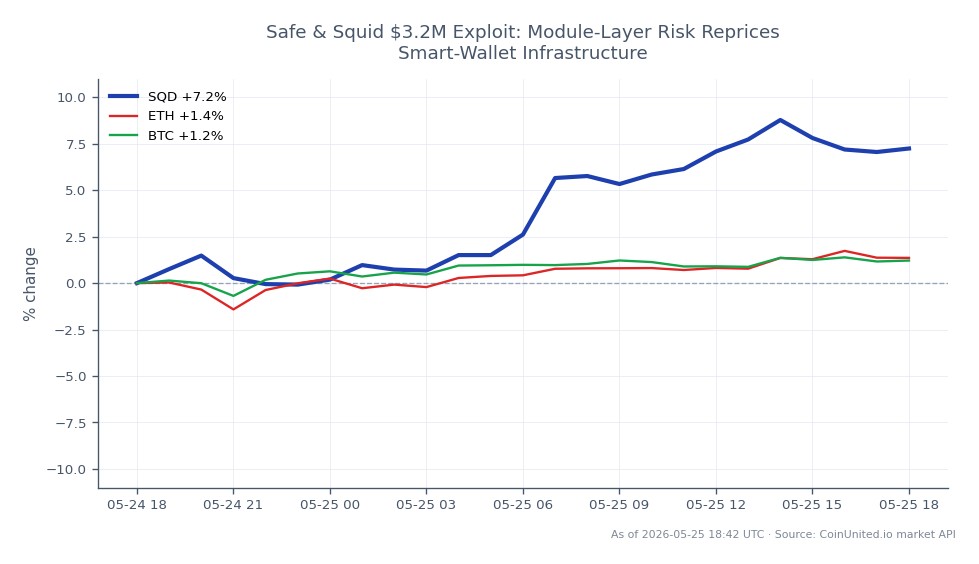
- •No material cross-market macro impact: $3.2M is insufficient to move ETH, BTC, or COIN materially, though Base reputational noise warrants monitoring.
- •DAOs and treasuries using Safe may pause module-based automations, creating secondary on-chain activity slowdowns in DeFi protocols dependent on automated Safe execution.
According to reporting by TradingView/Invezz and corroborated by blockchain security firm Blockaid, approximately $3.2 million was drained from at least 86 Gnosis Safe wallets across Ethereum and Base
Event Summary
According to reporting by TradingView/Invezz and corroborated by blockchain security firm Blockaid, approximately $3.2 million was drained from at least 86 Gnosis Safe wallets across Ethereum and Base networks via a vulnerability in a third-party module named `SquidRouterModule`. The exploit targeted the `executeSameChainActions()` function, allowing an attacker to impersonate authorized delegates, bypass multisig verification, and trigger unauthorized swaps from victim wallets — ultimately consolidating ~3.07M DAI into an attacker-controlled wallet via manipulated Uniswap v3 pools.
Both Squid and Safe Labs have clarified that their core contracts and production infrastructure remain unaffected. The exploited contract merely shared the `SquidRouterModule` name and was integrated via external, third-party deployments — many of which were single-sig Safes set up outside Safe's official UI. This is a DeFi structural reset moment for the module-layer security model underpinning smart-wallet ecosystems.
Leverage Impact Analysis
SQD is currently trading at $0.0398 (+6.53% 24h), with a 24h range of $0.0369–$0.0406. The counter-intuitive upward move likely reflects relief that Squid's core router was unaffected, but leveraged positions face asymmetric risk here.
Worked example — Long SQD perpetual at 100x: A trader entering a 100x long at $0.0398 with $100 collateral controls $9,980 notional. A 1% adverse move to ~$0.0394 wipes the position. Given exploit-driven headline risk, intraday swings of 5–10% are plausible — a 5% drop to $0.0378 liquidates any long with >20x leverage opened at current prices.
Short positioning: Traders shorting SQD on exploit fear face the inverse squeeze — SQD's bounce means short positions opened below $0.0398 are already under pressure. High-leverage shorts (>50x) opened pre-bounce near $0.0369 are approaching liquidation thresholds at current prices.
Monitor open interest and funding rates on CoinUnited.io for confirmation of directional bias. Exploit-related volatility tends to compress within 24–48 hours once containment is confirmed — but module-layer narratives can resurface if additional affected wallets are identified.
Cross-Market Impact
The $3.2M scale is too small for macro or equity spillover. However, the self-custody and cross-chain infrastructure narrative carries broader implications:
- -Ethereum (ETH): The exploit occurred on Ethereum and Base. No direct ETH price impact, but renewed scrutiny on smart-account module security could dampen short-term enthusiasm for account abstraction (ERC-4337) narratives that have been ETH tailwinds.
- -Coinbase (COIN): Base is Coinbase's L2. While the exploit is not Base-protocol-level, any negative framing around Base-deployed contracts adds marginal reputational noise — insufficient to move COIN materially but worth monitoring.
- -Bitcoin (BTC): No direct impact. BTC lacks a module-layer architecture and may see marginal safe-haven rotation within crypto if smart-wallet risk sentiment deteriorates.
- -DeFi security tokens / audit protocols: This is the sector with the clearest narrative tailwind — demand for module vetting and runtime monitoring tools rises after each high-profile exploit, consistent with the DeFi reset risks playbook.
Trading Considerations
SQD's immediate support sits at the 24h low of $0.0369; a break below that level on sustained volume would confirm bearish continuation and potential re-test of pre-exploit lows. Resistance is the 24h high at $0.0406 — a close above that would signal market acceptance of the "core infra unaffected" narrative. Position sizing should account for binary outcome risk: either further wallets are identified (bearish escalation) or containment is confirmed (neutral-to-bullish recovery).
For Safe/Gnosis ecosystem exposure, watch for DAO treasury announcements reviewing module configurations — these could create secondary selling pressure in GNO and adjacent tokens independent of SQD price action.
Trade SQD on CoinUnited.io
Trade SQD with up to 2000xx leverage → | Create Free Account
Frequently Asked Questions
With SQD at $0.0398, any long position above 20x leverage is liquidated by a move below ~$0.0394 — a threshold reachable on a single negative headline. Size positions to survive at least a 5–10% intraday swing given ongoing exploit uncertainty.
Continue Exploring
Disclaimer: This brief is for educational purposes only and is not investment advice.