Quick Links
MAP Protocol 96% Crash: Quadrillion-Token Mint Exploit Signals DeFi Bridge Risk Repricing
Key Takeaways
- •A quadrillion-scale unauthorized mint caused a ~96% MAP price collapse — a critical token integrity failure, not standard volatility.
- •Any leveraged long on MAP was effectively wiped: even a 3x position cannot survive a 96% drawdown before liquidation.
- •Exploit proceeds were swapped into ETH/stablecoins on DEXs, creating transient liquidity drain but limited systemic impact on major L1s.
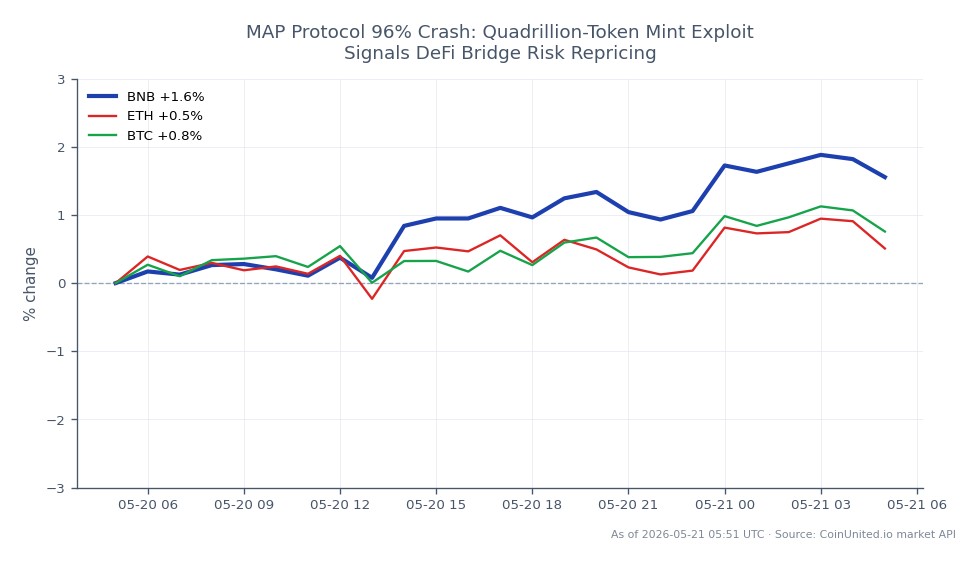
- •Cross-chain bridge and interoperability tokens face sector-wide risk repricing — capital is rotating toward BTC and ETH as relative safe havens.
- •MAP is uninvestable until a credible token migration, attacker blacklist, or rollback plan is confirmed with exchange support.
MAP Protocol (MAPO) suffered a near-total token collapse after an attacker executed a quadrillion-scale unauthorized mint, according to on-chain security monitoring consistent with reports from firms
Event Summary
MAP Protocol (MAPO) suffered a near-total token collapse after an attacker executed a quadrillion-scale unauthorized mint, according to on-chain security monitoring consistent with reports from firms including PeckShield and BlockSec. The exploit — likely an unlimited mint via a vulnerable or compromised minter role in the token or bridge contract — flooded the market with tokens far exceeding any prior circulating supply, triggering a ~96% price crash within hours. The attacker swapped minted tokens for real assets (ETH, stablecoins) on DEXs and bridged proceeds across chains, draining liquidity pools in the process.
As reported by on-chain forensics consistent with the exploit pattern, this is classified as a critical token integrity failure, not a standard volatility event. MAP Protocol's cross-chain architecture — central to its value proposition — appears to be the attack surface. No credible rollback or migration plan had been confirmed at time of writing.
Leverage Impact Analysis
For leveraged traders, the MAP collapse is a textbook liquidation cascade scenario. Any long perpetual position on MAP opened before the exploit would face near-total equity destruction regardless of leverage level — a 96% move eliminates a 25x long position with less than 4% adverse move tolerance.
Worked example: A trader holding a 10x long MAP perpetual with $1,000 margin, opened pre-exploit, would face a theoretical loss of ~$9,600 — wiping the position and triggering margin calls well before the bottom. Even a conservative 3x long would be fully liquidated on a 33% drawdown, let alone 96%.
The more nuanced leverage risk now sits in cross-collateral portfolios: traders using altcoins (including similar cross-chain infrastructure tokens) as margin collateral on Ethereum or BNB Chain positions face forced rebalancing if those assets reprice on contagion sentiment. Monitor funding rates on small-cap bridge tokens for elevated short bias — check live rates on CoinUnited.io for confirmation signals. The DeFi Structural Reset theme implies persistent risk-off pressure on leveraged altcoin longs across this sector.
Cross-Market Impact
This exploit is crypto-native with limited macro spillover, but meaningful second-order effects exist within digital assets:
- -ETH & BNB: Attacker proceeds were likely swapped into ETH and bridged via BNB Chain infrastructure. This creates transient sell pressure on DEX pools, but systemic impact on major L1s is minimal given MAP's market cap scale.
- -Bridge/interoperability tokens: Protocols sharing architectural similarities (upgradeable minter roles, complex cross-chain logic) face repricing of security risk premia. Refer to the Self-Custody & Cross-Chain Infrastructure Wave theme — this event is a negative catalyst for the sector.
- -Bitcoin & large-cap crypto: Capital rotation from exploited small-caps toward BTC and ETH is a recurring post-exploit pattern, providing marginal relative support for majors.
- -Crypto-proxy equities (COIN, MARA): Impact is indirect — another DeFi exploit reinforces regulatory narratives around smart contract risk but is unlikely to move crypto equities materially unless exchange bad debt materializes.
- -DeFi lending protocols: Any platform accepting MAP as collateral faces bad debt exposure. For a deeper framework on how these situations resolve, see DeFi Protocol Exploits: How Bad Debt Is Resolved in 2026.
For the structural governance dimension, the DeFi Reset 2026 framework outlines why admin-key and bridge vulnerabilities remain the sector's top systemic risk.
Trading Considerations
MAP should be treated as a distressed asset until a credible, technically sound migration or rollback plan is published with exchange coordination. No prior support levels or market cap anchors are valid — the supply has been catastrophically diluted. Watch for: (1) official team announcements of attacker address blacklisting or token reissuance with pre-exploit snapshot; (2) CEX deposit/withdrawal status as a proxy for institutional confidence in any recovery; (3) whether security firms confirm the exploit vector is contained or if further minting is possible.
For broader altcoin leveraged positions, reduce exposure to tokens with similar architectural risk profiles — particularly those with upgradeable contracts, centralized minter keys, or complex bridge logic — until the risk premium re-rating stabilizes.
Start Trading on CoinUnited.io
Create Your Free Account → — Trade crypto, stocks, forex, indices, and commodities with up to 2000x leverage and zero fees.
Frequently Asked Questions
No — a 96% adverse move liquidates any leveraged long position with less than ~104x the margin in buffer, meaning even a 2x long is fully wiped. Leveraged shorts opened after the exploit signal would have profited, but timing such events in real-time is extremely high risk.
Continue Exploring
Disclaimer: This brief is for educational purposes only and is not investment advice.