Быстрые ссылки
Aehr Test Systems Q4 Miss: Revenue Shortfall and 17% Drop Signal SiC Cycle Delay — Leverage Trader Playbook
Снимок данных
Основные выводы
- •AEHR Q4 revenue of $14.1M missed the $14.8M consensus, triggering an ~17% stock decline — a liquidation-level event for leveraged longs above 5x going into earnings.
- •Record $37.2M quarterly bookings and a >3.5x book-to-bill ratio signal strong FY2027 demand but do not offset near-term revenue shortfall in the CFD price action.
- •Management cited tariff-related uncertainty as the primary driver of Q4 order timing delays — a macro read-through for broader semiconductor capex cycles.
- •SiC growth has been pushed to FY2027, shifting the near-term narrative away from EV/power electronics supply chain acceleration.
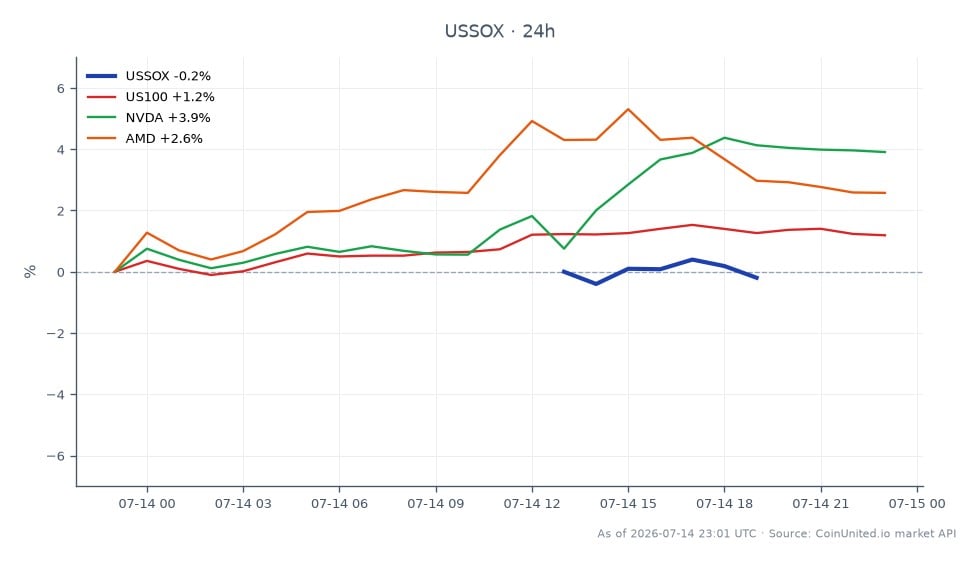
- •Applied Materials and SOX-adjacent names may see modest sympathy pressure; NVIDIA and AMD AI-GPU exposure remains structurally separate from SiC dynamics.
Aehr Test Systems reported fiscal Q4 2026 results on July 14, 2026, after market close. According to Investing.com, Q4 revenue came in at $14.1M, missing the $14.8M consensus estimate and declining fr
Event Summary
Aehr Test Systems reported fiscal Q4 2026 results on July 14, 2026, after market close. According to Investing.com, Q4 revenue came in at $14.1M, missing the $14.8M consensus estimate and declining from $16.6M year-over-year. Adjusted EPS of -$0.01 was in line with expectations. Shares fell approximately 17% on the release — not the 29% gain referenced in initial signals, which is not corroborated by current sources.
The nuanced story lies in the bookings data: per an SEC Form 8-K filing, AEHR reported $37.2M in quarterly bookings with a book-to-bill ratio above 3.5x — a structurally strong signal for future revenues. Management guided full-year FY2026 revenue toward the high end of the $45–50M range previously issued, but declined to provide more granular forward guidance, citing tariff-related uncertainty that delayed order placements in Q4.
Management also flagged a near-term SiC (silicon carbide) pause, noting stronger growth in that segment is expected in FY2027 rather than FY2026 — a meaningful revision for a company whose burn-in equipment is central to SiC device production for EVs and power electronics.
Leverage Impact Analysis
A 17% single-session decline is a high-impact event for leveraged CFD traders on AEHR stock. On CoinUnited.io, stock CFDs can be traded with up to 2000x leverage — making position sizing discipline critical here.
Example scenario: A trader holding a 50x long AEHR CFD going into earnings would have seen 50 × 17% = 850% loss on margin — a full liquidation event well before the close of that session. Even at 10x leverage, the position would have suffered an 170% drawdown on margin, wiping the account.
Conversely, traders who identified the revenue-miss risk — noting the tariff-related order delays flagged in prior quarters — and entered a short CFD position pre-earnings would have captured significant gains. The 3.5x book-to-bill provides a sentiment floor, but the near-term revenue miss and SiC delay guidance can sustain downside pressure until bookings begin converting to revenue in H1 FY2027.
For those considering a post-drop recovery play, reviewing how to trade earnings misses and earnings miss recovery setups is warranted before sizing into a mean-reversion long. The 3.5x book-to-bill is a genuine fundamental catalyst — but timing the conversion to revenue is the critical variable.
Cross-Market Impact
Aehr's primary read-through is to the semiconductor capital equipment and SiC ecosystem. The PHLX Semiconductor Index (SOX) may register modest sympathy pressure, particularly in smaller-cap equipment names. However, megacap names like NVIDIA and AMD are insulated — their revenue drivers (AI GPU, data center) are structurally separate from SiC power devices. Applied Materials could see incremental read-through given its exposure to semiconductor capex cycles, but its diversification limits the impact.
The broader NASDAQ-100 is unlikely to move on AEHR alone given its small-cap weight, but the tariff-delay commentary reinforces existing concerns about trade policy constraining semiconductor capex — a macro theme relevant to the semiconductor supply chain geopolitics narrative playing out in 2026. EV supply chains and SiC wafer producers represent the most direct sector exposure beyond the stock itself.
Trading Considerations
Key levels to monitor: AEHR's post-earnings price (down ~17%) establishes a new near-term support zone to watch. The $37.2M bookings figure provides a fundamental anchor — if tariff uncertainty eases and order timing normalizes, revenue conversion could accelerate into H2 FY2026 and FY2027. Traders should watch for any revision to the $45–50M FY2026 range as a potential catalyst in either direction.
For sector positioning, the earnings miss deep dive guide offers applicable frameworks. Risk factors include further tariff escalation delaying SiC order placements, SiC ramp timing slipping beyond FY2027, and broader semiconductor capex softness.
Start Trading on CoinUnited.io
Create Your Free Account → — Trade crypto, stocks, forex, indices, and commodities with up to 2000x leverage and zero fees.
Часто задаваемые вопросы
Any long position above approximately 5x leverage would have faced full margin wipeout on the ~17% single-session decline. At 50x leverage, the theoretical loss on margin exceeded 850% — positions are liquidated well before that point.
Продолжить исследование
Отказ от ответственности: Этот бриф предназначен только для образовательных целей и не является инвестиционной рекомендацией.