Быстрые ссылки
Aehr Test Systems Posts EPS Beat but Revenue Miss Sends Stock Lower in After-Hours
Снимок данных
Основные выводы
- •AEHR posted an EPS beat of $0.02 but missed revenue estimates by $0.5 million, with the market penalizing the revenue shortfall — stock fell ~5.67% after hours per Investing.com.
- •For semiconductor equipment names, revenue and bookings are leading demand indicators; an EPS beat driven by cost control does not offset top-line weakness.
- •Sector read-through to large-cap semis or broad indices is low — this is a single-name, niche-equipment catalyst, not a macro semiconductor signal.
- •Traders should monitor management guidance and bookings commentary as the primary forward indicator for any recovery or continuation in AEHR.
- •After-hours positioning is available immediately on CoinUnited's stock CFDs — no need to wait for the next regular session open.
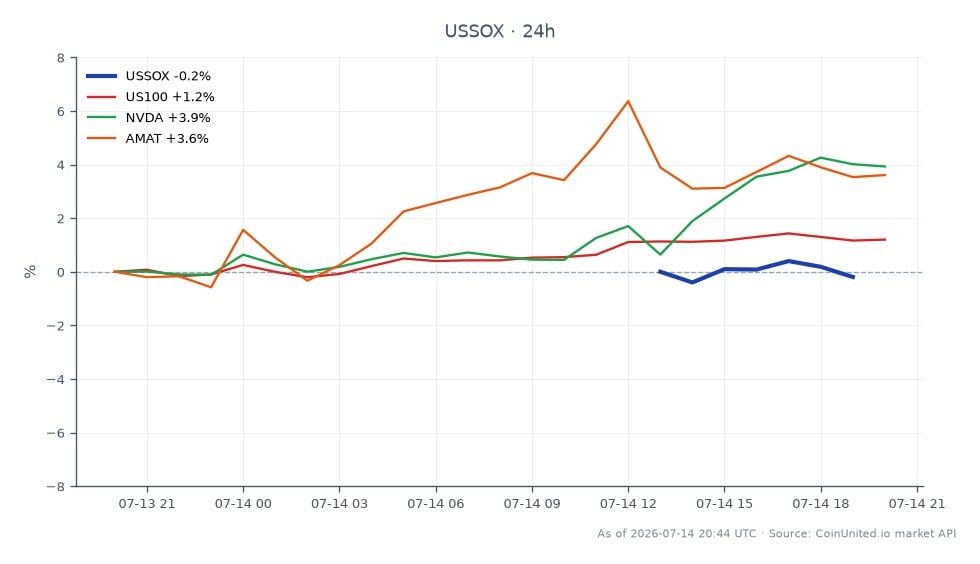
Aehr Test Systems (AEHR), a semiconductor test equipment maker, reported mixed quarterly results that highlight the divergence between profitability recovery and top-line momentum. According to Invest
Event Analysis
Aehr Test Systems (AEHR), a semiconductor test equipment maker, reported mixed quarterly results that highlight the divergence between profitability recovery and top-line momentum. According to Investing.com, the company posted EPS of -$0.05 versus the -$0.07 consensus estimate — a $0.02 beat — while revenue came in at $10.3 million against expectations of $10.8 million. A separate quarter tracked by Seeking Alpha showed a stronger print, with non-GAAP EPS of $0.18 beating by $0.02 and revenue of $20.62 million topping estimates by $1.37 million, suggesting Aehr has delivered mixed results across reporting periods.
The market response was telling: according to Investing.com, AEHR stock fell 5.67% in aftermarket trading following the mixed quarter, signaling that investors weighted the revenue shortfall more heavily than the EPS beat. For a small-cap semiconductor equipment name, the top line is a leading indicator of customer capex appetite and bookings health — and a miss there undermines the profitability narrative. This dynamic is not unusual in the equipment space, where a cost-controlled quarter can mask weak demand signals from foundry and fab customers.
What distinguishes AEHR from larger semiconductor equipment peers like Applied Materials, Inc. or Lam Research Corporation is its concentrated exposure to niche wafer-level burn-in testing — a segment closely tied to silicon carbide (SiC) and power semiconductor demand. Any softness in bookings or guidance carries outsized weight because the customer base is narrow. Traders should note that the key forward indicator here is not EPS, but management's commentary on bookings trajectory and customer concentration.
What This Means for Traders
This is primarily a single-name catalyst with limited read-through to broad semiconductor indices. The PHLX Semiconductor Index (SOX) and NASDAQ 100 Index are unlikely to move meaningfully on AEHR's print alone given the company's small-cap status. However, traders monitoring the broader semiconductor supply chain geopolitics theme may treat a weak AEHR print as a marginal negative signal for niche equipment demand, particularly in power semis. Peers like NVIDIA Corporation operate in a different demand segment and should not be mechanically paired with this result.
The after-hours decline creates a timing consideration. Since this earnings result landed outside the NYSE's regular 9:30am–4pm ET session, traders on CoinUnited can act on the AEHR CFD immediately rather than waiting for the next regular session open. For those studying how to trade earnings beats, the AEHR setup illustrates a classic mixed-quarter scenario where the EPS/revenue split determines directional bias. Volatility is likely to remain elevated around the next session open as price discovery catches up with the after-hours move. Guidance and bookings commentary from the earnings call should be the primary variable traders monitor for any mean-reversion or continuation setup.
Start Trading on CoinUnited.io
Create Your Free Account → — Trade crypto, stocks, forex, indices, and commodities with up to 2000x leverage and zero fees.
Часто задаваемые вопросы
The market focused on the revenue miss ($10.3M vs. $10.8M expected), which signals weaker demand or bookings rather than operational efficiency. For small-cap equipment names, top-line growth is a more critical forward indicator than cost-driven EPS beats.
Продолжить исследование
Отказ от ответственности: Этот бриф предназначен только для образовательных целей и не является инвестиционной рекомендацией.