Quick Links
Raydium's $1.34M Legacy Pool Exploit: RAY Liquidation Risk and Solana DeFi Repricing for Leveraged Traders
Data Snapshot
Key Takeaways
- •The exploit drained ~$1.34M (150,177 RAY, 5,603 SOL, 893,700 USDC) from five deprecated AMM V3 pools via an LP mint validation flaw — no active users were affected.
- •Leveraged RAY longs face direct balance-sheet risk: reimbursement comes from Raydium's treasury, making RAY token holders the economic backstop.
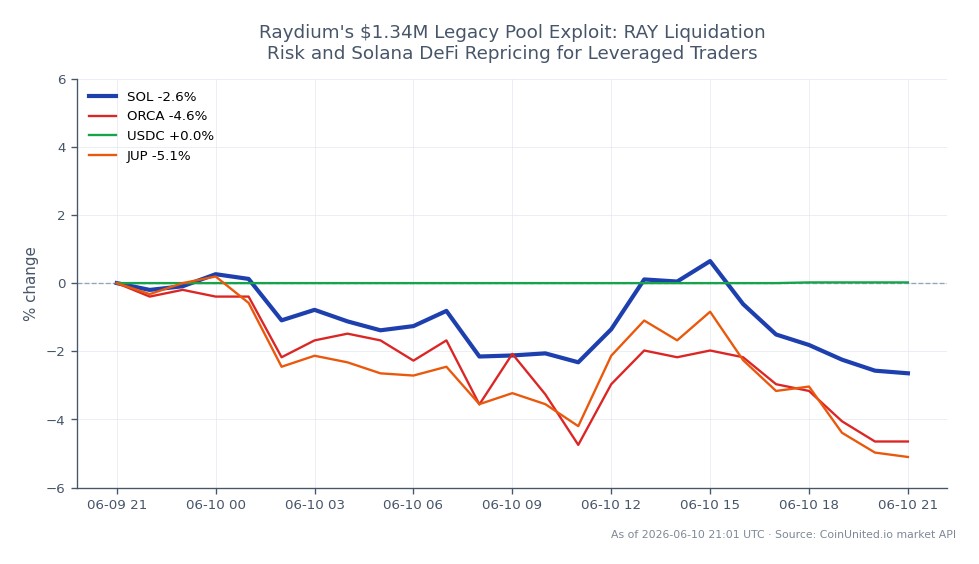
- •SOL is already down 3.70% to $63.16 with a 24h low of $62.91 — leveraged long positions have minimal margin cushion against further sentiment-driven selling.
- •Stolen funds routed through Tornado Cash and deBridge reinforce the regulatory narrative against DeFi privacy infrastructure, adding medium-term policy risk to bridge and mixer-adjacent tokens.
- •Orca, Jupiter, and other Solana DeFi protocols face sentiment contagion risk as traders reassess legacy smart contract exposure across the ecosystem.
As reported by CryptoTimes and confirmed by PeckShield, Raydium — a leading Solana-based AMM and DEX — suffered a $1.34 million exploit targeting its legacy AMM V3 program. The attacker drained five d
Event Summary
As reported by CryptoTimes and confirmed by PeckShield, Raydium — a leading Solana-based AMM and DEX — suffered a $1.34 million exploit targeting its legacy AMM V3 program. The attacker drained five deprecated liquidity pools (phased out in 2021) by exploiting a logic flaw: the withdraw instruction failed to validate that the supplied LP mint was a genuine Raydium LP mint. The attacker created a fake LP token mint with just 1 token, called `withdraw`, and claimed 100% of each pool's idle reserves — netting approximately 150,177 RAY, 5,603 SOL, and 893,700 USDC. Stolen funds were subsequently bridged to Ethereum and routed through Tornado Cash, deBridge, and FixedFloat.
Raydium confirmed no active users or live pools were affected, and committed to full reimbursement from its treasury. The exploit is classified as a self-contained logic flaw with no private key compromise and no propagation to current programs.
Leverage Impact Analysis
RAY perpetual traders face the sharpest near-term risk. Even with Raydium's treasury backstop, markets historically re-price protocol risk on any confirmed exploit — creating asymmetric downside for leveraged longs.
For SOL, live market data shows the token already trading at $63.16, down 3.70% on the day (24h range: $62.91–$65.73). This pre-existing weakness compresses the cushion for leveraged SOL longs. A trader holding a 100x long SOL perpetual entered at $65.00 faces a ~3% adverse move already — requiring only a further ~0.5–1% slide to approach liquidation thresholds depending on margin tier. With sentiment pressured by the exploit narrative, tight stops are critical.
For RAY longs, the treasury drawdown is a direct balance-sheet hit to RAY holders. High-leverage RAY positions (50x+) should treat $1.34M treasury depletion as a governance risk catalyst, not just a one-day event. Monitor whether Raydium discloses further legacy contract liabilities — any secondary revelation would amplify downside sharply. Check funding rates on CoinUnited.io for real-time positioning skew before entering.
Cross-Market Impact
This is a crypto-native event with limited macro spillover, but meaningful within the DeFi structural reset theme. The Solana DeFi ecosystem — including Orca and Jupiter — faces sentiment contagion risk, as traders reassess legacy contract exposure across all Solana AMMs. Protocols that haven't actively deprecated old code may see elevated risk premiums.
USDC itself faces no reserve or peg risk from the ~$893K drained — the stablecoin impact is purely transactional. However, the Tornado Cash laundering route feeds into existing regulatory narratives around DeFi mixer usage, incrementally pressuring the crypto regulatory environment for bridge and privacy-adjacent protocols. For a broader context on how DeFi exploits resolve, see the DeFi Protocol Exploits guide.
Broad equity indices, FX, and commodities are not materially impacted at this dollar size.
Trading Considerations
For SOL, the 24h low of $62.91 is the immediate support to watch — a clean break below opens a test of the next volume cluster lower. The 24h high of $65.73 represents near-term resistance; recovery above that level would reduce exploit-driven sentiment overhang. Traders should monitor Solana DeFi TVL data for signs of capital rotation out of the ecosystem.
For RAY, watch Raydium's official communications for any disclosure of additional legacy contract risks — this is the key binary event that could extend the repricing. Open interest trends on RAY perpetuals will confirm whether the market treats this as a contained event or a structural re-rating.
Trade Solana on CoinUnited.io
Trade SOL with up to 2000xx leverage → | Create Free Account
Frequently Asked Questions
The $1.34M treasury reimbursement is a direct balance-sheet hit to RAY holders, creating downside pressure on high-leverage RAY longs. Any disclosure of additional legacy contract liabilities would act as a secondary catalyst — monitor Raydium's official channels and check funding rates on CoinUnited.io before sizing positions.
Continue Exploring
Disclaimer: This brief is for educational purposes only and is not investment advice.