Quick Links
Zcash Counterfeiting Vulnerability: ZEC Crashes 31% as Protocol Integrity Fears Hit Leveraged Traders
Data Snapshot
Key Takeaways
- •ZEC fell 31.25% to $405.00 (24h range $386.31–$473.97) after ECC confirmed a 2018 Sprout pool bug enabling potential unlimited counterfeit ZEC minting.
- •Any ZEC leveraged long opened above ~$420 with 50x leverage on CoinUnited.io would have been liquidated — a 31% move is 16x the margin threshold at that leverage level.
- •The vulnerability is patched (Sapling upgrade, October 2018), but Zcash's privacy design means unlimited minting can never be mathematically ruled out — a permanent risk premium is now justified.
- •Cross-market spillover to BTC and ETH is limited; the main contagion vector is the broader privacy-coin complex and early zk-SNARK projects that shared code or trusted-setup parameters.
- •Regulatory risk is amplified: the disclosure provides direct ammunition for further privacy-coin scrutiny, potential delistings, and tighter KYC/AML enforcement at regulated venues.
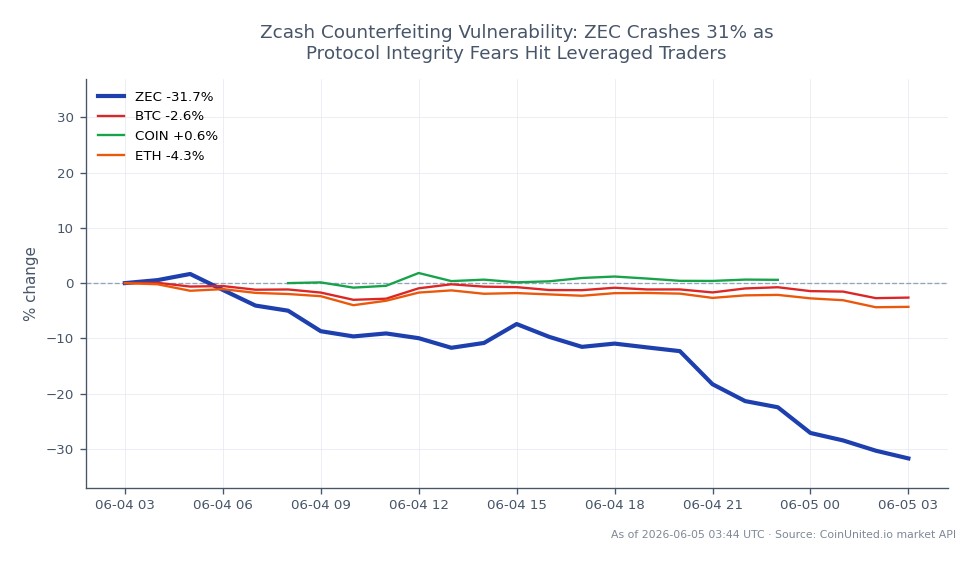
According to the Electric Coin Company's (ECC) official disclosure, a critical counterfeiting vulnerability existed in Zcash's original Sprout shielded pool — the zk-SNARKs-based proving system underp
Event Summary
According to the Electric Coin Company's (ECC) official disclosure, a critical counterfeiting vulnerability existed in Zcash's original Sprout shielded pool — the zk-SNARKs-based proving system underpinning ZEC's privacy guarantees. As reported by Fortune and The Hacker News, the bug was discovered internally in March 2018 by ECC engineer Ariel Gabizon and allowed an attacker to mint arbitrarily large amounts of shielded ZEC without detection by exploiting a flaw in the parameter setup of Zcash's zero-knowledge proof construction.
ECC patched the vulnerability via the Sapling network upgrade on 28 October 2018, then publicly disclosed the full details in February 2019. Critically, because Zcash's shielded pool is private by design, it is mathematically impossible to fully prove that no counterfeit coins were created prior to the fix — though ECC and community monitoring found no anomalies indicating large-scale exploitation. ZEC is currently trading at $405.00, down 31.25% on the day (24h range: $386.31–$473.97).
Leverage Impact Analysis
A 31% single-session move is a liquidation cascade event for leveraged traders. At CoinUnited.io's up to 2000x leverage on ZEC perpetuals, the math is severe:
- -Long position example: A trader with 50x leverage on ZEC entered at $473.97 (24h high) now faces a 31% drawdown. At 50x, a 2% adverse move triggers liquidation — this move is 16x that threshold. Any long opened above ~$420 with 50x leverage has been wiped.
- -Short opportunity: Traders who anticipated protocol-integrity repricing and opened 20x shorts near $473.97 would be sitting on roughly 600% returns on margin before fees.
- -Funding rate watch: Extreme bearish pressure typically flips funding rates negative as short demand surges. Monitor funding rates on CoinUnited.io — persistent negative funding may signal overcrowded shorts and a mean-reversion risk.
- -Position sizing: Given that the vulnerability is patched (2018 Sapling upgrade) but the supply-integrity question can never be fully closed, volatility is likely to remain elevated. Traders sizing into ZEC perpetuals should reduce notional exposure significantly versus standard crypto positions.
This type of "inflation-bug" disclosure — where a hard-capped asset's supply integrity is questioned — tends to produce multi-day volatility, not a single-session reset. Check open interest on CoinUnited.io for confirmation that leveraged positioning has cleared before re-entering.
Cross-Market Impact
The direct spillover to Bitcoin and Ethereum is limited — this is ZEC-specific protocol risk, not a sector-wide smart contract exploit. However, the event carries important thematic signals across markets:
- -Privacy-coin complex: Zcash forks and other early zk-SNARK privacy coins that reused code from Zcash's parameter-generation ceremonies face elevated structural risk repricing. Per ECC's disclosure, any project inheriting this proof system without independent patching carries analogous tail risk.
- -ZK-rollup ecosystem: As noted in the research, this event supports a more conservative stance on protocol risk for ZK-rollup tokens and L1/L2 chains marketing advanced zero-knowledge systems — particularly those with trusted setup ceremonies. See our Polyhedra Network (ZKJ) guide for context on ZK-infrastructure risk.
- -Crypto equities: Coinbase Global and other listed exchanges with ZEC listings face marginal fee-revenue headwinds from reduced ZEC trading activity and potential delisting pressure. The signal for equity investors is that protocol-level cryptographic bugs increase compliance and legal risk for custodians — a modest negative for exchange multiples.
- -Regulatory narrative: This disclosure arms regulators arguing that privacy coins have opaque supply dynamics. Increased delisting or KYC/AML scrutiny of ZEC across regulated venues could further compress long-term demand.
Trading Considerations
ZEC is trading at $405.00 with the 24h low at $386.31 acting as immediate support. A confirmed close below $386 opens downside toward prior structural levels with limited buy-side support given the supply-integrity narrative overhang. The 24h high of $473.97 now acts as near-term resistance — a recovery above this level would require credible counter-narratives (e.g., independent supply audit results).
The core risk factor is that the vulnerability, while patched, cannot be retrospectively disproven. This permanent tail risk justifies a structurally higher risk premium on ZEC versus peers. For leveraged traders, reduced position sizing and wider stop-loss buffers are warranted given the potential for continued volatility as the market fully digests the disclosure. Review our guide on crypto derivatives trading for risk management frameworks applicable to volatile single-asset moves.
Trade Zcash on CoinUnited.io
Trade ZEC with up to 2000xx leverage → | Create Free Account
Frequently Asked Questions
At 3x leverage, a trader can theoretically withstand a ~33% drawdown before liquidation — meaning only positions with 3x or lower survived the full move intact. Any leverage above ~3x on longs opened near the daily high would have been liquidated.
Continue Exploring
Disclaimer: This brief is for educational purposes only and is not investment advice.