Quick Links
MiCA D-Day: EU's July 1 Crypto Deadline Forces Exchange Delistings — Leverage Traders Face Liquidity Fragmentation
Key Takeaways
- •July 1 is a hard EU compliance cutoff — exchanges without MiCA authorization must restrict services to EU users, not a soft deadline.
- •Leveraged traders on USDT-margined perpetuals at EU-restricted venues face potential forced collateral migration or position closure — switch to USDC margin to reduce compliance risk.
- •USDC and Circle/Coinbase are structural beneficiaries; BNB faces direct downside risk if Binance's EU access is curtailed.
- •BTC and ETH have no direct delisting risk under MiCA but remain exposed to sentiment contagion and collateral-driven deleveraging.
- •This event fits the broader crypto regulatory convergence trend — MiCA is a template, not an endpoint; monitor for copycat frameworks in APAC and Latin America.
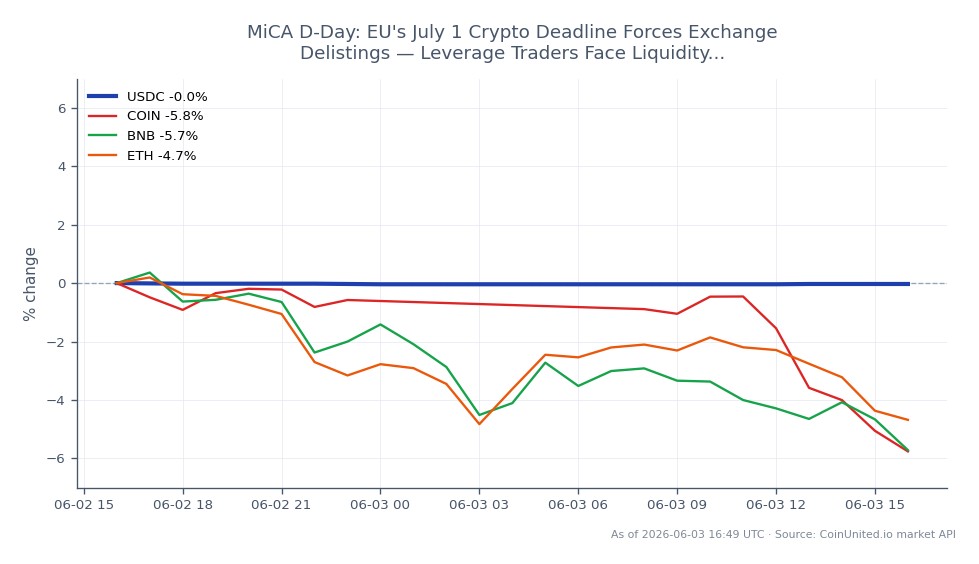
The European Union's Markets in Crypto-Assets (MiCA) regulation grace period expires on July 1, 2025, marking a hard cutoff for crypto firms operating across EU member states. Exchanges and service pr
Event Summary
The European Union's Markets in Crypto-Assets (MiCA) regulation grace period expires on July 1, 2025, marking a hard cutoff for crypto firms operating across EU member states. Exchanges and service providers that have not obtained full MiCA authorization must cease offering non-compliant products — most critically, unauthorized stablecoins — to EU-based users. This deadline follows an 18-month transition window that began when MiCA's stablecoin provisions took effect in mid-2024. Platforms including major centralized exchanges have been issuing delisting notices for non-MiCA-compliant stablecoins (notably Tether's USDT in several jurisdictions), while Circle's USDC and EURC have emerged as the primary compliant alternatives given Circle's registered status under MiCA.
The enforcement cutoff is not a soft guideline — EU national competent authorities (NCAs) are empowered to impose trading suspensions and fines on non-compliant operators. Firms without a MiCA license face immediate service restrictions for EU customers, creating a hard binary: comply or exit the EU market.
Leverage Impact Analysis
For leveraged traders, the July 1 cutoff introduces two acute risks: liquidity fragmentation and funding rate instability.
With USDT facing delisting pressure across EU-facing platforms, traders who use USDT-margined perpetuals on those venues face forced migration of collateral. A trader running a 100x BTC/USDT perpetual on an EU-restricted exchange must either convert margin to a compliant stablecoin or close the position — both actions generate market impact at scale. Position closures across a fragmented user base can compress open interest abruptly, widening bid-ask spreads precisely when traders need tight execution.
Funding rates on BTC and ETH perpetuals may spike in the short window around the deadline as net positioning shifts. If large leveraged longs on EU-restricted venues close simultaneously, local funding rates can flip negative — a signal that short-side pressure is building. Monitor open interest on CoinUnited.io for confirmation. Traders using USDC as margin are structurally insulated from this specific compliance shock.
The broader crypto regulatory & tax reckoning adds a regime-level overhang: if NCAs make high-profile enforcement examples in early July, sentiment could cascade into a broader deleveraging event across BTC, ETH, and BNB.
Cross-Market Impact
The MiCA deadline is primarily a crypto-structural event, but spillover is material in two areas:
Coinbase (COIN): Circle's MiCA compliance directly benefits Coinbase, a Circle co-owner. COIN equity CFDs may see positive divergence from broader crypto weakness as USDC captures EU stablecoin market share — a key angle within the stablecoin institutional buildout thesis. Watch Coinbase stock as a long hedge against broad MiCA-driven crypto bearishness.
BNB: Binance's EU regulatory standing has been contested. If Binance faces service restrictions for EU users post-July 1, BNB faces direct sell pressure as exchange volume and fee revenue decline.
BTC & ETH: Neither is classified as an asset token under MiCA, so direct delisting risk is minimal. However, collateral liquidations and sentiment contagion remain secondary risks, particularly for Bitcoin if broader risk-off develops.
Trading Considerations
Key levels to watch: any sharp USDT depeg widening (even briefly to $0.997–$0.995) would be an early stress signal triggering liquidation cascades on USDT-margined books. For BTC, the 2026 Crypto Market Outlook highlights regulatory overhang as a persistent headwind — position sizing should reflect elevated tail risk around the July 1 date.
Traders should review margin currency exposure now. Switching perpetual collateral to USDC reduces compliance-driven forced-close risk. The SEC-IMF crypto regulatory convergence theme suggests MiCA sets a template other jurisdictions may follow — medium-term structural pressure on non-compliant stablecoin liquidity globally.
Start Trading on CoinUnited.io
Create Your Free Account → — Trade crypto, stocks, forex, indices, and commodities with up to 2000x leverage and zero fees.
Frequently Asked Questions
CoinUnited.io is a global platform — MiCA's direct restrictions apply to EU-licensed exchanges serving EU users. However, if large EU-based exchanges delist USDT and trigger mass collateral migration, it can reduce liquidity and widen spreads on BTC perpetuals globally, increasing slippage risk on high-leverage entries and exits.
Continue Exploring
Disclaimer: This brief is for educational purposes only and is not investment advice.