Quick Links
RBI's Malhotra Flags Generalised Inflation Risk: Leverage Map for USD/INR, WTI, and Cross-Market Repricing
Data Snapshot
Key Takeaways
- •RBI held repo rate at 5.25% with a neutral stance but Governor Malhotra explicitly conditioned future action on whether supply shocks become generalised — a compression of dovish expectations.
- •Leveraged USD/INR longs face policy headwinds: a hawkish RBI response to broadening CPI would trigger INR appreciation and rapid margin compression on high-leverage short-rupee positions.
- •WTI at $94.07 is central to the RBI's inflation calculus — sustained oil above $95 increases the probability Malhotra's conditional warning becomes active policy, extending cross-asset volatility.
- •Cross-market read: mild headwind for EM risk assets and INR carry trades; limited direct impact on S&P 500 and crypto unless EM risk-off sentiment broadens.
- •The next India CPI data release is the true trigger event — not today's statement. Position sizing should account for binary volatility around that print.
Reserve Bank of India Governor Sanjay Malhotra signalled on April 8, 2026 that the central bank stands ready to act if supply-side price pressures become embedded in broader inflation, according to re
Event Summary
Reserve Bank of India Governor Sanjay Malhotra signalled on April 8, 2026 that the central bank stands ready to act if supply-side price pressures become embedded in broader inflation, according to reporting by the Economic Times. The RBI held its repo rate unchanged at 5.25% (Standing Term Facility at 5.00%, Marginal Standing Facility at 5.50%) with a neutral policy stance maintained since June 2025. Malhotra's warning centres on whether food and energy supply shocks migrate into core inflation — the trigger condition that would shift the RBI from watchful to active. Headline inflation had been running below the 4% target in early 2026, but the governor's language signals the bar for further easing has risen.
This is a macro inflation pressure signal with direct read-throughs for Indian rates, the rupee, and EM-linked risk assets globally. Traders should treat this as a conditional hawkish tilt — not a rate hike announcement — but one that materially compresses the probability of near-term RBI easing.
Leverage Impact Analysis
The conditional hawkish stance raises volatility risk for leveraged USD/INR positions. With the RBI prepared to defend against generalised inflation, INR weakness plays face a policy headwind. A trader holding a 100x long USD/INR position (long dollar, short rupee) must now price in the risk that a hawkish RBI print — triggered by broadening CPI — causes sharp INR appreciation, compressing spreads rapidly.
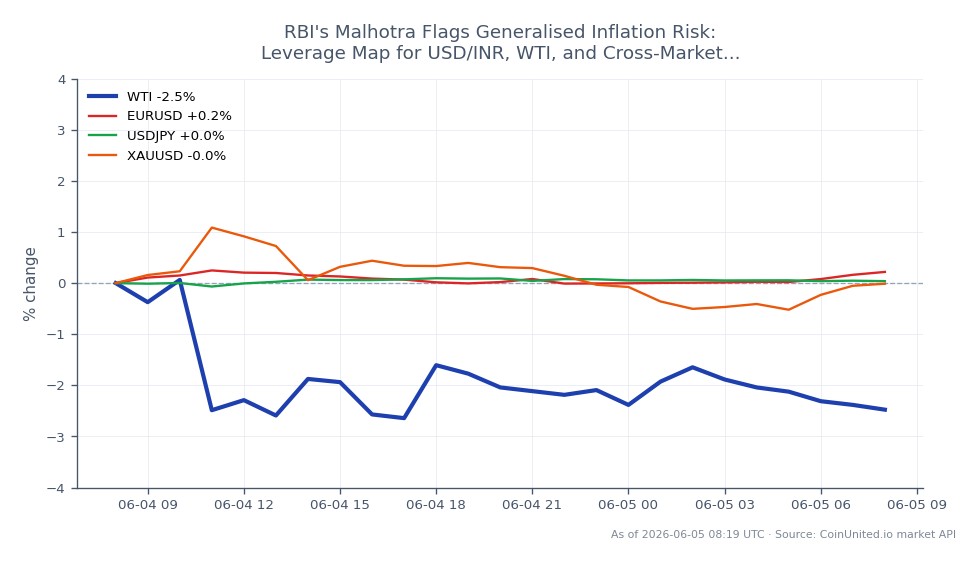
For WTI light crude oil at $94.07 (24h range: $93.54–$95.04, down 0.50%), the RBI's supply-shock framing is directly connected to energy import costs. India is the world's third-largest crude importer; elevated WTI sustains the very inflation pressures Malhotra flagged. A 50x long WTI CFD opened at $94.07 faces a layered risk: if oil stays elevated, RBI hawkishness deepens, pressuring Indian growth stocks and INR-funded carry trades — creating cross-asset contagion rather than a single-instrument move. Monitor stagflation risk signals closely: sustained WTI above $95 alongside sticky core CPI could accelerate the RBI's policy reaction timeline, generating rapid volatility spikes that erode leveraged margin buffers quickly.
Cross-Market Impact
INR & EM FX: The RBI's neutral-but-vigilant posture marginally supports the rupee versus peers where central banks are actively cutting. Carry trades funded in INR face repricing risk if the policy path diverges from earlier dovish expectations.
WTI & Brent Crude Oil: India's crude demand profile means RBI policy tightening signals can dampen demand-side expectations at the margin, applying modest downward pressure on oil. However, the dominant WTI driver remains geopolitical supply risk — see the oil geopolitical risk-off theme — which currently outweighs demand-side signals from a single EM central bank.
Gold: A more restrictive RBI environment reduces domestic gold-buying appetite in India (the world's second-largest consumer), a mild headwind for gold at the margin. However, if generalised inflation broadens, inflation hedge demand globally could offset this.
S&P 500 & Global Equities: Limited direct impact. The indirect channel runs through EM risk sentiment — if India's inflation broadens and RBI tightens, EM equity outflows can temporarily pressure global risk appetite, with modest knock-on to US indices.
BTC/ETH: The macro inflation risk-off repricing theme applies if the RBI signal contributes to a broader EM risk-off mood. Crypto correlates with risk sentiment in stress periods; monitor whether this combines with other EM inflation prints.
Trading Considerations
Key level to watch on WTI: $95.04 (24h high) acts as immediate resistance; a sustained break above $95 reinforces the RBI's supply-shock concern and extends the conditional hawkish read. For USD/INR, the key question is whether headline CPI data in coming weeks confirms generalisation of food/energy into core — that data print, not today's statement, is the true trigger event.
For leveraged positions, this event raises implied volatility risk on INR pairs and energy CFDs. Check live funding rates on CoinUnited.io before sizing positions, as elevated geopolitical and central bank uncertainty can widen spreads. For a broader framework on trading this inflation regime, the macro inflation trading strategy guide provides context on position construction across rate environments.
Trade WTI Light Crude Oil on CoinUnited.io
Trade WTI with up to 1000xx leverage → | Create Free Account
Frequently Asked Questions
Long USD/INR positions (short rupee) now face a policy headwind — if India CPI data shows generalisation into core inflation, an RBI response would likely appreciate the INR sharply, compressing margins on high-leverage dollar-long trades rapidly. Reduce position size ahead of the next CPI print.
Continue Exploring
Disclaimer: This brief is for educational purposes only and is not investment advice.