Quick Links
May NFP +172k Blows Past Forecasts: Fed Cut Bets Collapse, USD Surges — Leverage Scenarios Across Forex, Indices & Gold
Data Snapshot
Key Takeaways
- •May NFP printed +172k vs ~88k expected — a ~90k upside surprise that is the largest labor beat in recent months, per BLS and Fortune.
- •Leveraged long positions in Nasdaq CFDs (50x+) absorbed ~70%+ notional losses on the 1.4% index decline; Gold longs face liquidation pressure with XAUUSD down 3.22% to $4,332.85.
- •USD broadly strengthened across majors — USD/JPY and USD/CAD are the primary forex expression vehicles; EUR/USD faces continued headwinds from Fed-ECB rate divergence.
- •Strong labor + WTI near $93/bbl creates a dual inflationary signal, reducing Fed easing optionality and sustaining a higher-for-longer rates narrative.
- •Crypto trades as high-beta risk: BTC and ETH face indirect pressure via tighter USD liquidity and elevated opportunity cost, with crypto-proxy equities likely underperforming Nasdaq.
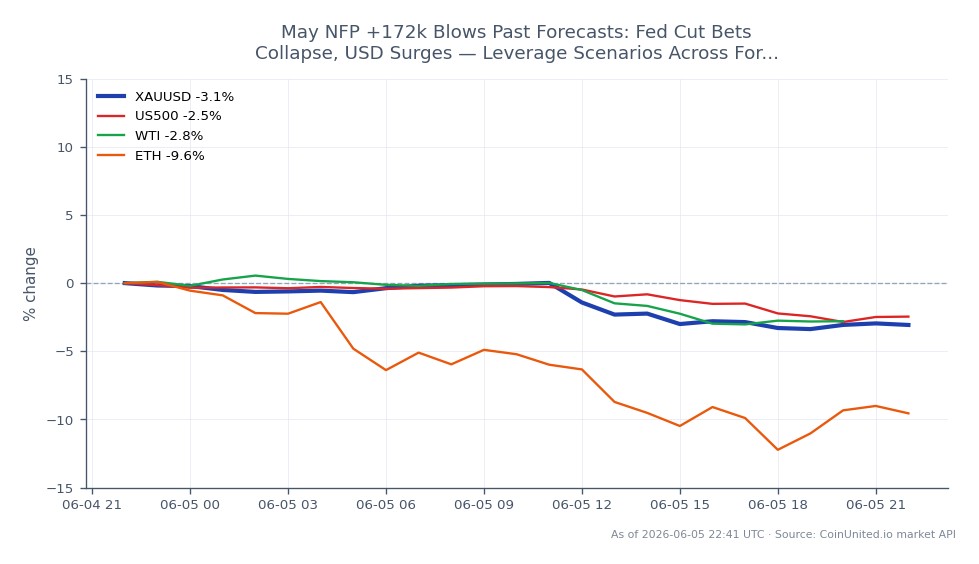
According to the U.S. Bureau of Labor Statistics, May 2026 nonfarm payrolls came in at +172,000 — roughly double the consensus estimate of ~88,000 — while the unemployment rate held steady at 4.3%. As
Event Summary
According to the U.S. Bureau of Labor Statistics, May 2026 nonfarm payrolls came in at +172,000 — roughly double the consensus estimate of ~88,000 — while the unemployment rate held steady at 4.3%. As reported by Fortune, April payrolls were also revised up to +115,000, reinforcing labor market resilience. Job gains were concentrated in health care, transportation and warehousing, and retail trade, while federal government employment continued to decline.
The print triggered immediate cross-asset repricing: per Times of India coverage of June 5 US markets, the S&P 500 fell ~0.7%, the Nasdaq dropped ~1.4%, and bond yields surged as traders slashed near-term Fed rate-cut expectations. This is a textbook Fed macro policy crossroads event — stronger labor data pushes the "higher-for-longer" narrative firmly back into the driver's seat.
Leverage Impact Analysis
The NFP shock creates asymmetric danger for leveraged longs in rate-sensitive assets and leveraged USD shorts.
Forex — USD/CAD example: A trader holding a 100x long USD/CAD position benefits from the USD bid driven by higher yields. Every 10-pip move equals 10x the notional pip value at 100x leverage — tight stop discipline is essential as oil prices (WTI near $93/bbl) provide a partial offset for CAD, creating two-way volatility risk. Conversely, a 100x short EUR/USD position opened pre-NFP would see amplified gains as the dollar strengthens into higher-yield repricing — but any Fed communications softening the hawkish read could trigger rapid reversal.
Indices — Nasdaq CFD example: A trader with a 50x long US100 CFD faces a ~1.4% index decline translating to ~70% notional loss on margin. At 100x leverage, the same move approaches full liquidation territory. Big tech names like Nvidia and Broadcom led the decline, per Times of India reporting — traders monitoring the 2026 Global Indices Outlook should note that long-duration tech valuations remain most exposed when yields spike on labor beats.
Gold — XAUUSD: Live market data shows Gold/USD currently at $4,332.85, down 3.22% on the day (24h range: $4,332.85–$4,335.85). A trader with a 50x long Gold CFD opened above today's high is now deeply underwater. Rising real yields compress gold's non-yielding appeal — check open interest and funding rates on CoinUnited.io for confirmation of further downside pressure. Our Gold vs. US Dollar trader's guide covers this dynamic in depth.
Cross-Market Impact
The NFP beat creates a consistent USD-positive, yield-positive, risk-asset-negative backdrop across all five major markets:
- -Forex: USD broadly bid. USD/JPY faces upward pressure as yen remains a low-yielder — watch for potential Bank of Japan intervention chatter if USD/JPY breaks key resistance. EUR/USD faces headwinds from the widening US-EU rate differential, relevant to the Fed & ECB policy divergence theme.
- -Indices: S&P 500 down ~0.7%, Nasdaq ~1.4%. Semiconductor and AI names (Nvidia, Broadcom) led declines. Asian tech (SK Hynix, Samsung, Tokyo Electron) followed in subsequent sessions.
- -Commodities: WTI crude at ~$93/bbl provides a partial inflation offset — strong labor + elevated energy = sustained inflationary pressure, reinforcing the macro inflation risk-off repricing theme. Gold under direct pressure from higher real yields.
- -Crypto: Bitcoin and Ethereum trade as high-beta risk assets. Tighter USD liquidity and higher opportunity cost weigh on the complex indirectly — crypto-proxy stocks (MSTR, COIN, MARA) likely underperformed alongside Nasdaq. See the 2026 Crypto Market Outlook for macro sensitivity context.
Trading Considerations
Key levels to monitor: Gold support at current $4,332.85 is the immediate floor — a break lower opens further downside given the yield shock. For Nasdaq CFDs, the ~1.4% post-NFP decline establishes a near-term resistance zone; any Fed speaker softening the hawkish interpretation could trigger sharp short-covering rallies, dangerous for high-leverage shorts.
The primary risk to the "higher-for-longer" trade is a surprise softening in inflation data (CPI, PCE) that decouples rate expectations from labor strength. Monitor Fed speaker commentary in coming days for any pushback on market repricing. For USD/CAD specifically, oil price direction (Hormuz Strait risk premium) remains a live countervailing force — review the Iran conflict energy markets guide for commodity channel context.
Trade Gold / US Dollar on CoinUnited.io
Trade XAUUSD with up to 2000xx leverage → | Create Free Account
Frequently Asked Questions
The strong jobs print supports a USD bid via higher yields, benefiting long USD/CAD; however, WTI near $93/bbl cushions CAD, creating two-way volatility risk that can rapidly liquidate positions at 100x+ leverage on any oil-driven CAD rally.
Continue Exploring
Disclaimer: This brief is for educational purposes only and is not investment advice.