Quick Links
Dow Hits All-Time Highs on Financials & Healthcare Rotation: Leverage Scenarios & Cross-Market Impact
Data Snapshot
Key Takeaways
- •The DJIA's price-weighting means a 3%+ move in UNH or a major bank can swing the index 100–200 points — leveraged Dow longs face outsized liquidation risk from single-stock healthcare/financial headlines.
- •Healthcare posted ~5% weekly gains and financials ~2% per commentary sources — the rotation from AI/tech to value/defensive sectors is live and measurable.
- •Long Dow / Short Nasdaq is the clearest relative-value expression of this rotation; NASDAQ is expected to lag if AI sentiment continues to cool.
- •USD support from stable-to-rising yields aligned with financials outperformance creates a mild headwind for risk-currencies (AUD, NZD) and Gold near-term.
- •UNH's ~20% January crash followed by a 3.1% recovery (adding 55+ Dow points on Feb 13) illustrates how a single managed-care stock can dominate index-level P&L for leveraged traders.
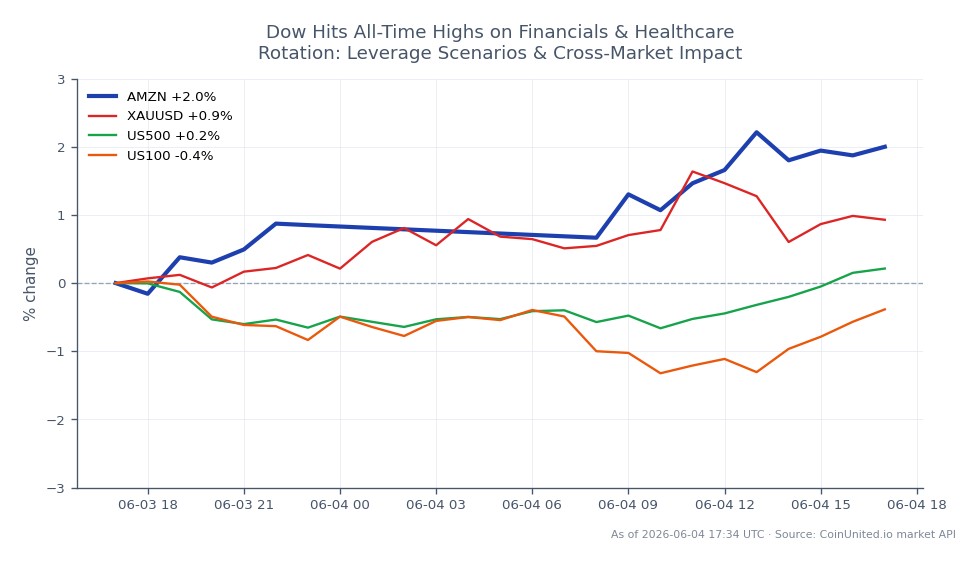
According to FXStreet, the Dow Jones Industrial Average has rallied to fresh all-time highs, with the advance led by banking/financial stocks and a breakout in healthcare names — marking a clear rotat
Event Summary
According to FXStreet, the Dow Jones Industrial Average has rallied to fresh all-time highs, with the advance led by banking/financial stocks and a breakout in healthcare names — marking a clear rotation away from the concentrated AI/tech trade that dominated earlier in 2026. As reported by markets.financialcontent.com, UnitedHealth Group (UNH) delivered a 3.1% single-session gain on February 13, 2026, adding over 55 Dow points in one day — a vivid illustration of how the Dow's price-weighted methodology amplifies moves in high-priced components. Healthcare is described as posting approximately 5% weekly gains while financials have gained over 2% over the same period, per YouTube market commentary.
The rotation thesis is explicit: investors are easing back from overexposed AI/tech positions and rotating into defensive/value sectors — major banks, managed care, pharma, and medical equipment. Seasonal data cited in commentary shows financials averaging approximately 8.5% gains in Q4 historically, with the sector comprising a large share of the Dow's weight.
Leverage Impact Analysis
For traders running US30 CFD positions with high leverage, the sector composition shift is the critical variable — not just index direction.
Worked Example — Long US30 CFD: A trader long the Dow at 42,000 with 50x leverage controls $2,100,000 in notional exposure. A 1% Dow advance (+420 points) returns $21,000 on margin — but a single adverse healthcare or financial headline (e.g., a deteriorating Medical Care Ratio print for UNH, or a credit-quality scare at a major bank) could swing the index 200–400 points intraday. At 50x, a 0.5% adverse move represents a full margin loss of $10,500.
Liquidation risk is asymmetric here: the Dow's price-weighting means a 3–4% gap down in UNH or Goldman Sachs can move the index 100–200 points before risk systems react. Traders should monitor UNH's Medical Care Ratio (MCR) releases and bank earnings guidance as lead indicators — these are direct liquidation triggers for leveraged Dow longs, more so than macro data.
For those expressing the financials & industrials earnings beat thesis via individual stock CFDs on JPMorgan or Goldman Sachs, leverage amplifies both sector tailwinds and regulatory/rate reversal risk. Position sizing should reflect that single-stock CFDs at high leverage (e.g., 100x long JPM) face outsized drawdown if Fed rate expectations shift dovish and compress net interest margin forecasts.
Cross-Market Impact
This rotation has identifiable ripple effects across all five asset classes available on CoinUnited:
- -S&P 500 & NASDAQ 100: The move implies relative underperformance of high-beta tech. A Long Dow / Short Nasdaq pair trade is a direct expression of the cross-sector liquidity rotation thesis. Watch for NASDAQ lagging if AI sentiment cools further.
- -Forex (USD): Financial sector outperformance typically aligns with stable-to-rising yields, which supports USD through capital inflows. Stronger USD is a mild headwind for AUD/NZD and EM FX — watch the DXY for confirmation that rate expectations are supporting the financials bid.
- -Gold: A confident, broad-based equity rally in blue-chip defensives reduces safe-haven urgency. Gold faces modest near-term headwinds if the rotation signals macro stability rather than fear-driven accumulation.
- -Crypto: The Dow's price-weighted structure has limited direct crypto-proxy exposure (unlike the NASDAQ). Near-term, sustained Dow strength can dampen crypto's role as a risk hedge, though risk-on appetite broadly can lift major crypto assets. Amazon (AMZN, currently $254.16, +1.15% on the day) trades within this risk-on regime — its AWS/AI positioning keeps it a cross-market sentiment barometer.
Trading Considerations
Key risk factors for leveraged Dow longs: UNH's MCR trajectory, bank net interest margin guidance, and any Fed rate pivot language that could compress financial sector valuations. Support sits at recent breakout levels; a failure to hold all-time highs would signal the rotation is fading. Traders should watch earnings miss recovery setups in healthcare names that have already had large single-day drops — UNH's prior ~20% January crash followed by a 3.1% recovery bounce is a textbook pattern. Monitor Fed policy signals closely, as the sustainability of financials leadership is directly rate-dependent.
Trade Amazon.com, Inc. on CoinUnited.io
Trade AMZN with up to 1000xx leverage → | Create Free Account
Frequently Asked Questions
Due to the Dow's price-weighting, a 3.1% UNH move translates to over 55 index points in a single session — at 50x leverage on a US30 CFD, that alone can represent a meaningful percentage of your margin. Always size positions to withstand single-component swings, especially around MCR and earnings releases.
Continue Exploring
Disclaimer: This brief is for educational purposes only and is not investment advice.