Quick Links
Rémy Cointreau FY26 Profit Hit Eased but Still Painful: What the Tariff Relief Really Means
Data Snapshot
Key Takeaways
- •U.S. tariff impact on Rémy Cointreau reduced to €20m (from €35m) after U.S.-EU agree a 15% rate on European wines and spirits.
- •Total global tariff headwind remains €30m (China unchanged at €10m) — a partial win, not a clean bill of health.
- •FY26 current operating profit guidance revised to mid-single-digit organic decline — still a deterioration from FY25's already-depressed €217m base.
- •Sector read-through is negative for European spirits peers (e.g. Pernod Ricard) with concurrent U.S. and China exposure.
- •The 15% tariff framework is a live policy variable; further guidance revisions remain possible if trade negotiations shift.
Rémy Cointreau has updated its fiscal 2025-26 guidance following a formal U.S.-EU agreement on a 15% tariff rate for European wines and spirits imports — down from the previously feared 30% scenario.
Event Analysis
Rémy Cointreau has updated its fiscal 2025-26 guidance following a formal U.S.-EU agreement on a 15% tariff rate for European wines and spirits imports — down from the previously feared 30% scenario. According to the company's official press release and reporting by The Spirits Business and RTE News, the U.S. tariff impact is now estimated at €20 million on current operating profit, reduced from an earlier estimate of €35 million. The Chinese tariff drag remains unchanged at €10 million, bringing total global tariff headwinds to €30 million, versus €45 million feared previously.
This is meaningful context for a company already under severe pressure: Rémy Cointreau reported €217 million in current operating profit for 2024-25, itself down 30.5% organically amid weak U.S. and Chinese demand. The revised FY26 guidance now points to a mid-single-digit organic decline in current operating profit — an improvement from the prior mid-to-high-single-digit decline outlook, but still a deteriorating trajectory. This is not a recovery story; it's a "less bad than feared" update. For traders tracking earnings miss and revenue shock dynamics, the distinction matters enormously in how markets price forward multiples.
What makes this event strategically significant is its role as a real-time read on U.S.-EU trade policy transmission into corporate earnings. The 15% tariff framework is a live policy variable — not yet fully stable — meaning future guidance updates remain contingent on geopolitical trade negotiations. Rémy Cointreau's exposure to both U.S. and Chinese tariff regimes simultaneously makes it a dual-front case study in how premium European consumer exporters absorb macro trade shocks. Peers like Pernod Ricard face structurally similar dynamics, so this guidance revision functions as a sector-wide signal.
What This Means for Traders
The market implication is bearish but with relief built in. The stock's reaction will depend heavily on whether the "less bad" guidance revision was already priced in following earlier tariff-war headlines. Traders watching how to trade earnings misses and guidance cuts should note that partial tariff relief often produces a short-covering bounce followed by resumed downward pressure once the market refocuses on the underlying volume weakness in both the U.S. and China. The FY25 base is weak, and a further mid-single-digit decline compounds an already deteriorated earnings base.
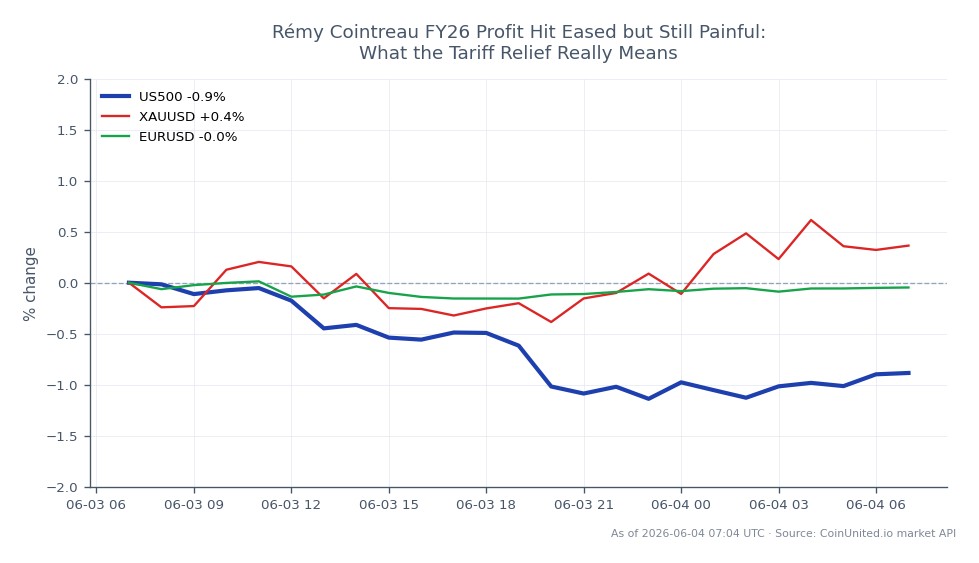
The sector read-through is negative for European spirits and premium consumer staples broadly. Any name with significant U.S. export exposure and concurrent China softness faces a similar margin compression narrative heading into the second half of 2025. For the S&P 500 Index and EUR/USD, the impact is minimal unless the tariff framework becomes a broader catalyst for U.S.-EU trade sentiment — worth monitoring but not a primary driver here. Gold is unaffected by this specific event.
Start Trading on CoinUnited.io
Create Your Free Account → — Trade crypto, stocks, forex, indices, and commodities with up to 2000x leverage and zero fees.
Frequently Asked Questions
Not clearly — operating profit is still declining on an already-weakened FY25 base, and both U.S. and Chinese demand remain soft. The guidance revision is 'less bad,' not a fundamental inflection point.
Continue Exploring
Disclaimer: This brief is for educational purposes only and is not investment advice.