Quick Links
Nasdaq Suffers Worst Day Since April — Rate Fear Triggers Broad Risk-Off, Leverage Liquidation Risk Spikes
Data Snapshot
Key Takeaways
- •Nasdaq Composite fell 2.3% to 22,870.36; Bloomberg cited it as the worst day since April 10 for Nasdaq 100/Composite (both -3%+).
- •Leverage warning: A 100x long US500 CFD at the 24h high of $7,574.85 would be down ~280% of initial margin at current $7,363.05 — well past liquidation threshold.
- •Rising 10-year Treasury yield (4.12%) is the macro driver — Fed rate-cut expectations are being priced out, compressing growth stock valuations.
- •Bitcoin fell below $99,000 alongside equities, confirming risk-off spillover into crypto; MSTR/COIN/MARA face dual equity+BTC pressure.
- •Cross-market: Gold faces a yield headwind despite equity stress; defensive sector rotation signals institutional re-positioning, not just a one-day flush.
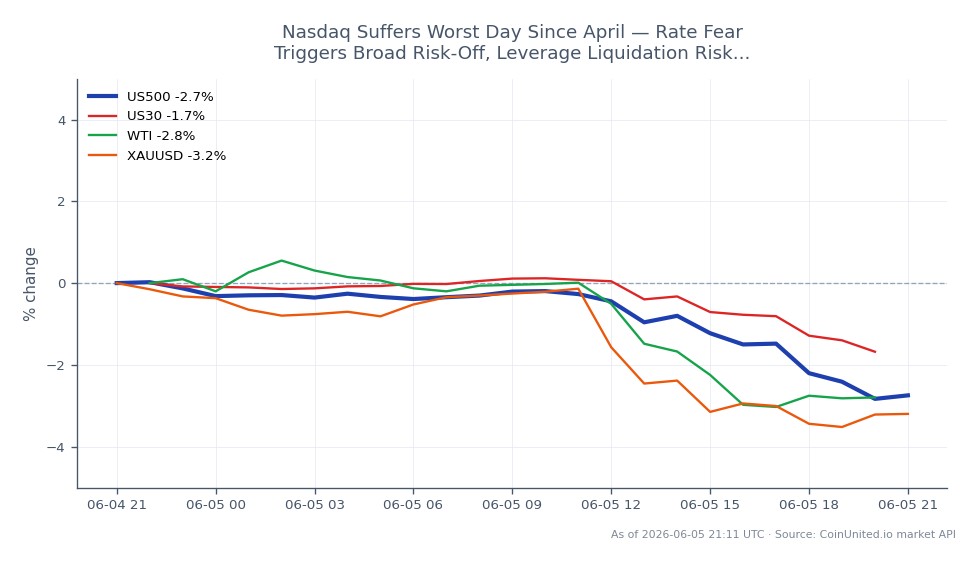
U.S. equities closed sharply lower in what Bloomberg described as the worst session for the Nasdaq 100 and Nasdaq Composite since April 10, with both benchmarks falling more than 3%. According to the
Event Summary
U.S. equities closed sharply lower in what Bloomberg described as the worst session for the Nasdaq 100 and Nasdaq Composite since April 10, with both benchmarks falling more than 3%. According to the Los Angeles Times, the Nasdaq Composite dropped 2.3% to 22,870.36, the S&P 500 Index declined 1.7%, and the Dow Jones shed 797.60 points. The selloff was broad-based, hitting tech, AI, and semiconductor leaders hardest: Nvidia fell 3.6%, Super Micro Computer -7.4%, Palantir -6.5%, and Broadcom -4.3%.
The catalyst was a reassessment of the Federal Reserve's rate path. Rising Treasury yields — with the 10-year climbing to 4.12% — compressed valuations on high-duration growth stocks. This is a textbook example of the Fed macro policy crossroads dynamic, where sticky-rate fears reprice the long end and punish Nasdaq-heavy growth portfolios.
Leverage Impact Analysis
With the US500 currently trading at $7,363.05 (down 2.78% on the day, 24h high $7,574.85), leveraged long positions opened near session highs face severe mark-to-market stress.
Worked example — US100 CFD long: A trader entering a 50x long US100 CFD near the 24h high faces a notional drawdown of ~3%+. At 50x leverage, that translates to ~150% of margin — a full liquidation event for positions not protected by additional margin buffers. Even a 20x long from the day's high would be down roughly 60% of margin, dangerously close to maintenance thresholds.
US500 scenario: A 100x long US500 CFD opened at $7,574.85 (24h high) is now sitting at $7,363.05 — a $211.80 adverse move (~2.8%). At 100x leverage, this wipes 280% of the initial margin, meaning liquidation would have triggered well before current levels for undercollateralized positions.
Short-side traders who entered before the breakdown are in profitable territory, but must monitor for sharp mean-reversion bounces that are common after single-day moves of this magnitude. Monitor open interest and funding rates on CoinUnited.io for confirmation of directional continuation.
Cross-Market Impact
The risk-off move transmitted broadly. Bitcoin fell back below $99,000 alongside equities, confirming high correlation with Nasdaq-beta during de-risking events — a pattern well-documented in the 2026 Crypto Market Outlook. Crypto-proxy stocks (MSTR, COIN, MARA) would face compounded pressure from both equity and BTC weakness.
Gold typically benefits from equity stress but faces a headwind here: rising real yields (10-year at 4.12%) reduce gold's relative appeal. Traders should watch whether gold decouples as a safe haven or remains capped by yield pressure — a tension explored in depth in the Gold vs. US Dollar guide.
EUR/USD may see mild USD demand as risk-off flows lift the dollar, compressing the pair. WTI crude faces demand-destruction concerns if equity weakness signals macro slowdown.
Defensive sector rotation (consumer staples outperforming per Bloomberg) suggests institutional positioning is shifting, not simply deleveraging — a signal that the move may persist rather than snap back immediately.
Trading Considerations
The US500 printed a 24h low of $7,347.55 — this level is the immediate support to watch. A break below confirms continuation; a reclaim above $7,450 would be the first sign of stabilization. The cross-sector liquidity flows guide outlines how capital rotation between growth and defensives typically evolves after yield-driven selloffs.
Key risk to bearish positions: any Fed communication softening the rate-higher narrative could trigger a sharp squeeze. Position sizing at elevated leverage must account for headline-driven reversals.
Trade S&P 500 Index on CoinUnited.io
Trade US500 with up to 2000xx leverage → | Create Free Account
Frequently Asked Questions
With US500 dropping ~2.78% from the 24h high, any long position using 36x leverage or more (with no additional margin buffer) would face theoretical liquidation before the current price level. At 100x, the margin was effectively wiped ~2.8x over.
Continue Exploring
Disclaimer: This brief is for educational purposes only and is not investment advice.