Quick Links
Morgan Stanley Cuts PDD Target to $130 — What the -11.7% Drop Means for Leveraged Traders
Data Snapshot
Key Takeaways
- •Morgan Stanley cut PDD's price target to $130 from $150 but retained Overweight — bearish near-term, constructive longer-term.
- •PDD is trading at $85.38, down 11.69% — a 50x leveraged long from ~$96 would have faced ~585% margin loss, a full liquidation event.
- •Any PDD long position opened above ~$94 with more than 8x leverage is likely already liquidated; new entries at $85 require careful sizing given continued analyst repricing risk.
- •Cross-market spillover is mostly sector-specific (China ADRs, NASDAQ sentiment) with limited macro impact on indices, forex, or commodities.
- •Multiple brokers cut targets simultaneously, signaling a consensus earnings reset — not a one-off downgrade — which sustains near-term selling pressure.
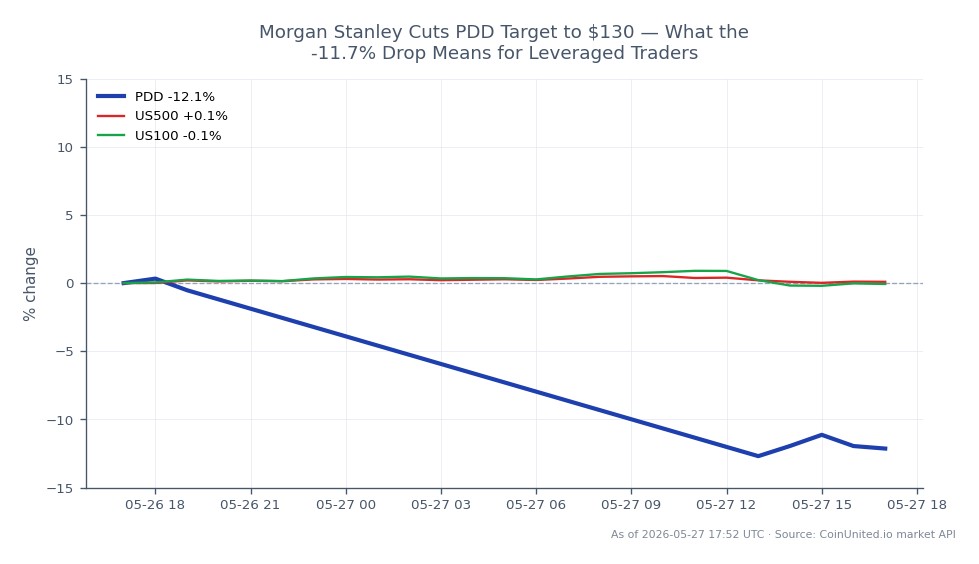
As reported by Investing.com, Morgan Stanley lowered its price target on PDD Holdings (NASDAQ: PDD) to $130 from $150, while maintaining an Overweight rating. The cut followed an earnings miss revenue
Event Summary
As reported by Investing.com, Morgan Stanley lowered its price target on PDD Holdings (NASDAQ: PDD) to $130 from $150, while maintaining an Overweight rating. The cut followed an earnings miss revenue shock tied to weaker-than-expected online marketing services revenue and slowing growth at Temu. Morgan Stanley was not alone — multiple brokers repriced targets in the same cycle, signaling a broad analyst consensus reset rather than an isolated call.
According to live market data, PDD is currently trading at $85.38, down 11.69% in the past 24 hours (24h High: $87.73 / 24h Low: $83.62). Notably, the stock is trading 34% below Morgan Stanley's revised $130 target, meaning the firm remains bullish on a multi-month horizon even as the near-term print is painful.
Leverage Impact Analysis
At CoinUnited.io's up to 2000x leverage on stock CFDs, PDD's 11.69% single-session move creates extreme liquidation pressure on leveraged longs.
Worked example — Long side: A trader opening a 50x long PDD CFD at yesterday's implied open (~$96.70 pre-drop) and holding into today's $85.38 print faces a ~11.7% move against a 50x position = ~585% loss on margin — a full liquidation event many times over. Even a modest 10x long would have been liquidated (10 × 11.7% = 117% margin loss).
Short side opportunity/risk: Shorts entered ahead of earnings at $96+ are now deeply profitable. However, with PDD trading 34% below Morgan Stanley's still-Overweight $130 target, aggressive short extensions carry mean-reversion risk. Shorts at current levels need to assess whether the $83.62 session low holds as support.
Key liquidation zone: Any long position opened above ~$94 with leverage exceeding 8x is likely already liquidated. New entries at $85 require careful position sizing — a 5% bounce to $89.65 would wipe a 20x short.
Monitor funding rates and open interest on CoinUnited.io for confirmation of directional bias before sizing new positions.
Cross-Market Impact
PDD's print is primarily a single-name and sector event, but spillover exists across three channels:
- -China ADR complex: PDD is a benchmark China internet name. Weakness here typically pressures peers across the US-listed China e-commerce and consumer tech space, relevant to broader NASDAQ 100 Index sentiment given concentration of ADRs.
- -S&P 500 Index: Limited direct weight, but sustained China consumer demand concerns can weigh on multinationals with China revenue exposure, creating minor index-level drag.
- -Forex — USD/CNY: A pattern of China consumer weakness misses can strengthen the dollar against the yuan. Traders watching China macro deterioration may reference the USD/CNY trading guide for positioning context.
- -Commodities: Limited direct linkage; this is not a macro demand shock large enough to move oil or metals on its own.
The 2026 Stocks Market Outlook context matters here — China internet names were already under pressure from regulatory and growth concerns, and this earnings miss reinforces that repricing cycle.
Trading Considerations
Key levels to watch: $83.62 (session low / immediate support), $85.38 (current price), and the $87.73 session high as first resistance. A reclaim of $87.73 on volume would suggest stabilization; a break below $83.62 opens a void toward the next technical structure. Traders considering earnings miss recovery plays should note Morgan Stanley's retained Overweight — historically a floor signal over a 3–6 month window.
Requires immediate market confirmation: watch whether PDD can hold the $83–85 range on follow-through sessions. High leverage entries in either direction carry outsized gap risk given the ongoing analyst repricing cycle.
Trade PDD Holdings Inc. on CoinUnited.io
Frequently Asked Questions
Assuming a standard 80–90% margin call threshold, a position would need to stay under approximately 7x leverage to absorb an 11.69% adverse move without liquidation — anything above that on a long from pre-drop levels would have been wiped.
Continue Exploring
Disclaimer: This brief is for educational purposes only and is not investment advice.