Quick Links
Dovish BoJ Hike + Hawkish Fed: USD/JPY Leverage Playbook at 160.52
Data Snapshot
Key Takeaways
- •USD/JPY trades at 160.52 — within the 160–162 intervention-watch zone where upside skew and reversal tail risk are both elevated.
- •Leverage risk: 100x long positions opened at 160.52 face liquidation on a ~1.5% drop to ~158.50; intervention spikes of 300+ pips have occurred historically with no prior warning.
- •BoJ's dovish-flavored hike framing keeps rate differentials wide, sustaining carry trade inflows into JPY crosses (EUR/JPY, GBP/JPY, AUD/JPY).
- •Cross-market: stronger USD is a structural headwind for gold and a mild drag on commodities; Nikkei 225 and Japanese exporters benefit from sustained yen weakness.
- •The critical sequence to watch: a BoJ dovish hike followed by strong US data or a hawkish FOMC statement would be the ideal catalyst for a USD/JPY breakout above 162.
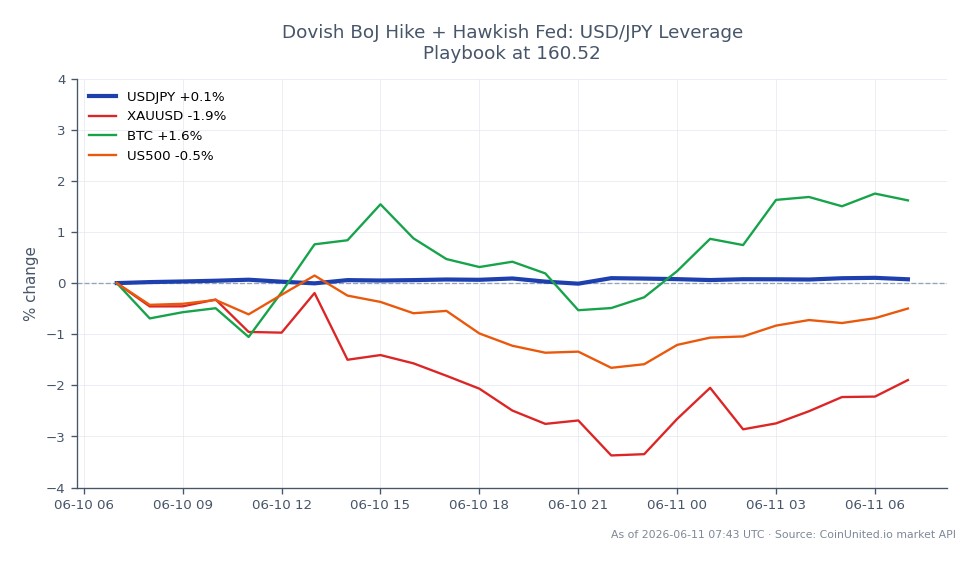
According to analysis from FX Empire and XTB, the dominant macro setup keeping USD/JPY elevated is a structural policy divergence: the Bank of Japan (BoJ) is hiking rates but framing each move in caut
Event Summary
According to analysis from FX Empire and XTB, the dominant macro setup keeping USD/JPY elevated is a structural policy divergence: the Bank of Japan (BoJ) is hiking rates but framing each move in cautious, data-dependent language that markets consistently read as *dovish relative to expectations*. The BoJ's current policy rate sits around 0.75%, and markets price only modest further hikes — one around mid-year and possibly one more later. Meanwhile, strong US payrolls and elevated Treasury yields have pushed back Fed easing expectations, reinforcing a Fed macro policy crossroads scenario where the Fed remains hawkish for longer than previously priced.
With USD/JPY trading at $160.52 (24h range: $160.43–$160.59), the pair is pressing a key zone where upside momentum and Japanese intervention risk converge. As noted by Investing.com, the BoJ's own communications acknowledge that FX moves now matter for inflation — yet acting too slowly paradoxically prolongs yen weakness and delays the aggressive response the market would need to see to reverse the carry trade.
Leverage Impact Analysis
At 160.52, leveraged USD/JPY longs are navigating a high-reward but spike-risk environment. On CoinUnited.io's forex CFDs with up to 2000x leverage, position sizing is critical near intervention-sensitive levels.
Long example: A 100x long USD/JPY CFD opened at 160.52 with $1,000 margin controls a $100,000 notional position. Each 1-pip move = ~$6.25 P&L. A clean breakout to 162.00 (+148 pips) would return ~$925 — a 92.5% gain on margin. However, a sharp intervention spike back to 158.00 (-252 pips) would generate a ~$1,575 loss, wiping the position and triggering liquidation well before that level.
Liquidation risk zone: Long positions using >50x leverage opened near 160.52 face liquidation if USD/JPY drops to approximately 158.50–159.00 on sudden BoJ hawkish surprise or official intervention — a historically plausible 1–1.5% reversal. The Japanese yen intervention guide documents prior episodes where 300–400 pip intraday reversals occurred with no warning. Traders should monitor verbal jawboning from Japan's Finance Ministry as an early signal.
Short squeeze risk: Any BoJ meeting where rhetoric turns more explicitly hawkish — faster hike guidance or concrete tapering signals — could trigger rapid JPY strengthening and squeeze leveraged carry longs. Check funding rates on CoinUnited.io for current carry cost positioning.
Cross-Market Impact
The macro inflation pressure theme extends well beyond the FX pair. A hawkish Fed path keeps US 2-year Treasury yields elevated, directly pressuring gold — a stronger USD is a structural headwind for the metal, as detailed in the Gold vs. US Dollar relationship guide. The S&P 500 faces a dual headwind: higher discount rates compress growth stock valuations, while US financials benefit from steeper net interest margins.
In Japan, yen weakness is equity-positive for large exporters (autos, electronics), supporting Nikkei 225 upside. JPY crosses — EUR/JPY, GBP/JPY, AUD/JPY — all benefit from carry inflows as long as global risk sentiment holds. WTI crude faces mild USD headwinds but remains sensitive to demand signals embedded in the same strong US data driving Fed hawkishness.
Trading Considerations
Key levels per research: 160–162 is the active resistance and intervention-watch zone; a sustained break above 162 would represent fresh multi-decade yen weakness with escalated intervention probability. To the downside, a break below the 50-day moving average signals a deeper correction toward 150–151, most likely triggered by a BoJ hawkish surprise or a "Sell America" risk-off episode. The USD/JPY trading guide and Fed rate decisions market impact guide provide additional structural context. Monitor US CPI, NFP, and FOMC communications as the primary Fed catalysts; watch Japan Finance Ministry statements for intervention signals near 160.50+.
Trade US Dollar / Japanese Yen on CoinUnited.io
Trade USDJPY with up to 2000xx leverage → | Create Free Account
Frequently Asked Questions
Given intervention risk of 300+ pip reversals, positions above 50x carry liquidation exposure on a move to ~158.50; sizing at 20–30x allows room to withstand intraday volatility without forced liquidation.
Continue Exploring
Disclaimer: This brief is for educational purposes only and is not investment advice.