Quick Links
USD/JPY Spikes Above 160 Then Plunges on NFP Beat — Leveraged Carry Traders Caught in Intervention Trap
Data Snapshot
Key Takeaways
- •April 2026 NFP printed 115K vs ~62K expected — a 1.6–1.8x beat that reduces Fed cut urgency and structurally supports USD carry trades.
- •USD/JPY breached 160.00, an area where Japanese authorities intervened in April 2024; the subsequent plunge confirms intervention-zone volatility risk remains extreme.
- •Leverage trap: a 100x long USD/JPY at 159.85 faces effective liquidation on a 51-pip drawdown to 159.75 — position sizing near 160+ must be drastically reduced.
- •Cross-market: yen carry unwind hits JPY-funded risk positions globally — watch for spillover into high-beta US equities, EM FX, and Bitcoin if USD/JPY plunge deepens.
- •Gold faces structural headwinds from a strong-NFP-driven USD/yield rally; the dollar-gold inverse relationship intensifies in hawkish repricing episodes.
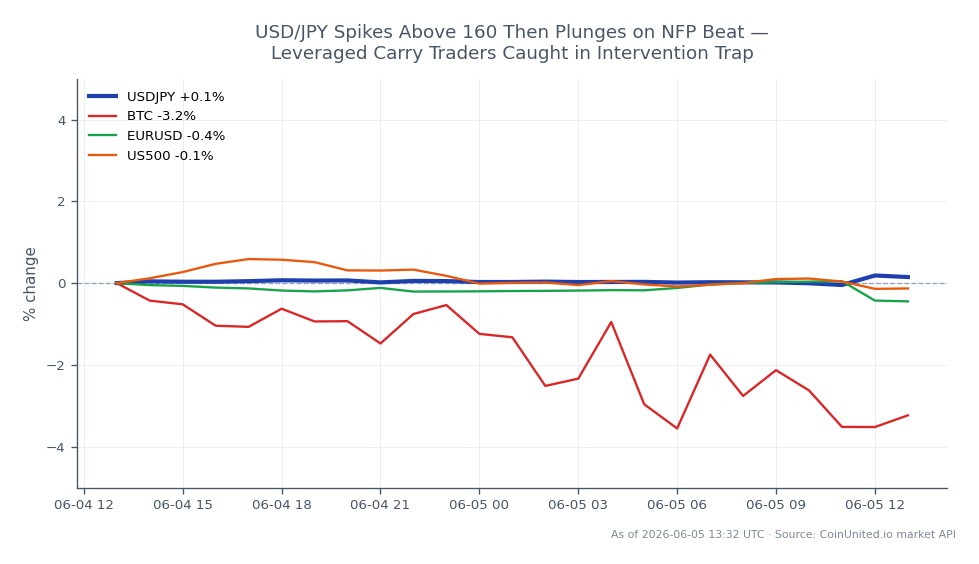
April 2026 non-farm payrolls printed 115K against a consensus of approximately 62K — a beat of roughly 1.6–1.8x expectations, according to the US Bureau of Labor Statistics. The unemployment rate held
Event Summary
April 2026 non-farm payrolls printed 115K against a consensus of approximately 62K — a beat of roughly 1.6–1.8x expectations, according to the US Bureau of Labor Statistics. The unemployment rate held steady at 4.3% and average hourly earnings rose 0.2% month-on-month. The stronger-than-expected labor market data reduces the urgency for Federal Reserve rate cuts, reinforcing USD carry.
Against this backdrop, USD/JPY broke above the psychologically critical 160.00 level — a zone where Japanese authorities intervened on 26 April 2024 at 160.23/45 — before reversing sharply. Live market data shows the pair currently at 160.15, with a 24h range of 159.75–160.26. This whipsaw dynamic sits squarely within the Fed macro policy crossroads theme, where strong US data collides with Japanese intervention risk.
Leverage Impact Analysis
The 160 breakout–plunge sequence is a textbook leverage trap for crowded USD/JPY longs. Consider a trader running a 100x long USD/JPY CFD entered at 159.85 (prior support per research). With the pair hitting 160.26 intraday then reversing toward 159.75, that 51-pip drawdown represents a 5.1% move against a 100x position — equivalent to a 510% loss on margin, triggering automatic liquidation well before the low.
For short USD/JPY positions opened after the 160 break (fading intervention risk), the brief spike to 160.26 represents a 26-pip adverse excursion from 160.00. At 50x leverage, that's a 1.3% margin drawdown — survivable, but requiring precise stop placement above 160.45–160.74, the next documented resistance cluster.
The core leverage risk here is two-sided volatility compression: bulls get stopped above 160 on intervention-driven reversals; bears get squeezed if the NFP-driven USD bid reasserts. Reduce position sizing materially near known Ministry of Finance intervention zones and monitor funding rates on CoinUnited.io for crowding signals.
Cross-Market Impact
A strong NFP print supports higher US front-end yields, widening the US–Japan rate differential — the structural driver behind the USD/JPY trend. For EUR/USD, broad USD strength from a hawkish Fed repricing typically pressures the pair lower, though Fed rate decision dynamics suggest the move depends on how aggressively markets reprice cut timing.
Gold faces a headwind from USD strength and higher real yields following the NFP beat — the inverse relationship between the dollar and gold becomes particularly pronounced in hawkish repricing episodes. The S&P 500 and NASDAQ 100 face rate-sensitive sector pressure (growth, duration), though financials may benefit from steeper yield expectations.
The yen carry trade unwind is the critical cross-asset contagion channel: a violent USD/JPY plunge forces de-leveraging across JPY-funded risk positions — impacting EM FX, high-beta equities, and Bitcoin via global risk-off sentiment. The Japanese yen intervention guide details how prior episodes cascaded across asset classes.
Trading Considerations
Key levels: support at 159.85 (prior channel base per research), with resistance at 160.45–160.74 and 161.16. The 160.23/45 band remains the most critical — it is where MoF intervened in April 2024. Aggressive longs above this zone carry asymmetric intervention risk; the research explicitly flags that moves beyond prior highs could trigger official action.
What to watch: any verbal guidance from Japanese authorities (Finmin Kato or BoJ Governor Ueda), US 2-year Treasury yield reaction to NFP, and whether USD/JPY can hold above 160.00 on a closing basis. A confirmed close below 159.75 would signal the plunge has technical follow-through beyond a stop-hunt.
Trade US Dollar / Japanese Yen on CoinUnited.io
Trade USDJPY with up to 2000xx leverage → | Create Free Account
Frequently Asked Questions
A 100x long entered near 159.85 faces liquidation on a move to ~159.75 — just a 10-pip adverse move wipes the position. Traders must use significantly reduced leverage (10x–20x max) near the 160 intervention zone and set stops above 160.45 if fading the move.
Continue Exploring
Disclaimer: This brief is for educational purposes only and is not investment advice.