Quick Links
Humanity Protocol $36M DPRK-Linked Hack: H Token Partial Recovery at $0.0243 — Leverage Risks and Cross-Market Fallout
Data Snapshot
Key Takeaways
- •H token trades at $0.0243 — ~74% below pre-exploit levels despite a partial rebound; the 447M token supply overhang makes leveraged long positions extremely fragile with liquidation risk within ~2% of current price.
- •Quantstamp confirmed DPRK-linked attribution via phishing/malware leading to seven private key compromises — no smart contract bug, making this a pure operational security failure.
- •ETH received modest transient sell pressure as exploiters converted stolen H; no sustained macro impact on BTC, SOL, or broader indices from this single event.
- •Crypto-exchange equities (e.g., COIN) face incremental compliance costs as DPRK-attributed exploits reinforce pressure for tighter sanctions-screening requirements.
- •Watch the June 25 token unlock and any team remediation announcement (burn, reissue) as binary catalysts that could gap H price in either direction regardless of leverage position direction.
According to a June 13 incident report by Quantstamp, Humanity Protocol suffered a $36 million exploit in which attackers drained approximately 141 million H tokens from its Ethereum bridge and minted
Event Summary
According to a June 13 incident report by Quantstamp, Humanity Protocol suffered a $36 million exploit in which attackers drained approximately 141 million H tokens from its Ethereum bridge and minted additional H on BNB Smart Chain. The breach originated from a phishing email that infected a developer's machine with malware, enabling attackers to extract seven private keys — including an admin hot wallet and Safe owner keys across both chains. Stolen tokens were largely converted into ETH. Critically, Humanity Protocol confirmed no smart contract vulnerability was exploited; the failure was entirely operational security. Quantstamp identified tooling and certificate-signing activity consistent with North Korea-linked threat actors, placing this incident within the broader crypto state-sponsored hacks pattern.
As reported by on-chain researchers Lookonchain and ZachXBT, the attack vector (private key compromise via malware) is confirmed, though state-sponsored attribution retains inherent analytical uncertainty.
Leverage Impact Analysis
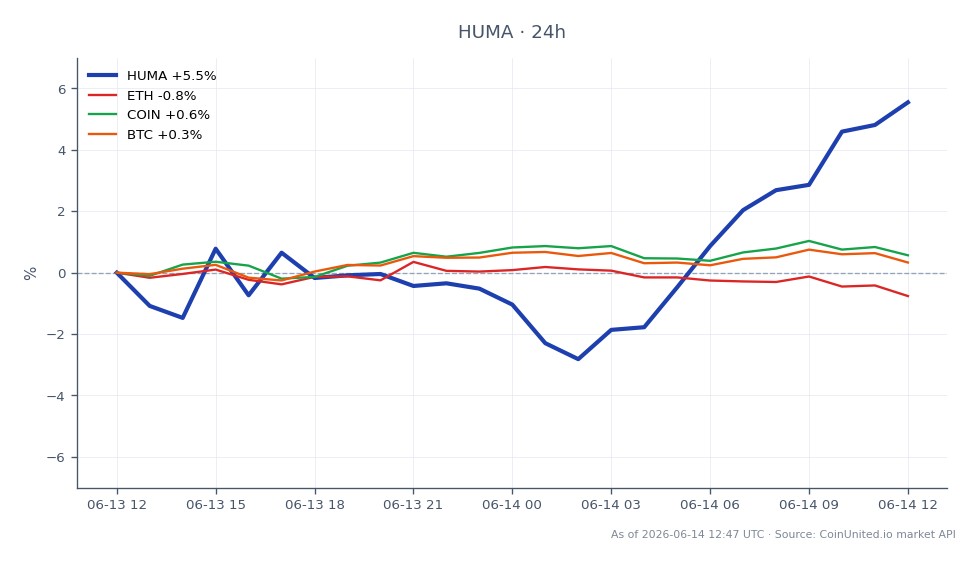
H token is currently trading at $0.0243 (24h high: $0.0244, low: $0.0222, +5.83% on the day per live data) — but remains approximately 74% below pre-exploit levels. This partial rebound creates a deceptive setup for leveraged longs.
Worked example — long scenario: A trader opening a 50x long HUMA perpetual at $0.0243 faces liquidation if price retreats roughly 2% (to ~$0.0238 depending on margin tier). Given the structural token overhang of 447M H implicated across chains, any renewed exploiter selling or negative headline can erase the bounce in minutes.
Worked example — short scenario: A 50x short entered at $0.0243 faces liquidation near $0.0267 (~+10%). Funding rates on exploit-driven tokens often flip sharply — monitor funding rate positioning closely before sizing any directional position.
Key risk: The partial recovery is event-driven and thin. High-leverage positions on either side face liquidation cascade risk if exploiter wallets move funds or the team announces a remediation plan (burn, reissue, or compensation). Check open interest on CoinUnited.io for confirmation signals before adding leverage.
Cross-Market Impact
The exploit has limited direct macro spillover but creates notable sector-level ripple effects:
- -Ethereum: Stolen H was converted primarily into ETH. Large-scale ETH sells from exploit proceeds can create transient sell pressure, though ETH's liquidity absorbs this at scale. The broader Ethereum ETH trading thesis is unaffected fundamentally.
- -Coinbase (COIN): Centralized exchanges face incremental compliance costs from OFAC-style screenings tied to DPRK-attributed exploits. Repeated high-profile incidents in this category can cap near-term multiples for crypto-exposed equities.
- -DeFi Bridge Tokens: This incident reinforces the DeFi bridge exploit contagion theme — admin-key-heavy bridges face heightened user scrutiny and potential liquidity withdrawal regardless of code quality.
- -BTC/SOL: No direct fundamental impact. Risk-off from exploit headlines can briefly weigh on Bitcoin and Solana sentiment, but correlation is weak for a single mid-cap event.
- -Biometric/ID token sector: Investor confidence in proof-of-personhood tokens broadly is damaged near-term; capital rotation toward blue-chip L1s is the likely path.
Trading Considerations
Key levels to watch: H's current range of $0.0222–$0.0244 represents the 24h trading band post-partial-recovery. A break above $0.0244 on volume could attract momentum buyers; a breakdown below $0.0222 reopens the path toward prior capitulation lows. The June 25 token unlock (previously flagged by on-chain researchers) compounds supply-side risk — any remediation announcement before that date is the primary positive catalyst to monitor.
For broader DeFi exploit resolution dynamics, watch for burn or compensation proposals from the Humanity Protocol team, exchange delistings, and OFAC wallet designations as binary risk events that can gap price in either direction.
Trade Huma Finance on CoinUnited.io
Trade HUMA with up to 2000xx leverage → | Create Free Account
Frequently Asked Questions
A 50x long opened at $0.0243 faces liquidation roughly 2% lower (~$0.0238); given the 447M token overhang and potential exploiter sells, this margin is extremely thin. Position sizing should reflect maximum-loss scenarios, not expected-move scenarios.
Continue Exploring
Disclaimer: This brief is for educational purposes only and is not investment advice.