Quick Links
SpaceX SPCX Priced at $135 With $250B+ Demand — Leverage Impact as Nasdaq Debut Looms
Data Snapshot
Key Takeaways
- •SpaceX targets $75B raised at $135/share fixed price, implying a $1.75–$2T+ valuation — the largest IPO on record by proceeds.
- •Demand exceeded $250B (3.5–4x covered) as of June 9, signaling extreme institutional risk appetite and near-term index bullishness.
- •Leverage risk: A 50x long US100 CFD at $29,500 gains/loses ~$14,750 per 1% index move — IPO debut volatility on June 12 amplifies both directions.
- •Cross-market: SPCX's eventual Nasdaq-100 inclusion will mechanically dilute existing mega-cap weights (Nvidia, Apple, Microsoft), creating rebalancing headwinds for those single-stock CFD longs.
- •Lock-up expiry (Sept–Dec 2026) and the first earnings call (Sept 2026) are the next major supply-shock and volatility windows to monitor.
According to Reuters and Bloomberg, SpaceX is raising approximately $75 billion in what would be the largest IPO on record, pricing ~555.6 million shares at a fixed $135 per share — bypassing the conv
Event Summary
According to Reuters and Bloomberg, SpaceX is raising approximately $75 billion in what would be the largest IPO on record, pricing ~555.6 million shares at a fixed $135 per share — bypassing the conventional price-range process entirely. The listing targets the Nasdaq under ticker SPCX, with formal pricing expected on June 11, 2026 and the debut on June 12. The implied market cap sits between $1.75 trillion and $2+ trillion, instantly placing SpaceX among the top-five public companies globally by equity value.
As reported by Reuters, investor demand as of June 9 exceeded $250 billion — roughly 3.5–4x the $75B target — a signal of extreme risk appetite. Goldman Sachs leads a syndicate of ~21 banks, with aggregate underwriting fees estimated above $500 million. Notably, SpaceX reported a net loss of $4.28 billion in Q1 2026 and an accumulated deficit of ~$41.3 billion, per its S-1 filing summarized by BitMEX Research — making this a hyper-growth, loss-making asset priced at a mega-cap tech multiple.
Leverage Impact Analysis
The SPCX debut is a high-volatility binary event for leveraged traders. First-day IPO prints on mega-cap listings historically swing 10–30% intraday, and the 3.5x oversubscription suggests strong opening demand — but also a crowded long base prone to rapid reversal.
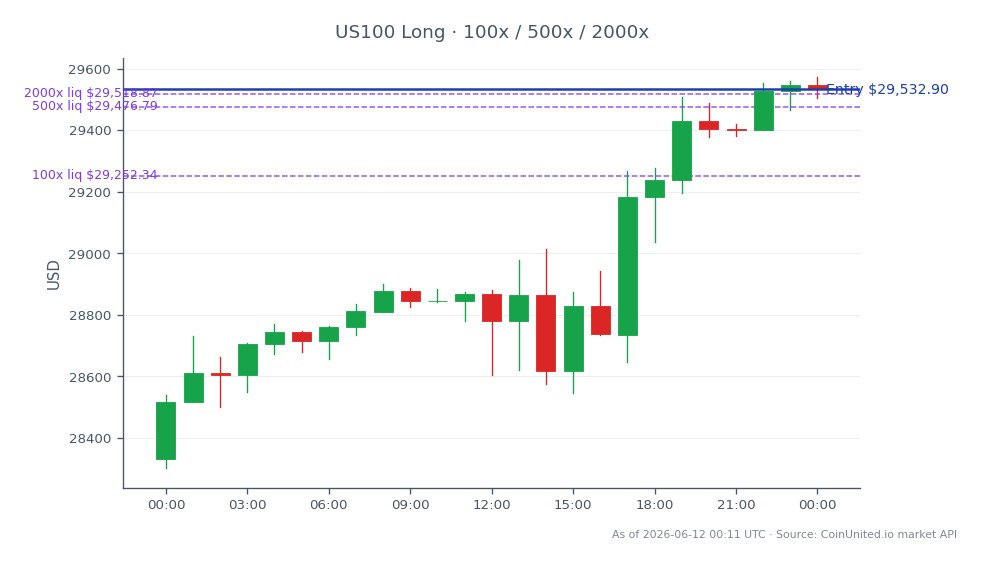
Index CFD scenario: The NASDAQ 100 Index currently trades at $29,550.70 (24h range: $29,450.20–$29,572.20, +0.34%). A trader holding a 50x long US100 CFD at $29,500 controls $1,475,000 notional. If SPCX's debut drives a 1% index lift to ~$29,795, that position gains ~$14,750 (a 50% return on margin). The inverse is equally sharp — a 1% index fade on post-IPO profit-taking liquidates ~50% of margin. At 100x, a 0.5% adverse move wipes the position entirely. Given SPCX's eventual index inclusion could mechanically displace existing mega-cap weights (Apple, Nvidia, Microsoft), traders holding leveraged long index positions should monitor rebalancing flows closely — passive outflows from incumbents are a real near-term risk even within a bullish debut.
Lock-up expiry (90–180 days post-IPO, implying September–December 2026) and the first public earnings call in September 2026 are the two major supply-shock windows to pre-position around.
Cross-Market Impact
The $250B+ order book is a macro signal: US primary equity markets are wide open, financial conditions are loose, and institutional risk appetite is elevated. This supports the broader IPO Wave & Capital Markets Revival narrative and reinforces near-term bullish bias for growth and tech indices.
Nasdaq / US100: Direct beneficiary near-term via sentiment and eventual index weight. Watch for mechanical selling in existing mega-cap constituents (Nvidia, Apple, Microsoft) as index rebalancing absorbs SPCX. The AI & Crypto IPO Launch Wave theme broadens as SpaceX's S-1 frames Starlink and on-orbit compute as AI infrastructure plays, potentially pulling flows from pure-play software/semiconductor names. Traders following the Quantum & SpaceX IPO Capital Surge theme should note that a blockbuster debut could catalyze sympathy moves in aerospace peers (Boeing, Lockheed Martin, Northrop Grumman) and space-adjacent AI infrastructure stocks.
S&P 500: Secondary beneficiary. The S&P 500 Index gains from improved risk sentiment, though SPCX's Nasdaq primary listing means the direct index-weight impact is US100-first.
Crypto: Musk-linked asset cycles have historically correlated with speculative risk appetite. A strong SPCX debut may briefly compete for risk capital vs. high-beta crypto, but net risk-on sentiment is supportive. Monitor BTC and ETH funding rates for confirmation of spillover positioning.
Forex/Commodities: The massive capital inflow into US equities modestly supports USD pro-cyclical flows. Industrial metals (aluminum, titanium) face incremental demand from SpaceX's expanded launch cadence — marginal but relevant for aerospace materials suppliers.
Trading Considerations
For US100 CFD traders, the key level is the current 24h high at $29,572.20 — a sustained break above this on debut day would signal index-level follow-through buying. Support sits at $29,450.20 (24h low); a close below this would indicate IPO-day profit-taking is bleeding into index positioning. Position sizing at high leverage warrants particular caution on June 11–12: fixed-price IPOs with extreme oversubscription can see violent first-day reversals once flippers exit. Traders interested in the SpaceX story directly can explore the Complete Guide to Trading SpaceX Pre-IPO Stock for structural context on the valuation re-rating from the $421 December 2025 tender price to the $135 IPO price (which reflects a share restructuring, not a discount). Watch open interest on US100 futures for confirmation of institutional positioning ahead of the June 12 debut.
Trade NASDAQ 100 Index on CoinUnited.io
Trade US100 with up to 2000xx leverage → | Create Free Account
Frequently Asked Questions
SPCX's debut on June 12 introduces index-level volatility — at 50x leverage on US100, each 1% move in the index translates to a ~50% gain or loss on margin. Traders should tighten stop-losses and reduce position size around the debut date given the potential for sharp intraday swings.
Continue Exploring
Disclaimer: This brief is for educational purposes only and is not investment advice.